Category Archives: Science
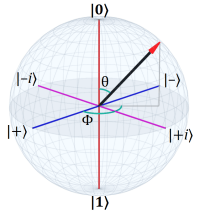 The previous post began an exploration of a key conundrum in quantum physics, the question of measurement and the deeper mystery of the divide between quantum and classical mechanics. This post continues the journey, so if you missed that post, you should go read it now.
Last time, I introduced the notion that “measurement” of a quantum system causes “wavefunction collapse”. In this post I’ll dig more deeply into what that is and why it’s perceived as so disturbing to the theory.
Caveat lector: This post contains a tiny bit of simple geometry.
Continue reading
13 Comments | tags: measurement problem, QM101, quantum mechanics, quantum physics, Schrödinger Equation | posted in Opinion, Physics
Over the last handful of years, fueled by many dozens of books, lectures, videos, and papers, I’ve been pondering one of the biggest conundrums in quantum physics: What is measurement? It’s the keystone of an even deeper quantum mystery: Why is quantum mechanics so strangely different from classical mechanics?
I’ll say up front that I don’t have an answer. No one does. The greatest minds in science have chewed on the problem for almost 100 years, and all they’ve come up with are guesses — some of them pretty wild.
This post begins an exploration of the conundrum of measurement and the deeper mystery of quantum versus classical mechanics.
Continue reading
24 Comments | tags: measurement problem, QM101, quantum mechanics, quantum physics | posted in Opinion, Physics
 Being retired, along with doing all my TV watching via streaming services, has the consequence of almost completely disconnecting me from the weekly rhythm. Weekends mean nothing when every day is Saturday. To create some structure, I follow a simple schedule. For instance, Mondays I do laundry and Thursdays I buy groceries.
More to the point here, Monday (and sometimes Tuesday) evenings are for YouTube videos, many of which are science related. Last night I watched Jim Baggott give two talks at the Royal Institution, one about mass, the other about loop quantum gravity (LQG).
In the latter, Baggott mentioned gravity waves and that generated a Brain Bubble.
Continue reading
13 Comments | tags: Albert Einstein, gravity, gravity wave, quantum gravity, quantum physics | posted in Brain Bubble, Physics
 Earlier this month I posted about Quantum Reality (2020), Jim Baggott’s recent book about quantum realism. Now I’ve finished another book with a very similar focus, Einstein’s Unfinished Revolution: The Search for What Lies Beyond the Quantum (2019), by Lee Smolin.
One difference between the books is that Smolin is a working theorist, so he offers his own realist theory. As with his theory of cosmic selection via black holes (see his 1997 book, The Life of the Cosmos), I’m not terribly persuaded by his theory of “nads” (named after Leibniz’s monads). I do appreciate that Smolin himself sees the theory as a bit of a wild guess.
There were also some apparent errors that raised my eyebrows.
Continue reading
7 Comments | tags: Copenhagen Interpretation, Lee Smolin, ontological anti-realism, quantum mechanics, quantum physics, realism | posted in Books, Physics
 I recently read, and very much enjoyed, Quantum Reality (2020) by Jim Baggot, an author (and speaker) I’ve come to like a lot. I respect his grounded approach to physics, and we share that we’re both committed to metaphysical realism. Almost two years ago, I posted about his 2014 book Farewell to Reality: How Modern Physics Has Betrayed the Search for Scientific Truth, which I also very much enjoyed.
This book is one of a whole handful of related books I bought recently now that I’m biting one more bullet and buying Kindle books from Amazon (the price being a huge draw; science books tend to be pricy in physical form).
The thread that runs through them is that each author is committed to realism, and each is disturbed about where modern physics has gone. Me, too!
Continue reading
24 Comments | tags: Jim Baggott, Lee Smolin, ontological anti-realism, Peter Woit, quantum mechanics, quantum physics, realism, Roger Penrose, Sabine Hossenfelder | posted in Books, Physics
 Recently my friend Tina, who writes the blog Diotima’s Ladder, asked me if I could help her with a diagram for her novel. (Apparently all the math posts I’ve written gave her ideas about my math and geometry skills!)
What she was looking for involved Plato’s Divided Line, an analogy from his runaway bestseller, the Republic (see her post Plato’s Divided Line and Cave Allegory for an explanation; I’m not going to go into it much here). The goal is a geometric diagram proving that the middle two segments (of four) must be equal in length.
This post explores and explains what I came up with.
Continue reading
26 Comments | tags: algebra, geometry, Plato | posted in Math, Philosophy
 Last time I began explaining my “CD collection” analogy for entropy; here I’ll pick up where I left off (and hopefully finish — I seem to be writing a lot of trilogies these days). There’s more to say about macro-states, and I want also to get into the idea of indexing.
I make no claims for creativity with this analogy. It’s just a concrete instance of the mathematical abstraction of a totally sorted list (with no duplicates). A box of numbered index cards would work just as well. There are myriad parallel examples.
One goal here is to link the abstraction with reality.
Continue reading
14 Comments | tags: entropy | posted in Physics
Entropy is a big topic, both in science and in the popular gestalt. I wrote about it in one of my very first blog posts here, back in 2011. I’ve written about it a number of other times since. Yet, despite mentioning it in posts and comments, I’ve never laid out the CD collection analogy from that 2011 post in full detail.
Recent discussions suggest I should. When I mentioned entropy in a post most recently, I made the observation that its definition has itself suffered entropy. It has become more diffuse. There are many views of what entropy means, and some, I feel, get away from the fundamentals.
The CD collection analogy, though, focuses on only the fundamentals.
Continue reading
31 Comments | tags: entropy | posted in Physics
 It’s actually an old debate — in fact, it’s a variation on the Ship of Theseus — but modern day science fiction gives it a new spin. At root it’s a question about exactly where our identity as self-aware conscious beings actually resides. I don’t find it paradoxical so much as intriguing.
Recently Sabine Hossenfelder jumped into the discussion with a video asking whether Captain Kirk dies every time he uses the transporter. Not just him, of course, but everyone who uses it.
As with trees falling in forests, the answer depends on defining key terms. This case depends on exactly what we mean by “dies” and “Kirk” — the latter being the Ship of Theseus.
Continue reading
16 Comments | tags: Captain Kirk, Sabine Hossenfelder, Star Trek, transporters | posted in Opinion, Science
 There is a key rule of thumb (or heuristic) in science known as the Copernican Principle. It essentially says: “We’re not special.” (The “we” in question being the human race.) It’s named after Nicolaus Copernicus, who, in 1543, forever banished the Earth and its thin film of humanity from the center of the universe.
Ever since, the science view of humanity is that it’s just part of the landscape, nothing particularly special, a mere consequence of energy+time creating increasing organization in systems. We may be complex, perhaps even a little surprisingly so, but we’re still nothing special.
Yet it seems to me that, at least in some ways, we really are.
Continue reading
20 Comments | tags: dark energy, dark matter, Drake Equation, entropy, Fermi Paradox | posted in Science




You must be logged in to post a comment.