Category Archives: Philosophy
 Yesterday I re-posted (with a few small edits) a Substack post from last September about my basic metaphysical stance: physicalism and realism. I’d posted here about the latter back in 2018 [see Realism], but the more recent Substack post reflects eight more years of thought on the matter.
My view has evolved some without really changing. I’m still committed to physicalism and realism. Nothing I’ve learned or heard argued has persuaded me towards idealism or anti-realism.
In this re-post I’m focusing on a couple of philosophical topics that have gotten a little under my skin:
Continue reading
4 Comments | tags: color, idealism, physicalism, realism | posted in Philosophy, Science
 During the two years that I was active on Substack I never managed to quite find my “voice” there. I never fixed on exactly what I wanted my Substack blog to be beyond being just a version of this one. That ended up feeling like a dilution.
With a view towards re-concentrating my efforts, I decided to reprise (with minor edits) some of my Substack posts here. I started this last month with The Noise is Deafening, and I’ve got two more somewhat related posts for this week.
The first one is an elucidation of my basic metaphysical stance:
Continue reading
3 Comments | tags: idealism, physicalism, realism | posted in Philosophy, Science
 When I was in college (multiple lifetimes ago) I took a class where we studied the nature of belief and disbelief. It was actually a class about logic and situational analysis, but (despite being raised Lutheran) I attended a Jesuit college, so the emphasis on belief versus disbelief was well aligned with their gestalt.
I loved the class (for many reasons, not all of them scholastic). The topic of what we believe — or disbelieve — has fascinated me ever since. It’s a key branch of philosophy under the umbrella of epistemology, the theory of knowledge.
Because our beliefs affect everything from science to politics to personal relations.
Continue reading
5 Comments | tags: belief, epistemology, ideas and beliefs | posted in Philosophy, Politics, Society
 Zeno’s famous Paradoxes involve the impossibility of arriving somewhere as well as the impossibility of even starting to go somewhere. And that flying arrows have to be an illusion. [Time flies like an arrow, but fruit flies like a banana.]
If Zeno were alive today, he’d be over 2500 years old and would have seen his paradoxes explained in a variety of ways by a lot of very smart people. Yet at heart they still have some metaphysical oomph. And the thing is, at least in some contexts, Zeno was (sort of) right. There is something of a paradox here involving space and time.
Or at least something interesting to think about.
Continue reading
7 Comments | tags: rational numbers, real numbers, Zeno of Ela, Zeno's paradoxes | posted in Brain Bubble, Math, Philosophy
 At one point I had the idea that I was going write a bunch of For The Record posts — position papers that attempt to be final words on a topic (at least until new considerations came into play). Other one about guns (back in 2015), I never really followed through.
In a sense, all posts, are final words (until further consideration), so all posts can be seen as FTR. The question is whether it makes any sense to mark an expressed opinion as more official or duly considered rather than off the cuff or casual. That was my thought, anyway.
So, seven years later, FTR take two: Free Will
Continue reading
37 Comments | tags: causal determinism, determinism, For The Record, free will, physical determinism | posted in Philosophy
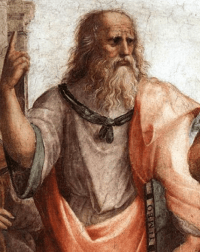 Last February I posted about how my friend Tina, who writes the Diotima’s Ladder blog, asked for some help with a set of diagrams for her novel. The intent was to illustrate an aspect of Plato’s Divided Line — an analogy about knowledge from his worldwide hit, the Republic. Specifically, to demonstrate that the middle two (of four) segments always have equal lengths.
The diagrams I ended up with outlined a process that works, but I was never entirely happy with the last steps. They depended on using a compass to repeat a length as well as on two points lining up — concrete requirements that depend on drawing accuracy.
Last week I had a lightbulb moment and realized I didn’t need them. Lurking right in front of my eyes is a solid proof that’s simple, clear, and fully abstract.
Continue reading
4 Comments | tags: algebra, geometry, Plato | posted in Math, Philosophy
Recently my friend Tina, who writes the blog Diotima’s Ladder, asked me if I could help her with a diagram for her novel. (Apparently all the math posts I’ve written gave her ideas about my math and geometry skills!)
What she was looking for involved Plato’s Divided Line, an analogy from his runaway bestseller, the Republic (see her post Plato’s Divided Line and Cave Allegory for an explanation; I’m not going to go into it much here). The goal is a geometric diagram proving that the middle two segments (of four) must be equal in length.
This post explores and explains what I came up with.
Continue reading
26 Comments | tags: algebra, geometry, Plato | posted in Math, Philosophy

I’ve got stuff on my mind!
My post last month about Dr. Gregory Berns and his studies of animal minds ran long because I also discussed Thomas Nagel and his infamous paper. Dr Berns referenced an aspect of that paper many times. It seemed like a bone of contention, and I wanted to explore it, so I needed to include details about Nagel’s paper.
The point is, at the end of the post, there’s a segue from the “Sebald Gap” between humans and animals to the idea we can never really even understand another human (let alone an animal). My notes for the post included more discussion about that, but the post ran long so I only mentioned it.
It’s taken a while to circle back to it, but better late than never?
Continue reading
10 Comments | tags: animal minds, human mind, mind, theory of mind | posted in Philosophy, Science
 In the nearly nine years of this blog I’ve written many posts about human consciousness in the context of computers. Human consciousness was a key topic from the beginning. So was the idea of conscious computers.
In the years since, there have been myriad posts and comment debates. It’s provided a nice opportunity to explore and test ideas (mine and others), and my views have evolved over time. One idea I’ve found increasing skepticism for is computationalism, but it depends on which of two flavors of it we mean.
I find one flavor fascinating but can see the other as only metaphor.
Continue reading
10 Comments | tags: algorithm, analog computer, brain, brain mind problem, computationalism, digital computer, human brain, human mind | posted in Computers, Philosophy
 I’ve come to realize that, when it comes to the Many Worlds Interpretation (MWI) of quantum physics, there is at least one aspect of it that’s poorly understood. Since it’s an aspect that even proponents of MWI recognize as an issue, I thought I’d take a stab at explaining it. (If nothing else, I’ll have a long reply I can link to in the future.)
The issue in question involves what MWI does to probability. Essentially, our view of rare events — improbable events — is that they happen rarely, as we’d expect. Flip a fair coin 100 times; we expect to get heads roughly 50% of the time.
But under MWI, someone always gets 100 heads in a row.
Continue reading
11 Comments | tags: Many Worlds Interpretation, MWI | posted in Philosophy, Physics




You must be logged in to post a comment.