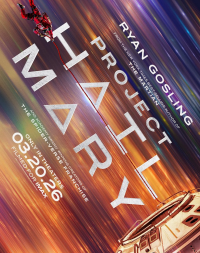
 I wrote about Project Hail Mary (the 2021 book by Andy Weir) back in February [see this post]. Last month I wrote a few paragraphs about the movie (written by Drew Goddard and directed by Phil Lord and Christopher Miller).
Project Hail Mary (the 2026 movie) was released to theaters on March 20th. I wanted to be sure to see it on the big screen, so I went to go see it on the 22nd. And loved it.
I need to see it again before I can write about it, but for Sci-Fi Saturday I thought I’d post some links to videos that dig into the actual science behind the book and its adaptation.
One (wonderful) thing about the book is all the science. And the lack of central silly interpersonal conflicts between characters. This is real science fiction — a story about minds dealing with threatening realities. Weir writes diamond-hard SF. He researches the science behind his ideas, and that science comes first, before he actually has a plot.
He points out (in the last interview linked here) that sticking to physics as much as possible is actually freeing (counterintuitive as it may be, constraints in art often are). Weir’s perception is that authors who make up a bunch of magic, often find more and more edge cases they need to patch over (or ignore). The sorts of things that give fans raised eyebrows.
But if you stick to real physics — except for a little special magic — well, reality has billions of years of experience in being consistent. I think he’s exactly right about that, and it may explain, in small part, why I favor hard SF. It doesn’t raise my eyebrows.
Weir is proud that you have to go down to the quantum level to find his gimmes, the science fiction magic that enables the story. In my post about the book, I mentioned a possibly magic alien material (xenonite), but Weir actually seems to be acceptably within Clarke’s Third Law about technology so advanced it seems like magic.
It actually makes an important point about differences between Rocky’s people and ours. They may not have discovered Relativity or ionizing radiation, but they are far beyond us in material science. This is echoed in the personal difference between Grace, the scientist, and Rocky, the master engineer.
Enough intro; let’s get to the videos.
Dr. Rebecca Smethurst, who posts astrophysics videos on YouTube as Dr. Becky, put out four videos about Project Hail Mary. This first one is a general overview with snippets from her interviews with Weir, Lord, Miller, and Gosling:
She also released the entirety of her interview with Andy Weir:
And her interview with Phil Lord and Christopher Miller:
And lastly, her interview with Ryan Gosling:
I highly recommend her channel for anyone interested in astrophysics.
She’s written two books, Space: 10 Things You Should Know and A Brief History of Black Holes. Her area of research is supermassive black holes.
Next up, Adam Savage, who many of us got to know from the very interesting and entertaining TV show MythBusters.
[One of my favorite episodes is when they built a tiny house and plugged the pressure release valve on a water heater and blew that thing through all the floors, the roof, and into the sky. I also love the one where they made a bunch of thermite and burned a car in half (lengthwise). But the best was when they used a homemade cannon to launch a soccer ball out the back of a moving truck at exactly the speed the truck was going. Once the ball exited the cannon, it just hung in the air and dropped straight down.]
Adam, of course, has his own YouTube channel, Tested, and he released three videos that go behind the scenes to explore the practical effects used in Project Hail Mary.
This first one is the longest (25 minutes) and takes you inside the set:
The amount of effort that went into that set is astonishing, and it’s all practical. The lights light up, the buttons push, the screens display. It’s all real (for a cinematic value of “real”).
This shorter video features a discussion with the set designer:
And lastly, they demonstrated how they film zero-gravity space walks by hooking Adam up Gosling’s rig and letting him “spacewalk” around the exterior of the Hail Mary (the ship):
Lucky guy: it looks like fun.
Full disclosure, I don’t follow his channel, but The Algorithm sometimes throws his videos my way, and sometimes I watch them. In this case, though, I suspect The Algorithm noticed my interest in videos about the movie.
Which is how this video about the biology of Rocky (the alien) came to my attention:
It’s fairly short, just over eight minutes, but features a fairly deep science dive into Rocky’s biology. It bases its content on the book (and perhaps things Weir has said in interviews).
The movie pushes most of the science into the background. It’s there, you’d recognize it from the book, but it’s never explained. No info dumps, and the movie works fine without them.
This 40-minute video also explores Rocky’s biology and features an interview with Andy Weir:
I’m not familiar with either of the YouTube channels above. The Algorithm threw their videos my way because I’d been watching other videos about the movie.
I’m also not familiar with this last channel, apparently by another astrophysicist, Andy Howell. This one dives into all aspects of (the science behind) the story and, like the video above, is a 40-minute interview with Weir:
These videos are mostly spoiler-free, but if you have a thing about spoilers, and haven’t read the book or seen the movie, it might be best to hold off until you do. I think the movie is good enough to let it unfold for you.
If you’ve seen the movie but have not read the book, these videos can fill you in on a lot of things the movie skates past.
If you’ve read the book, you know all the spoilers, and except for some details and the fun of Andy Weir’s enthusiasm, you may not find too much new material (but Weir does fill in some details and background).
He mentions at one point that screenwriter Drew Goddard covered a minor plot weakness (having to do with Grace’s genetics and presence on the ship) in a way Weir wishes he’d thought of. Goddard also wrote the script for The Martian (Weir’s first book), so they’ve worked together before.
If you haven’t yet seen the movie (but have read the book), it’s a very faithful adaptation. More to the point, it honors and does full justice to the source material. If you loved the book, you won’t be disappointed by the movie.
I want to see it at least once more on the big screen, preferably on IMAX. Beyond being a worthy adaptation of the text, it’s a visual and beautiful movie. You do want to see this on as big a screen as possible.
§ §
Stay rocky, my friends! Go forth and spread beauty and light.
∇









April 4th, 2026 at 11:46 am
As a Sci-Fi Saturday aside, last week I gulped down Neal Asher’s standalone trilogy set in The Owner Universe. The books are The Departure (2011), Zero Point (2012), and Jupiter War (2013). By gulped, I mean I read — and very much enjoyed — all three in the span of five days.
Now I’m back in his Polity Universe reading his Rise of the Jain trilogy. The books are The Soldier (2018), The Warship (2019), and The Human (2020). I’m not quite halfway through the first book but am thoroughly engaged. (I’d gulp these down as fast as the others, but baseball has started, and that cuts into my reading time.)
Bottom line, though, I’m clearly a fan of Neal Asher’s work.
One thing that has become clear to me is that it’s best to read his Polity novels according to their internal chronological level. You get a lot more from the overarching story that way. It’s not absolutely necessary, the books can stand on their own okay, but I’m getting a lot more from them reading them in the order the stories happen. This Jain trilogy, for instance, takes place centuries after the Cormac stories, and events from those stories are mentioned, are even causative factors, in these later stories.
In contrast, and perhaps it’s lack of familiarity on my part, I don’t sense that the Culture novels by Iain M. Banks have much continuity between them. It’s notable, I think, that the bibliography for Asher’s Polity novels also list the internal chronological order — something I don’t see for Banks’s Culture books.
April 6th, 2026 at 6:04 pm
Here’s another video interviewing Drew Goddard, who wrote the screenplay. It touches on a couple of key moments from the book that the writer and directors wanted to be sure was in the movie (SPOILERS!):
June 27th, 2026 at 5:38 pm
[…] Last Words: In a note-to-self comment I added to my Project Hail Mary Videos post, I wrote (regarding Asher and this […]
September 12th, 2026 at 4:22 pm
[…] loved it]. In March I mentioned having seen and loved the movie [see this post]. In April, I wrote a post with a bunch of links to videos exploring the movie and its […]