Category Archives: Philosophy
 Last week, when I posted about the Mathematical Universe Hypothesis (MUH), I noted that it has the same problem as the Block Universe Hypothesis (BUH): It needs to account for its apparent out-of-the-box complexity. In his book, Tegmark raises the issue, but doesn’t put it to bed.
He invokes the notion of Kolmogorov complexity, which, in a very general sense, is like comparing things based on the size of their ZIP file. It’s essentially a measure of the size of information content. Unfortunately, his examples raised my eyebrows a little.
Today I thought I’d explore why. (Turns out I’m glad I did.)
Continue reading
18 Comments | tags: complexity, Kolmogorov complexity, Mathematical Universe Hypothesis, Max Tegmark, random | posted in Philosophy, Physics
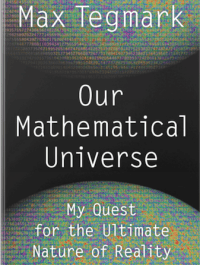 I finally finished Our Mathematical Universe (2014) by Max Tegmark. It took me a while — only two days left on the 21-day library loan. I often had to put it down to clear my mind and give my neck a rest. (The book invoked a lot of headshaking. It gave me a very bad case of the Yeah, buts.)
I debated whether to post this for Sci-Fi Saturday or for more metaphysical Sabbath Sunday. I tend to think either would be appropriate to the subject matter. Given how many science fiction references Tegmark makes in the book, I’m going with Saturday.
The hard part is going to be keeping this post a reasonable length.
Continue reading
34 Comments | tags: anthropic principle, block universe, doomsday argument, Mathematical Universe Hypothesis, Max Tegmark, MUH, MWI | posted in Books, Philosophy, Physics
 At the beginning of the week, I mentioned I’m reading Our Mathematical Universe (2014), by Max Tegmark. His stance on inflation, and especially on eternal inflation, got me really thinking about it. Then all that thinking turned into a post.
It happened again last night. That strong sense of, “Yeah, but…” With this book, that’s happening a lot. I find something slightly, but fundamentally, off about Tegmark’s arguments. There seems an over-willingness to accept wild conclusions. This may all say much more about me than about Tegmark, which in this case is perfect irony.
Because what set me off this time was his chapter about human intuition.
Continue reading
24 Comments | tags: human consciousness, human mind, intuition, Max Tegmark | posted in Opinion, Philosophy, Science
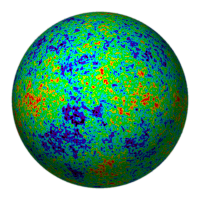
Bang!!
I’m reading Our Mathematical Universe (2014), by Max Tegmark, and I’ll post about the book when I finish. However, he got my attention early with the topic of eternal inflation. That got me thinking about how there are some key unanswered questions regarding the Big Bang and inflation of the non-eternal sort.
Inflation certainly does need some explaining. It may be related to dark energy, as both seem to do the same sort of thing (push space apart). The putative physics of inflation is bad enough; eternal inflation is (in my view) fairy tale physics.
For one thing, eternal? Seriously? Infinite something from nothing?
Continue reading
26 Comments | tags: big bang, eternal inflation, inflation, Max Tegmark, reality, the multiverse, universe | posted in Philosophy, Science
 I was surprised to discover I’ve never posted about the Many Worlds Interpretation (MWI) of quantum physics — I would have sworn I had. I’ve mentioned it a few times, and I know I’ve discussed it in comment sections, but it seems I never tackled the subject explicitly for the record.
It’s been on my mind lately because others have talked about it. Sean Carroll’s book promoting it generated a wave of discussion. The final push for me was Jim Baggott’s Farewell to Reality, which consigns MWI to the “fairy tale physics” heap.
Since I quite agree, this seems a good follow-up to yesterday’s post.
Continue reading
13 Comments | tags: Copenhagen Interpretation, Many Worlds Interpretation, measurement problem, MWI, Schrödinger Equation, Schrödinger's Cat | posted in Philosophy, Physics
 My voracious reading habit has deep roots in libraries. The love of reading comes from my parents, but libraries provided a vast smörgåsbord to browse and consume. Each week I’d check out as many books as I could carry. I discovered science fiction in a library (the Lucky Starr series, with Isaac Asimov writing as Paul French, is the first I remember).
Modern adult life, I got out of the habit of libraries (and into book stores and now online books). But now the Cloud Library has reinvigorated my love of all those free books, especially the ones I missed along the way.
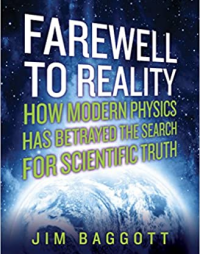
For instance, Farewell to Reality: How Modern Physics Has Betrayed the Search for Scientific Truth (2014), by Jim Baggott.
Continue reading
13 Comments | tags: Farewell to Reality, Jim Baggott, library, Many Worlds Interpretation, MWI, theoretical physics | posted in Books, Philosophy, Physics
 I’ve been slowly going through the NPR Tiny Desk Concerts. Most of the musicians and groups are unknown to me (it’s been decades since I even attempted to keep up with music). Truth is, most of the acts are interesting, but don’t really grab me. Maybe one in ten engages; none have made me a new fan.
Which is a whole other story. I mention it because many of these music makers are sweet, gentle, loving people who just want everyone else to be sweet, gentle, and loving. It’s a common sentiment. Banish the bad forever!
But balance is required. There is a Yin-Yang aspect to life.
Continue reading
50 Comments | tags: civilization, greatness, human brain, human consciousness, human mind, humanity, Yin and Yang | posted in Basics, Philosophy
 One of the great philosophical conundrums involves the origin of numbers and mathematics. I first learned of it as Platonic vs Aristotelian views, but these days it’s generally called Platonism vs Nominalism. I usually think of it as the question of whether numbers are invented or discovered.
Whatever it’s called, there is something transcendental about numbers and math. It’s hard not to discover (or invent) the natural numbers. Even from a theory standpoint, the natural numbers are very simply defined. Yet they directly invoke infinity — which doesn’t exist in the physical world.
There is also the “unreasonable effectiveness” of numbers in describing our world.
Continue reading
8 Comments | tags: math theory, mathematics, natural numbers, nominalism, numbers, Plato, Platonic, Platonism, rational numbers, real numbers, Theory of Mathematics | posted in Math, Philosophy
 I cracked up when I saw the headline: Why your brain is not a computer. I kept on grinning while reading it because it makes some of the same points I’ve tried to make here. It’s nice to know other people see these things, too; it’s not just me.
Because, to quote an old gag line, “If you can keep your head when all about you are losing theirs… perhaps you’ve misunderstood the situation.” The prevailing attitude seems to be that brains are just machines that we’ll figure out, no big deal. So, it’s certainly (and ever) possible my skepticism represents my misunderstanding of the situation.
But if so, I’m apparently not the only one…
Continue reading
41 Comments | tags: algorithm, brain, brain mind problem, computationalism, consciousness, human brain, human consciousness, human mind, Matthew Cobb, mind, Theory of Consciousness | posted in Philosophy, Science
 In this corner, philosopher John Searle (1932–), weighing in with what I like to call the Giant File Room (GFR). The essential idea is of a vast database capable of answering any question. The question it poses is whether we see this ability as “consciousness” behavior. (Searle’s implication is that we would not.)
In that corner, philosopher and mathematician Kurt Gödel (1906–1978), weighing in with his Incompleteness Theorems. The essential idea there is that no consistent (arithmetic) system can prove all possible truths about itself.
It’s possible that Gödel has a knockout punch for Searle…
Continue reading
24 Comments | tags: algorithm, Incompleteness Theorems, John Searle, Kurt Gödel, The Chinese Room | posted in Philosophy, Science




You must be logged in to post a comment.