 I’ve been up to no good lately — if by “no good” we mean reading and watching science fiction. That bad behavior has been a constant all my life. It began in early grade school when I started picking my own reading material.
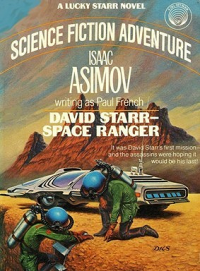
Prominent in the very first SF books I ever read is the Lucky Starr series, by Isaac Asimov (writing as “Paul French”). The books were written for a juvenile audience, and I was exactly that audience.
Just recently, two of the six novels showed up as e-books at my local library. Nicely, one of the two is the first of the series, and I’m reading it now.
The series comprises six novels:
- David Starr, Space Ranger (1952) 📖 reading now
- Lucky Starr and the Pirates of the Asteroids (1953)
- Lucky Starr and the Oceans of Venus (1954)
- Lucky Starr and the Big Sun of Mercury (1956)
- Lucky Starr and the Moons of Jupiter (1957)
- Lucky Starr and the Rings of Saturn (1958)
The other one available at my library is #3, Lucky Starr and the Oceans of Venus. I’ll read that next, though I seemed to have switched from reading mode to blogging mode lately. Since the latter has been elusive since Spring, I’ll indulge it as long as it lasts.
So far, the writing is what I’d expect from Asimov writing in the 1950s for a juvenile audience. David Starr, son of the beloved Lawrence Starr, has just been accepted into the Council of Science (a very 50s name):
The Council of Science was not an official government agency, but its members were nearly above the government.
From a time when science was seen as savior. And very much the vision of the early SF writers such as Asimov (and much later, Gene Roddenberry). David is soon enmeshed in a Space Adventure investigating a possible terror plot that involves random poisoning of food grown on Mars (one of Earth’s key breadbaskets — Earth can no longer feed itself).
Both David’s parents were killed by Space Pirates when he was a child. The text describing it is too deliciously retro not to share. The outlaws have forced their way onto the ship…
…Barbara, a blast gun in her hand, desperately thrusting David into the lifeboat, trying to set the controls as best she could, rocketing it into space. And then?
She had a gun in her hand. As long as she could, she must have used it against the enemy, and when that could be no longer, against herself.
Exciting reading for this grade-school kid! The family friend reminiscing about this goes on to wish he had been allowed to help “turn the asteroid caves into flaming oceans of atomic destruction” (but Council of Science members are too valuable to risk in such actions).
David, our hero, is described as “reaching six feet, rangy and hard, with the cool nerves and quick muscles of an athlete and the sharp, clear brain of a first-class scientist.” The two friends (and Council scientists) who raised him speculate a bit about the radiation David received in the lifeboat as an explanation for his almost unnatural prowess. (Back when we thought radiation granted superpowers. It worked for Spider-Man, the Hulk, the Fantastic Four, and others, so why not?)
The book isn’t long, nor any challenge to read, but as I mentioned, I seem out of reading mode for the moment. There is also that the book is (intentionally, of course) juvenile and inescapably very 1950s SF.
I’ll report back after reading both books.
[I was back then a voracious reader of library books, reading everything they had by Asimov, Clarke, Heinlein, E.E. “Doc” Smith, and all the other early SF authors. Their stories combined two of my favorite things: science and imagination. Some even stirred a favorite third ingredient: laughter.]
§
 Last September I very much enjoyed When the Moon Hits Your Eye (2025), a recent novel by John Scalzi [see Sci-Fi Saturday 9/5/26].
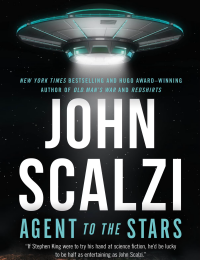
This month I very much enjoyed another Scalzi book, Agent to the Stars (2005). It’s the second science fiction novel he published — the first standalone SF novel.
[The same year, he also published Old Man’s War, the first book of what is now a popular ten-book series (which I haven’t gotten into, yet).]
Agent to the Stars, a comedy, is told first person from the protagonist Tom Stein’s POV. He’s a resourceful agent representing actors for a small Hollywood agency. His most notable client is Michelle Beck, a rising action star who is brainless but earnest in her desire to break into “serious acting” despite having no real talent (or anything amounting to acquired skills).
As the book begins, Tom’s boss, owner of the agency, calls Tom into a private meeting and asks him to farm out his current clients so he can devote all his attention to a new client, named Joshua. Who is a Very Important Client. A genuinely game-changing client.
Because Joshua is an alien, the first Earth has experienced.
Joshua’s people, the Yherajk, have been in space near Earth for many years learning our language from our TV broadcasts. As such, they’re steeped in modern culture (as seen on TV). They’re completely friendly and eager to meet us.
There’s just one small problem: the Yherajk are, in their natural state, undifferentiated mostly transparent blobs of what looks more or less like phlegm (but is, in fact, warm and dry to the touch). To top it off, they communicate using smells. Powerful and to Earth people incredibly odious smells. A meeting of many Yherajk that involves much yelling puts out a stink that can knock an Earthling unconscious.
Essentially, they have a horrendous PR problem. They know full well how Earthlings are likely to react to their first aliens ever (the Yherajk have seen The Blob, its remake, and similar films). And then there’s the smell.
So, they’ve decided they need an agent. A smart one who can figure out a way to introduce the Yherajk to humanity in a way that won’t cause mass freakouts and revulsion.
I tend to do well with Scalzi’s comedies, and this one is no exception. I thoroughly enjoyed it and give it an Ah! rating. It’s fairly well-grounded in terms of the science in the fiction, the aliens basically make sense.
§
As a quick aside, I also read the Scalzi short story The President’s Brain is Missing (2010). In it, Presidential staffers come to realize the President’s brain is missing. Literally, it’s just not there. Yet the President continues to function normally.
For obvious reasons, it was a bit weird to read in 2026…
§
 I apparently haven’t mentioned Daniel H. Wilson here.
I’m surprised, because I thought I would have mentioned Robopocalypse (2011) and Robogenesis (2014) back when I wrote about the C. Robert Cargill books [see Robot Apocalypse!]. Both two-book series involve robots taking over humanity Terminator-style.
The Wilson books focus more on the battle between humans and robots, and I’m not a big fan of battle stories. There is a sameness to them.
Recently, I decided to read his The Clockwork Dynasty (2017) and Hole in the Sky (2025). The latter is tagged SF/horror, and I guess it was, but I couldn’t make much sense of the plot, to be honest. I skimmed through most of the latter half of the book and give it a Meh! rating. I apparently am alone in that assessment, because the book is well regarded and has been optioned for a film.
A few notes:
- Another good start that got tedious.
- Not SF, horror fantasy with nightmare logic. Meh.
- One dumb image after another. Visual not sensible.
- No explanation of abilities or reasons.
- Mikayla has the superpowers of autism.
- A giant brain structure! 😄
- Main villain reminds me of the one in ST:TNG’s “Skin of Evil” (a widely acknowledged bad episode in part because of the villain).
- Felt derivative; didn’t care about the characters.
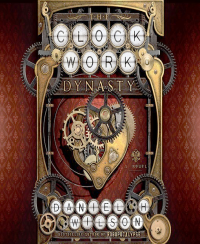
I liked The Clockwork Dynasty better but thought it bogged down a bit around 70% through. It’s a modern day steampunk story featuring a race of mechanical beings created by an advanced civilization over a thousand years ago. Their innards consist of lots of fine clockwork levers and gears.
This is also soft SF to the point of fantasy; nothing is explained. These ancient clockwork creatures, called avtomat, are animated and powered by a crescent-shaped piece in their chest called an anima. Effectively, their soul but also their energy source. While the avtomat have created advanced technology allowing them to repair their very strong and robust bodies from occasional damage (making them almost immortal), they cannot fix, recreate, or repower their anima.
The story alternates chapters between modern day and Russia in 1725, in both cases in first person. In the present, June Stefanov, an anthropologist specializing in ancient technology, makes a discovery that pulls her into the hidden and deadly world of the avtomat. In the past, the story follows two avtomat, Peter and “sister” Elena. Peter mistakenly believes he was created at that time and place, but we learn the avtomat are much older than that. June meets Peter early on.
It’s fine if you like that sort of thing, but it didn’t do much for me. I have a few last notes:
- The avtomat remind me of golem and how they contain a written word in their head that animates and guides them. The avtomat have a symbol engraved on their anima that guides their thinking and personality (Peter’s involves serving; Elena’s involves logic).
- How do they sense things? They clearly can feel touch and can smell and, obviously, see and hear. How?
- The story works pretty much the same if the avtomat are elves hidden among us.
- Peter is a dick and obsessed with Elena.
I give it an Eh! rating.
§
Another quick aside: I reread The Martian (2011), the first novel by Andy Weir. I wrote about his third book, Project Hail Mary (2021), back in February [see Weir: Project Hail Mary].
Both books, of course, were adapted into movies successful with audiences and critics. I consider the 2026 Project Hail Mary adaptations one of the better ones I’ve seen [see Project Hail Mary videos]. For me, each of Weir’s books has been better than the last.
In fact, I didn’t care for The Martian when it came out (neither the book nor the movie). I think I was counter-reacting to the insane-billionaire-induced lust for going to Mars that was going on at the time. The last thing I wanted was yet another science fiction story on Mars.
There is also that it’s essentially a person-stranded-on-a-desert-island story, and that’s a fairly old theme.
That said, I enjoyed the reread more than I expected and would give the movie another chance if it comes around on one of my streaming platforms.
§
The guy who came to measure my windows and doors for replacement turned out to be (these days, yet another) science fiction fan, and we got to chatting about books and shows we liked.
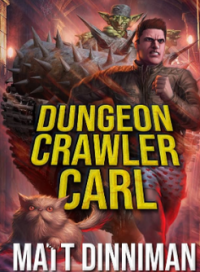 He recommended a favorite of his, Dungeon Crawler Carl (2020), the first in an eight-book series by Matt Dinniman.
It’s modern day science fantasy that starts off by annihilating just about everyone on Earth. The only survivors are those who did not have any kind of roof over their heads at the moment the hammer fell (so to speak, but appropriately). “Any kind of roof” includes tents and cardboard boxes. To survive the initial event, there had to be sky above your head.
Carl is one of the few million who survive because he was outside (in his underwear and a tee-shirt) chasing his ex-girlfriend’s escaped cat, Princess Donut. A message broadcast to the comparative handful of survivors advises them, on penalty of pending death, to find one of the many entrances scattered around the world. These lead to the dungeon, a D&D-style game avidly watched as entertainment by trillions around the galaxy.
Of course, the object for the remaining Earth folks is to not die. I can’t say I loved it, but I do have the next two on hold with the library. Whether I continue depends on where things go and if it stays fresh. As always, it’s a sign of my disengagement that I took notes:
- Rather derivative; nothing original. Seems very age 20s age level in terms of language and topical refs.
- I am so tired of the constant snark in modern lit and screen.
- Everyone sounds the same.
- Weird that the author uses “2/3s” and “3/4s” rather than “two-thirds” and “three-quarters”. I’ve never seen that done before.
- Obviously oriented towards gamers with terms such as “mob” and “buff”.
- A lot of it feels random and makes no sense (another defect of modern storytelling, I think). For instance, drug dealing llamas.
- Reductive. Assumes aliens are the same boring assholes as us.
- Definitely pure fantasy (no science).
- The lone human against high odds fantasy trope.
- The D&D details are so boring!
- Having healing spells tends to ruin tension.
- Occupies time with stuff that seems just filler.
As a small sample of what I mean, while chasing the cat, Matt is thinking about things:
Her whole family was into raising and showing Persian cats. Me, I didn’t really know much about the whole cat show world. I didn’t want to get too involved. Like I said, I don’t do drama.
And let me tell you something about cat people. More specifically, cat show people.
Actually, never mind. Fuck those guys. All that’s important is Bea and Donut were a part of this whole world I didn’t want anything to do with.
I never considered myself a big fan of cats. But, if we’re being truthful here, I liked Donut. That cat did not give two shits about anybody or anything, and I could respect that. I Donut wanted to set on my lap while I was blasting away on Playstation, then she sat on my damn lap. If I tried to pick her up, she hissed and scratched and jumped right back up there. And then she looked at me with a squished face that said, what’re you gonna do about it?
I’d been tempted, more than once, to throttle the thing. But I’m not an asshole. Plus, I could respect the little monster’s tenacity. Some of my buddies would give me crap about it, me spending all this time with a fuzzy cat that was probably worth more than I would make in a year, but I enjoyed it. I enjoyed having that ball of fuzz sitting in my lap.
One of Beatrice’s ironclad, this-is-not-negotiable rules was no smoking in the apartment. So after our fight and breakup, I’d made a point of smoking as much as I could. I know, immature. But it was freezing outside.
It’s hard to explain, and this post is getting long, so maybe I’ll revisit this down the road, but it has to do with the fundamental negativity and cynicism behind the character. He’s disaffected and doesn’t give a shit and likes that the cat is, too. Another quote I found expressive:
I had no idea what the word “mawkish” meant, but I assumed it translated to “cheesy.”
I find myself bemused and left cold by such ignorant fictional heroes. I find it hard to care much about what happens to them.
[As an aside, I do not understand educated people in “this day and age” who actually still smoke cigarettes. I’m not rabid about making them stop; I just can’t believe anyone in their right mind does it. But then I feel that way about a lot of things people do.]
The writing is in the easy-breezy colloquial style of a lot of modern writing. I do wonder a bit sometimes how well it will age (not so much is my guess). But the story was entertaining enough to keep me reading, and nothing really pissed me off, so I’ll see what the next one is like. Carl is just getting started on dungeon levels.
Oh, I forgot to mention: Princess Donut is taken by the system to be a game player (rather than a pet) and thus given intelligence and the power of speech, so part of the fun is that Carl is running around with a smartass talking cat.
§ §
Stay Lucky, my friends! Go forth and spread beauty and light.
∇







October 25th, 2026 at 8:52 am
The Lucky Starr books were my original introduction to Asimov. Although I actually remember very little from them. As a boy, I think I was disappointed by how dated they were. Of course since then, I’ve read a ton of dated stuff and enjoyed it for what it was. With the ebooks dropping, I’ve thought about revisiting them, although similar to you, I seem to be out of a fiction reading mode at the moment.
Agent to the Stars is interesting in that it was actually the first novel Scalzi ever wrote, before Old Man’s War. I read it many years ago when he put it out with a warning that it was a practice novel.
My cousin loves Dungeon Crawler Carl. He characterized it as sci-fi, so I picked up the first one and read a couple of chapters. I agree that it’s really just fantasy. I do like the writing, but the concept wasn’t really drawing me in. I’ve been a casual D&D player, maybe too casual to be in the target audience. OTOH, I like the simple straightforward writing style, and might return to it, particularly because it is so popular, and I like to study popular writing.
October 25th, 2026 at 10:55 am
Yeah, I don’t remember them at all (but I famously don’t remember books well). I think we’re about ten years apart (?), so if you experienced them around the same age I did, they would have been about 15 years out of date. But in the early 1960s, they weren’t too bad. At least, I don’t recall reacting to them badly the way you describe (whereas it’s really clear now how dated they are but, as you say, can be read for what they are).
For a practice novel, Agent… is pretty good. Interesting how often first novels, first record albums, even first MLB seasons of baseball players, to use an appropriate metaphor, knock it out of the park compared to their later efforts. My canonical example being the band Boston’s first album, an enduring rock classic and miles above their other albums. Or Shyamalan’s first movie, The Sixth Sense. I know of many other examples…
I’ve never actually sat down and played D&D but have seen it enough in TV shows and movies to feel as if I have. And I have played computer versions. One called Moria was popular in the early days of PCs. Crude graphics and based, of course, on the Dungeons of Moria from LotR.
I agree with your assessment of DCC. Readable and reasonably enjoyable fluff.
October 25th, 2026 at 3:33 pm
I can’t remember how old I was when I read the Lucky Starr books. I think it was early in my exploration of old time space opera, because I eventually stopped caring about people being able to breath on Mars or Venus being a dense jungle (or whatever it was in those books).
My friends and I played around a little with D&D as teenagers, but we didn’t really know what we were doing. It was as an adult that I got into an eight year long campaign. The DM was pretty experienced and many of the people playing were a lot more into it than I was. But I showed up for most of the game nights just to hang out.
Eventually one of the major players was moving away and asked if we could wrap the campaign before he left, so the DM made it happen. The experience was sort of a cross between playing a computer game and a medium sized card game between friends. The Stranger Things TV show actually did a good job of capturing it. (Although as adults we were never as exuberant as those kids.)
October 26th, 2026 at 10:41 am
If you were explicitly checking out “space opera”, that sounds to me like you might have been beyond grade school? Or were you into SF from an early age? I was wondering about the term and checked out the Wiki page for space opera. It was first coined back in 1941 (!!) and became somewhat in vogue in the 1970s. When I read those books in the early 1960s, I’d never heard the term “space opera” but I led a pretty sheltered life as a child (being a Midwestern preacher’s kid and all).
I finished the first book, the one that introduces the character. David Starr ends up on Mars (which Asimov gets mostly right; breathing equipment is required) investigating a food-poisoning plot. He ends up meeting actual Martians, an ancient race that retreated to caverns they created miles beneath the surface. As 1950s cheesy Asimov as it was, the story wasn’t bad. I enjoyed it once I got into it. I’ll read Oceans of Venus (book #3) next.
Eight-year campaign! Wow, impressive! I can appreciate the social draw part. For us it was usually card games (a lot of Hearts) and sometimes board games. For some reason, I’ve never been much of a game player. Got into a couple of video games early on, but I haven’t played any in decades. I think maybe the hobby coding I do fills that need to play. 🤷🏼♂️
I’ve never seen Stranger Things and have no opinion on it.
October 26th, 2026 at 12:49 pm
I don’t think I knew the label “space opera” until I was an adult. But I started with SF pretty young: TV viewing around 5-6, comic books sometime in the mid 1970s, and tried reading novels several times and struggling until I found junior and middle grade books at the local library to act as a bridge.
Once I had a few of those under my belt, I was able to tackle more adult stuff. I know I had read 2001 A Space Odyssey (with my dad’s help) before the movie came on network TV, and that was sometime before Star Wars came out. I was ten that summer. I do know I read the early Foundation books long before Foundation’s Edge came out in 1982, when I would have been 15 or 16. By then I recall being a pretty experienced SF reader.
I’ve actually never not enjoyed anything by Asimov. I know his writing is pretty basic, but I’ve always preferred it to the more elaborate literature. Although my memory of that book must be off if they were wearing spacesuits on Mars. (I’m likely conflating it with a lot of other old Mars stories where the air was typically thin but breathable.)
On the eight year campaign, I remember the DM telling me a few months in that he’d been part of a ten year one before, which at the time had seemed incredible. I didn’t later realize we had gone eight years until the guy leaving pointed it out. We only played once every couple of weeks, canceled a lot, and mixed in other campaigns, which stretched it out.
Stranger Things felt like those old Sunday Disney shows where kids have adventures, although with some gore and horror mixed in. It’s mostly fantasy with trappings of SF. I was drawn into it because of a long time crush on Winona Ryder, and 1980s nostalgia also helped.
October 26th, 2026 at 1:55 pm
I don’t know when 2001 showed up on network TV. Both the film and book came out in 1968; I’m pretty sure my parents took me to see it. I know I saw it several times at the Cinerama Dome in Los Angeles when it ran there in 1974 (that was after high school, so I was an SF fan but also a moviemaking fan and had learned a lot about how Kubrick filmed it).
The Foundation trilogy was big for me, too. And the Robot stories. Like you, I’ve always enjoyed Asimov, and he probably is my favorite among the Big Three. (Heh, I think my ranking there is alphabetical just as it is with Asher, Banks, and Reynolds. Close race in both cases, though.)
I suppose centering on kids is why I never felt pulled by Stranger Things. I can certainly appreciate the draw of Ms. Ryder, though. She’s a good reason to watch Beetlejuice (though I’ve crushed on Geena Davis, too).
October 26th, 2026 at 2:43 pm
Gemini says 2001 came on NBC in February of 1977, which feels about right. I remember going into Star Wars thinking the ships would move like they did in 2001, and of course being disabused of that notion in the first few seconds.
On the big three, Heinlein actually ranked on top for me as a boy, until his adult stuff ruined it. I think Clarke had better concepts, but I’m now struck by how little conflict his stories have. Asimov’s definitely work best when you just want entertainment. For the British guys, I think I’m Reynolds, Banks, and Asher, mostly because I like Reynolds harder SF take.
Pretty sure Beetlejuice is when my infatuation began. Beetlejuice Beetlejuice has both her and
WednesdayJenna Ortega in it. I’ve always had a thing for Goth girls.October 26th, 2026 at 3:40 pm
The thing that impressed my buddy and me was that Kubrick dared to let the space shots be silent (as they should be). Even my belovèd Star Trek put in the whoosh because it played better.
Somehow, I got it backwards with Heinlein: read his adult stuff before I discovered he wrote YA and kid stuff. As I recall, Stranger in a Strange Land was a big deal back in high school. It was a relatively new book in the late 1960s. I was old enough to find it a little creepy, which fine, whatever, but the books after that didn’t do much for me. His earlier stuff, classic, but he didn’t age as well as the other two.
Heh, you’re not alone (witness all the sexy goth girl Halloween costumes and Abby on NCIS was a hugely popular character). I had a major childhood crush on Morticia Addams (the original played by Carolyn Jones). On a related note, I just added Charmed (which I never watched) to my Hulu lineup…
October 26th, 2026 at 5:33 pm
The silence in 2001 impressed me too. Most producers convince themselves audiences won’t accept it, so it’s rare. Firefly, Gravity, and Ad Astra are some of the few exceptions I can think of, and all use the silence for surreal scenes. Even The Expanse, which I generally give high marks for scientific accuracy, caved on sound in space. (Ty Franck took a fair amount of grief about it on Twitter at the time.)
Stranger in a Strange Land had faded in inflluence by the time I was reading. I enjoyed Heinlein’s juveniles, then found Starship Troopers ok, but weird and preachy. Podkayne of Mars was the last thing he wrote that I could finish. (Orphans of the Sky wasn’t bad, but that was a fixup of much older stories.)
Alyssa Milano is another old crush. I watched some of Charmed during its run on the WB, but it never really hooked me. It’s been decades since I’ve seen it.
October 26th, 2026 at 6:41 pm
Honestly, it’s probably only space geeks like us that even notice. Most people seem to prefer the sound effects. I suppose it ties back to our childhood when we ran around with a bath towel cape flying our spaceships and going “whooooooosh!” It did seem more noticeable in The Expanse because the show was usually pretty authentic. How silent were those scenes with Naomi escaping through space without a suit? I don’t remember.
I have gone back as an adult to read some early Heinlein and would read more. Don’t think I want to reread SiaSL or anything after that, though.
I had a manager for several years who liked the show, and our opinions on things tended to coincide (except she was a cat gal; I’m a dog guy), so I’ve long mentally bookmarked the show as a possibility. Obviously, for me the eye-candy is a factor, too. And I want something for that last hour or so of the evening, when I’m not quite ready to crash, but don’t want to watch anything that demands much attention. Thought maybe an episode of Charmed might make a nice nightcap.
October 26th, 2026 at 8:29 pm
Probably so on only space geeks noticing whether there are sounds. I can’t remember either on that Naomi scene. Often shows will omit sound in those scenarios since they’re focused on the character’s experience, rather than a God’s eye view of spaceships flying around.
I can see Charmed being used that way. But for that kind of stuff, these days I often throw up a Pluto channel, typically the ST:DS9, Stargate, Twilight Zone, or BBC Earth channel. That way if I fall asleep, I’m not messing up any progress tracker. Now that I think about it, there’s also a Charmed channel in the lineup. Just pulled it up and was reminded of that WB vibe where everyone is young and beautiful. Anyway, Pluto is another of those ad supported services.
October 27th, 2026 at 10:24 am
Watching baseball this summer (and the World Series right now), I’ve remembered how much I hate commercials. Especially now with the mid-terms pending: lots of political ads. I think it would take something very special to make me suffer through commercials.
An ironic aside: Prime has many of the more well known Charlie Chaplin movies. I haven’t seen those since I was a film student in college, and it’s surprising how watchable they are. But of the seven available, The Great Dictator was available only with ads. The other six, no ads. Months later, it became available without ads, but another Chaplin movie now had them. Then that one reverted, so now they’re all ad-free. The irony is that I’d never seen The Great Dictator but had heard about it since college and really wanted to see it. And it turns out it kinda sucks. It’s from 1940 and has dialog, for one thing, and it’s just weird to hear Chaplin talking. Quite a let-down after all these years wanting to see it.
As far as falling asleep, I have auto-play turned off, so if I fall asleep during an episode, I only miss the end. Usually, though, if I’m fading I manage to turn off the TV and stumble off to bed. I rarely actually fall asleep watching TV or reading.
October 27th, 2026 at 11:47 am
Yeah, and Pluto.tv has local slots for its ads, so for the last couple of weeks I’ve seen a single ad against one particular politician running constantly. I’m not even sure what the guy’s running for, but I know someone (another Republican from how the ad attacks him) really doesn’t want him to win. I usually just pull Pluto up for background ambience, or to fall asleep to. (Eventually both the TV and ROKU time off.)
It’s interesting (and somewhat sobering) how many silent film stars couldn’t make the transition to the talkies. I once watched the beginning of a weird Douglas Fairbanks movie with him talking throughout, and didn’t think he sounded bad, but apparently audiences didn’t like his voice. (It didn’t help that his health was also starting to slip in the 1930s.)
October 27th, 2026 at 1:18 pm
Yet another example of how every game-changer is an advance and an amputation. The talkies spawned new professions but ended a number of careers.
October 25th, 2026 at 1:26 pm
I read several of the Lucky Starr books too. I’d say your assessment of science as savior is spot on. As much as I disagree with that philosophy, I do find it worlds better than our current “everything is going to hell in a handbasket” outlook.
Now that you’ve re-read The Martian, how do you feel it stacks up against Project Hail Mary? It’s been long enough that I feel like I’m not one of the herd if I read him now.
October 26th, 2026 at 10:22 am
Taste probably has a lot to do with this, but I still think each of Weir’s books is better than the last. The Martian is pretty good, but I liked Artimis better (and plan to reread it soonish), and I like Project Hail Mary even more. As I mentioned in the post, the first is essentially a guy-trying-to-survive-with-meager-resources story, which are quite familiar to me, the middle one is kind of a crime-caper-for-justice (on the Moon) story, and the last is an alien contact story (with impending doom for both worlds thrown in).
October 26th, 2026 at 11:59 am
I’ll have to think about PHM then.
October 26th, 2026 at 12:23 pm
At least he didn’t write a series, so you can read them in any order or skip some or whatever. Seems like a lot of the authors writing today put out a series, which forces you to read them all for the full experience.
October 26th, 2026 at 12:37 pm
It’s what the publishers want. Sadly.
October 26th, 2026 at 1:41 pm
Oh, I know. And thick books so consumers feel they’re getting more bang for their bucks.