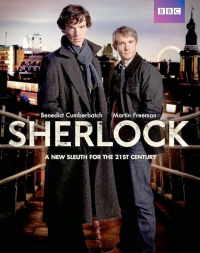
 A Substack post caught my eye back in early October. It asked whether the BBC series Sherlock (2010-2017) was “brilliant” or “twaddle” (ultimately concluding the show was, in fact, “brilliant twaddle”).
Ever since the series showed up on Hulu recently, I’ve been pondering rewatching it. That post nudged me over the line. Seeing it again reminded me that, while the show had a lot to offer, it wasn’t at all my favorite modern implementation of the belovèd character.
So, yes indeed, “brilliant twaddle” (and sadly, probably closer to twaddle).
Sherlock is the brainchild of Steven Moffat and Mark Gattis. Both are known to Whovians as key writers on the revived (but now again terminal) Doctor Who (2005-2025). Besides creating Sherlock, Moffat and Gattis, either individually or together, wrote all but three of the thirteen scripts. The other three were written by Stephen Thompson (who also wrote three Doctor Who scripts). There is some overlap: all three (fittingly) worked on the episode “The Sign of Three” (S3E2).
Gattis, an active actor, also appears regularly as Mycroft Holmes, Sherlock’s smarter brother (he also appeared in several different roles in Doctor Who).
I first wrote —albeit briefly — about Sherlock back in 2015 [see Too Much TV]. Back then I was entirely thumbs up on the show because it was a Sherlock Holmes type show that actually featured a character named Sherlock Holmes (in contrast to many other shows with a different brilliant detective — for example, one of my favorites, House, M.D. [see House is a Holmes]).
In that post I concluded:
Benedict Cumberbatch is excellent as the Great Detective, and so is Martin Freeman as Dr. Watson. It’s been especially fun how they’ve danced with some of the original stories — we’ve met Irene Adler, the Baskerville Hound, and the Reichenback Fall.
Definitely up on the show (but season four hadn’t dropped then, and it changed my view considerably).
I wrote in a bit more detail about the series in 2020 [see Recrudescent]. I still gave it high marks as an adaptation. In fact, I said it was “one of the best ever in many ways”. I’ll stand by that now with the caveat that I mean of characters actually named Sherlock Holmes. (Even so, it’s not number one in that category for me — I liked Elementary (2012-2019) much more.)
I also wrote that it, “is not without its flaws and irritations”. As I went on to explain:
One big irritation has always been that this Sherlock Holmes is a major dick. The canonical Holmes has a much higher “emotional IQ” — is much more of a gentleman socially.
It annoys me that this Sherlock is smart enough to figure out the most subtle clues about people but remains utterly clueless and uncaring about his personal effect on them.
Back then I also realized I disliked — rather intensely — Martin Freeman’s Watson, in part because I’d taken a dislike to the actor, but also because of how the character is written:
Freeman’s Watson is self-centered and self-absorbed in the extreme and just as socially retarded as Holmes is. Over and over Watson is painted as an oblivious boob, especially with women. (I find it incredible that the Mary this show created (Amanda Abbington) would see anything in him. Their relationship doesn’t make sense to me.)
Rewatching this recently, those factors were major detractions to my enjoyment of the show. Which, despite that, does still offer some well-told and engaging stories (at least until the fourth and final season).
I ultimately concluded, and mostly still stand by:
I also realized that the series is really strong for two seasons but starts to run out of gas in season three. Season four is just weird with its Eurus plot line.
Still, all in all, very much two thumbs up. A definite Ah! rating. I’d even give certain episodes (e.g. “A Study in Pink” and “The Abominable Bride”) a Wow! rating.
This time I’m seeing it more clearly, how the first two seasons are strong (if irritatingly flawed) but it really does decline in the third season. Parts are indeed brilliant, but too much of it is unfortunate twaddle.
And the three major characters are abominable asshats.
I don’t plan to rewatch the fourth season.
§
Of course, I have notes:
“A Study in Pink” (S1E1, 2010-10-24):
Based on the first Sherlock Holmes novel, A Study in Scarlet.
• It’s clear this Sherlock is autistic but he’s also obnoxious to the point of cruelty, not just to strangers, but to people close to him. John Watson starts off bitter and angry and never seems to find peace. Nor is Mycroft Holmes a joyful character.
• Sergeant Sally Donovan (Vinette Robinson) adds a hostile element (foreshadowing Sherlock’s later “burning” by Moriarty, whose existence is mentioned at the end of the episode).
• In contrast to older implementations, the series seems to reflect the abiding negativity and cynicism of much 21st century writing.
• This Mrs. Hudson (Una Stubbs) is probably the best implementation of that character I’ve ever seen. Definitely a high point in the series.
• The graphics and editing still impress. Scene transitions, for instance. The edges of doors following wipes between scenes. Numerous examples of clever split-screen effects (not the usual boxes with hard edges).
• Also, the creative way they use graphics in POV shots to show what Sherlock sees. Various titles appear over the clues Sherlock spots.
“The Blind Banker” (S1E2; 2010-10-31):
This is one of the Stephen Thompson episodes. It’s a mashup of multiple Holmes stories, mostly “The Adventure of the Dancing Men”.
• Watching it again, it occurs to me that Sherlock, like much modern TV, leans fairly hard into the action genre. This one involves a down-to-the-wire deadly action scene.
• John is strikingly clueless about women. He’s almost as bad as Sherlock. Watching him interact with his various girlfriends is painful.
• The plot requires villainous General Shan to be an idiot in confusing Watson for Holmes. (No photos?) And to be the kind of villain who drags her elaborate killing device to the deserted tunnel. It’s cartoonish preposterous nonsense.
• In the struggle at the end, why not just knock Sarah’s chair over so the arrow misses? So much script-induced false tension. Bah!
• More Moriarty. I’d forgotten how the first two seasons comprise an arc about Moriarty taking on and ‘burning the heart out of’ Sherlock. In contrast to most other implementations, named or not, with a more episodic approach to the various cases of the Great Detective and not so much Moriarty.
• The hairpin surprise at the end was cute. The look on her face!
“The Real Game” (S1E3; 2010-11-07):
Somewhat based on “The Adventure of the Bruce-Partington Plans” with references to “The Five Orange Pips” (both short stories). This season finale ends with a cliffhanger confrontation between Sherlock and Moriarty.
• The cold open is a (really dumb) grammar joke. Ha. Ha.
• Sherlock isn’t just an asshole, he’s an infantile asshole. So is Mycroft, sometimes. Sherlock makes the show hard to watch. How he treats Molly, for example, is despicable.
• My practical mind wonders about the woman who has to sit in her car for nearly 12 hours. No bathroom breaks. Likewise, the guy who has to stand on a street corner for 6 hours.
• Despite numerous and various issues, the show is pretty good during the two-season Moriarty arc. It begins to fall apart after that, though. Season three wasn’t awful, but season four was.
“A Scandal in Belgravia” (S2E1; 2012-05-06):
Based on the short story “A Scandal in Bohemia”. Introduces Irene Adler (played here by Lara Pulver), the only villain to best Sherlock Holmes (and to win his respect and grudging love). Canonically, he refers to her ever after as “the woman”.
• Sherlock’s lack of social graces, despite being fully intelligent enough to understand them and their importance to others, is really grating. It’s here that I made the actual note about his horrendous treatment of Molly. Frankly, why she continues to see anything in him is utterly beyond me.
• To repeat myself, Sherlock and John are often infantile. (Yet another illustration of the infantilization of modern culture.)
• The deerstalker hat. Something of an inside gag. In the Canon, Holmes is never explicitly described wearing a deerstalker hat, though he was described as wearing a cloth cap that matches the description. The original illustrations by Sidney Paget depicted Holmes in a deerstalker, and ever since the image has become an identifying trademark of the character.
• Lara Pulver is well suited to the role and (pardon the pun) pulls it off wonderfully.
“The Hounds of Baskerville” (S2E2; 2012-05-13):
Based, obviously, on the famous novel The Hound of the Baskervilles.
• Sherlock’s cruel and clever snark reveals that he well understands what he’s saying and its probable effects. It’s not just a case of an autistic person not knowing any better. He’s more than smart enough to figure it out. Witness his uncanny ability to read people. He’s just a childish dickhead. Selfish in the extreme.
• He essentially terrorizes John in the laboratory. Some friend.
• At this point, after only five episodes, the infantilism, snark, and atrocious behavior towards people close to him is really wearing. Not sure at this point how much more of the show is worth watching.
“The Reichenback Fall” (S2E3; 2012-05-20):
Second season finale. Inspired by (but not much based on) the short story, “The Final Problem”, in which the author tries to kill off his belovèd character so he can write “serious” fiction (a plan that didn’t work out). In the story, Holmes and Moriarty physically fight at the top of Reichenback Falls, in Meiringen, Switzerland. Supposedly, both fall to their deaths.
• A plot device here is the magical hacking MacGuffin that can break into any computer system. What’s a bit fun about the script is that Moriarty ultimately derides Sherlock for believing such a thing could exist (it couldn’t).
• Once again, Sherlock is unnecessarily cruel, here to the reporter who is on his side. At least until she actually meets him. Talk about shooting yourself in the foot.
• Surely such a clearly absurd “not guilty” verdict, when the defense presented no case, would call for an investigation into jury tampering. It would be the only reasonable expectation.
• Oof, the CSI bullshit is thick in this one. Tracking down the exact location by supposed bits left on the shoes. Shaking my head (yet it is canonical).
• The assassins stuff is pretty high nonsense, too. As if. Modern cultural TV BS.
• Anyone familiar with the Holmes canon realizes Sherlock isn’t dead. In fact, the episode reveals that at the very end. The key question is why Sherlock didn’t tell John but allows John to mourn bitterly. To the point of seeking psychiatric help.
“Many Happy Returns” (BBC mini-episode): Never seen it — available online only. Apparently, former police forensic scientist Philip Anderson (Jonathan Aris) believes (correctly) that Sherlock didn’t die and tries unsuccessfully to convince Lestrade (Rupert Graves). An aspect of this shows up at the beginning of the S3E1 episode.
“The Empty Hearse” (S3E1; 2014-01-19):
Based on the short story, “The Adventure of the Empty House” along with references to other stories. And to no one’s surprise, two years later, Sherlock isn’t dead.
• Yow! The cold open is almost fetishistic in its glorification of Sherlock Holmes, action hero extraordinaire.
• To surprise John at the restaurant, Sherlock: spills water on one diner and steals his bowtie, steals other items from other diners, and despite his observational powers and towering intellect, is clueless about John’s reaction. The scene is embarrassing to watch. Sherlock is a child.
• John is furious enough with Sherlock to physically assault him, yet all three stick together through three different venues (all of which they get kicked out of because of John’s assaults).
• If John finds his doctor job so dreary, why not find something more exciting? He could work in an ER, for instance. The script deliberately puts him in that job to motivate his rejoining Sherlock.
• The way everyone assumes Sherlock and John are a couple finds some justification in John’s (rightful) anger and in his getting over it to be with Sherlock again. They sure seem like a couple (though the relationship seems abusive to me; likewise Sherlock and Molly).
• We never really see why Sherlock needs John (or Molly). The most likely answer is that he’s a narcissist who needs an audience. (Of course, the Watson-like characters in Holmes-like stories are stand-ins for the audience. Holmes’ explanations to Watson are explanations for us.)
• Facing imminent death, Watson calls Sherlock the “wisest” and “best” man he has ever known. Sherlock is very intelligent and capable, but “wise” seems a stretch since that usually includes an element of social intelligence.
• Overall, the episode feels infantile and gag-ridden. Focused more on personal shenanigans and action thrills than in telling good Sherlockian stories.
“The Sign of Three” (S3E2; 2014-01-26):
The wedding episode; John and Mary get married; Sherlock is the best man. Very loosely based on The Sign of the Four (1890), the second novel, in which John meets Mary (their client) and proposes to her at the end of story. About the only other thing from the story is the name Major Sholto.
• The cold open features a montage with Lestrade and Donovan trying to capture a gang of thieves that has eluded them multiple times. On the brink of finally catching them, Lestrade gets an “emergency” text from Holmes demanding his help. Lestrade rushes off (calling for emergency back up including a helicopter) only to find Sherlock just needs help with his best man’s speech.
It really really emphasizes what a complete self-centered asshole this Sherlock is, but I think it was intended to be a humorous opening. At this point, though, I’m beginning to think this is one of the worst implementations of the character I know.
• Character behavior is script-driven and inconsistent. Sherlock is fine expounding his deductions and questioning others. He was fine talking to a beautiful, sexually aggressive, naked woman. He’s made it clear he doesn’t care what others think of him. Yet, making a speech at the wedding discommodes him?
• The script, having set up his discomfort, initially gives us the strange, painfully awkward speech we expect. Then it surprises us by turning into something almost perfect; not a dry eye in the house. It’s a fine piece of writing, but it raises a lot of questions about the character. Mostly, it suggests Sherlock’s snark and cruelty towards his friends is knowing and deliberate.
• Sherlock describes himself at one point as a “high functioning sociopath”, which is a fair description, but he’s also highly intelligent, vastly more so than most, so he’s fully capable of figuring out how to act like a decent human being. He simply chooses not to. Given the disadvantages that creates, how does such an intelligent person make that choice?
• There’s a weird contrast between smart-Sherlock and stupid-Sherlock. There is likewise a weird contrast between strong-John and clown-John. It seems to depend on what the script needs at the moment to make feels (what I call Spielbergisms, and it’s not a compliment).
• The comic bit where Sherlock is obtuse about John asking him to be best man (and then locks up once he gets it) falls a bit flat given the ending of the previous episode. Gatiss wrote that one and is one of the three writers on this one, so the disconnect isn’t because of separate writers.
• A truth about alcohol is that it strips social filters and reveals the real inner person. The drunken “bachelor party” by John and Sherlock reveal what childish assholes they are. It is a bit funny how Sherlock’s deductive powers fail.
• An aside: The dropping-your-glass-because-you’re-startled trope. Does anyone really do that? I never have, and I’ve never seen anyone else do it.
“His Last Vow” (S3E3; 2014-02-02):
The title is based on “His Last Bow”, a short story about Holmes and Watson catching spies. That story also has the reference Mycroft makes to “an east wind coming” — a reference to the coming war that doesn’t make much sense in the episode’s context. The blackmail plot comes from “The Adventure of Charles Augustus Milverton”.
• Sherlock apparently has a drug problem and has hooked up with Janine (the maid of honor from the wedding last episode). John is once again kept in the dark in order to keep the viewer in the dark. As with many of these scripts, the tricks only work the first time through and feel lame when rewatched.
• In a huge WTF moment, we learn Mary has an ugly past as an expert assassin. Later it is presented that John was drawn to her because of her deadly past (similar to how he’s drawn to the excitement of Sherlock’s life). I think my key problem is that Martin Freeman, as an actor, doesn’t pull it off.
• Sherlock knows how to act like a decent human being enough to fool Janine into thinking he wants to marry her. So, clearly Sherlock has the ability to treat his friends better. He’s just too selfish and childish to bother.
• The soap opera and melodrama is really cranked up on this one.
• As an aside on a theme I’ve been pondering, the level of deceit this season, mostly by Sherlock and Mary towards John. The amount of lying fictional characters do to supposed friends and loved ones is starting to really get under my skin. No wonder our culture is so messed up.
• No one ever called Magnussen’s bluff? No one ever demanded to see the photos or letters? No government or powerful enemy ever chose to bomb or raid his house (and supposed vault)? And if he was so unassailable, why was Mary just going to shoot him? The plot doesn’t really hold together, and it’s more thriller than detective story.
• Once again Sherlock calls himself a “high functioning sociopath”. Given how dysfunctional his relations with all other people are, I’d question the “high functioning” part.
• Mycroft teases the season four sister with his “the other one” reference (which channels Obi Wan in SWIV more than a little).
• Moriarty is supposedly back, which grants Sherlock a reprieve and instant return from his certain-death espionage assignment. Apparently, in England it’s possible to shoot someone in the head in front of witnesses and … nothing happens to you.
• The trope of being able to take over all screens everywhere is stupid. It’s essentially a superpower that requires the mythical hacking device to accomplish.
• The fetishizing of Sherlock Holmes seems especially apparent in this season. Perhaps in reaction to the show’s popularity at the time.
“The Abominable Bride” (2016 New Year’s Special):
A special episode that places Holmes and Watson in Victorian times (as in the original stories). Rather than being a one-off episode done for fun, it turns out the whole thing is Sherlock’s drug dream. Which makes it hard to criticize the plot: not just dream logic, but drug dream logic. The episode has references to three of the short stories but is essentially pure Moffat and Gattis.
• The 19th century recreation of their first meeting (S1E1) is cute, along with the many meta references to the stories and character self-awareness of being fictional, are a lot of fun. Seriously fourth-wall-breaking, but fun.
• Lots of gags, which increases the fun but — because this is all happening in Sherlock’s head — makes it clear he’s astute about people (making his usual behavior inexcusable).
• I especially liked Mrs. Hudson (still one of the best parts of this show) complaining about never speaking and always making tea.
• It’s moody and portentous verging into stylized and pretentious. They’re having too much fun showing off their clever writing to tell a good story.
• Molly passing as a male doctor is a huge foreshadowing of the feminism angle behind the mystery. It’s an intriguing aspect of the story, but Sherlock’s imagination is weird and dark. But, again, reveals a deep understanding (in fact, the writer’s understanding) of people.
• Sherlock imagines John as smarter and stronger, and it just highlights how Martin Freeman is ill-suited to the role.
• The Reichenbach Falls (drug dream) sequence reeks of the show’s fetishization of Holmes. The episode is a weird psycho-drama that doesn’t make a whole lot of sense.
• Holmes wakes up at the end to decide, despite the suggestion otherwise, that Moriarty really is dead, but “I know his next move.”
And while this third season lacked a lot — hence the longer notes for these last episodes — it’s here that the show finally loses its mind and (ultimately) gives us Sherlock’s (insane, revenge-minded) sister, Eurus (who collaborated with Moriarty and had him tape messages for use after his death).
In fact, this fourth season arc “ruined” the show for many viewers. Not sure I’d go that far, but it raised my eyebrows first viewing, and I didn’t care for it when I rewatched the show some years ago. This time I’m skipping it; I’ve seen enough.
§
Overall, I’d say Sherlock is an above-average TV show but a decidedly sub-par implementation of Holmes. In fact, the only modern adaptation of Holmes I’ve liked less are the Guy Ritchie movies (2009 and 2011) with Robert Downey, Jr. (largely because they make Holmes just another Hollywood action figure).
The works of Sir A.C. Doyle provide a concrete definition of the character, but over the years the many (many!) adaptations make that definition fuzzy [see The Real Sherlock Holmes].
Older writers sometimes referenced the character (Maurice Leblanc has his infamous thief Arsène Lupin outwit him; Agatha Christie has her famous detective Hercule Poirot disdain him), but modern writers have divided the canon into two distinct parts: adaptations featuring a character named Sherlock Holmes; and adaptations featuring a character very like Sherlock Holmes in all but name. Above I mentioned the TV shows Elementary and House, M.D. as examples of both, respectively.
I might rate Sherlock a bit higher when compared to all adaptations, named or not, because there are a lot of Holmes-like characters, and the quality is mixed.
Bottom line, I think Sherlock suffers from being too stylized, too clever, too smug, and too snarky. It’s hard to like any of the main characters, to want to be their actual friends, and that (and all the clever snark) distances the viewer.
At least it did this viewer. Your milage may vary.
§ §
This turned out to be a long one, but I wanted to do all three seasons in one go. Congrats if you read the whole thing.
Stay detecting, my friends! Go forth and spread beauty and light.
∇




November 2nd, 2026 at 9:18 am
This is comment #20,002 on this blog. (On post #1525 here.)