 When I got seriously into baseball starting in the early 2010s, I read some Wikipedia articles about cricket. I figured it was British baseball, but the articles left me confused.
Earlier this year I stumbled on a streaming channel devoted to cricket. Watching games let me figure out a few basics so when I looked at the Wiki articles again, they now made sense and explained the game to me.
Which definitely isn’t baseball. I think it’s more dissimilar than not, but it can be viewed through a baseball lens. This post is an attempt to explain cricket for those who know the basics of baseball.
To begin, both baseball and cricket are bat-and-ball games where a batter (from the current offense) attempts to hit a ball thrown by a member of the current defense. That ball, whether hit or not, is fielded by members of the defense.
Which already suggests some unpacking to make sure we’re on the same page. Bat-and-ball games, as with many games, are two-team games in which one team is the current offense trying to score and the other is the current defense trying to prevent scoring. A key strategy for the offense is attempting to prolong their inning (in cricket: innings — always plural), which gives them as many opportunities to score as possible. Conversely, the defensive strategy is to end their opponent’s inning(s).
At some point, this happens, and the teams switch between offense and defense. There usually is symmetry in how often each team bats and defends, except in cases where a final inning(s) guarantees the batting team’s win.
Playing Field
⚾ In baseball, the game is played on what George Carlin once referred to as “an ever expanding angle.” Specifically, a 90° angle with home plate in the corner. In practice, the outfield fence limits the expansion. The legs of the angle extend straight from home plate to the fence and comprise the two foul lines.
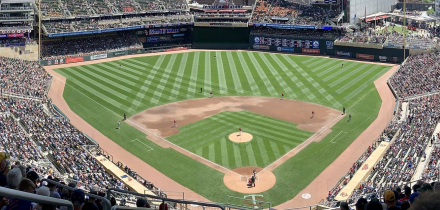
A key point is that, in baseball, three-quarters of the area around the batter — the 270° winding around behind the batter from one foul line to the other — is foul territory. To get a hit, batters must hit the ball into fair territory in the 90° part of the angle. Essentially, only one-quarter of the field is useful to the batter.
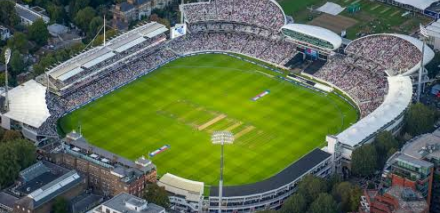
🏏 In cricket, the game is played on a large generally oval field that varies in outline from circular to rectangles with rounded corners. The diameter varies from 450 to 500 feet (for men’s cricket; smaller for women’s cricket).
In almost all cases, the field boundary is round without sharp corners. The boundary can be marked by a thick rope, a series low padded triangular-cross-section pieces, or even by a small picket fence. As in baseball, the boundary plays a significant role in scoring runs.
[Cricket is a bit unique in that the rules don’t specify a fixed shape for the cricket field. In contrast, football (both kinds) and basketball have detailed rules about the playing field; all fields are the same. Baseball falls between; the bases and foul lines are specified, but the shape of the outfield fence is not (the rules only specify minimum distances from home base to the foul poles).]
In the center of the cricket field lies the cricket pitch, defined by the rules as a rectangular strip 66 feet long and 10 feet wide:
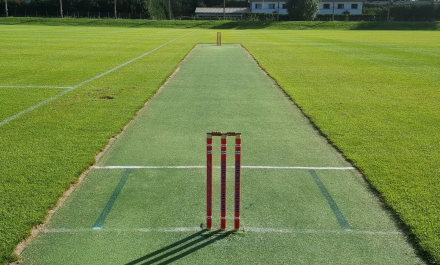
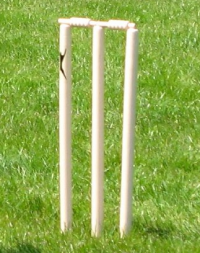
It’s covered in very short grass or dirt. At each end there is a wicket: three vertical stumps (28 inches tall, 4.5 inches separation) supporting two bails laid across the top (they sit in shallow grooves on the top of the stumps).
Two white lines called creases mark off small rectangular zones (also called creases) at each end of the pitch. The innermost lines on each side (called the popping creases) are considered to extend all the way to the boundaries and thus divide the field into three zones: two outer zones separated by an inner zone, not unlike a fat hamburger:
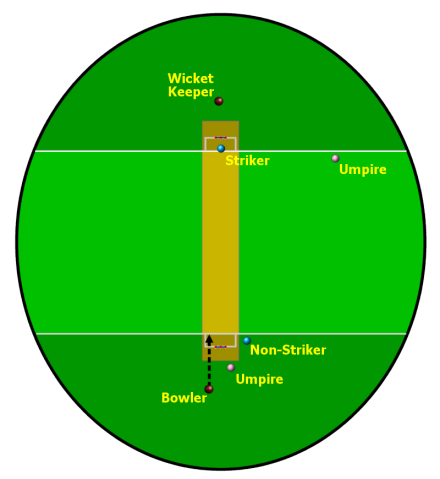
The above is a schematic and not to scale. In particular, the black boundary should be much further away, and the white popping creases are not actually drawn across the field. The diagram includes the only required player positions: the two strikers (blue), the bowler and wicket keeper (dark red), and two umpires (pink). Not shown are the other nine defensive players scattered about the field.
I’ll discuss the players and game play in more detail below. For now, in baseball terms, think of strikers as batter-baserunners, the bowler as the pitcher, and the wicket keeper as the catcher. (The umpires, of course, are umpires.)
The strikers (aka batsmen aka batters) are safe in the upper and lower dark-shaded zones; think of them as giant baseball bases. When the ball is in play, strikers can be put out if they are in the middle zone. (Note that the shading is for illustration on the diagram; the field itself is just grass.)
Game Structure
⚾ In baseball, a game consists of nine innings. In each inning, one team — the away team —bats first (the top of the inning) and gets three outs. Then the home team bats, also getting three outs (the bottom of the inning). A team continues to bat until they have three outs, so — in theory — an inning can last indefinitely.
[Technically, an inning is comprised of two half-innings or frames, but colloquially (and confusingly), players and fans sometimes refer to a half-inning as an inning.]
After nine innings, the winner is the team with the most runs.
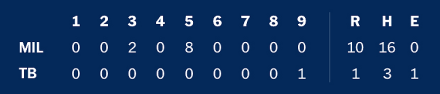
However, if the home team is already ahead by the bottom of the ninth, the game is over without anyone batting. If the home team is behind (or tied), runs scored that put them ahead immediately end the game (before three outs).
Regular baseball games cannot end in ties. The teams play extra innings until one team is ahead after a full inning. Again, in the bottom of the inning, if the home team scores and gets ahead before three outs, the game ends. In theory, a tied baseball game can last forever. In practice, 18 or more innings is rare. The new ghost runner rule makes extended games even less likely.
🏏 In cricket, the structure is quite different and depends on the type of cricket being played. In Twenty20, aka T20, a popular (and modern) form of cricket, each team gets a single innings comprising 20 overs. These innings last about 90 minutes, so T20 games last about three hours. This makes them comparable to baseball in terms of game time. Other forms of cricket can involve much longer games (in first-class cricket, three days or more).
As with baseball, the team with the most runs wins. And a final innings can end early if the batting team gets ahead. Different from baseball, tie games are possible and allowed; there is no concept of extra innings.
⚾ A baseball inning is structured in terms of nine players taking turns having at-bats in which they either reach base safely (and become baserunners) or are put out. Each at-bat is limited by, at most, either three strikes or four balls. (At-bats are prolonged if the batter hits foul balls after having two strikes.)
Batters come and go fairly quickly and occasionally have more at-bats in a single inning (so long as the team doesn’t get three outs). Batters typically bat again in latter innings, limited only by being replaced, either due to injury or to being substituted for another player from the bench.
🏏 In a cricket innings, each batter gets only a single chance to bat, but that chance continues until they are put out by the defense. They cannot return to the game in that innings. A cricket team comprises eleven players, and one way an innings ends is when ten of the eleven are put out.
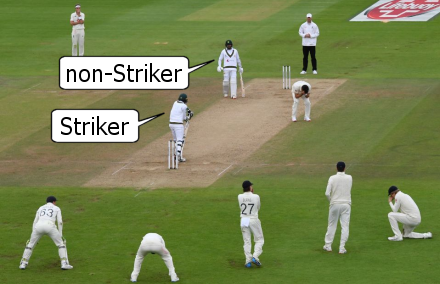
Why only ten? Because in cricket there are always two batters on the field. One, the striker, is the one currently batting. The other, creatively called the non-striker, is a kind of alternate batter/runner.
More to the point, when ten of the eleven players are out, there cannot be two batters, so the innings is (pardon the pun) over.
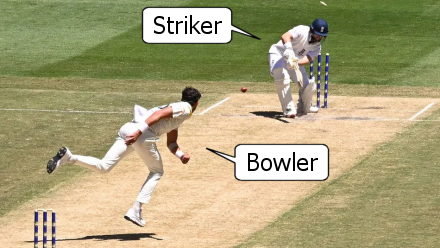
Speaking of which, a cricket over is six legal deliveries of the ball to a batter by the bowler. After six balls, another player must become the bowler. Two players can alternate bowling overs, but the team usually includes more than two players who specialize in bowling. Various forms of limited overs cricket restrict the number of overs per innings. As mentioned, T20 cricket, has 20 overs in each innings.
Note that, as in baseball pitching, how a bowler delivers the ball is specified by the rules in detail. In particular, bowling is not throwing. Very different from baseball, the bowler nearly always bounces the ball off the ground before it reaches the batter. Also, a bowler starts some distance back from the pitch, strides or runs up to the crease, and bowls the ball to the batter standing in the opposite crease.
Besides the bowler and wicket keeper, the other nine members of the defensive team take various field positions. These players can stand anywhere in the field the situation demands (though there are traditional fielding positions).
Generally, teams have some players good at batting and some players good at bowling. Those good at batting go first in the offense innings. Those good at bowling rotate overs in the defense one(s).
Strikers remain on the field and continue to bat until put out (be dismissed), so any given striker can be responsible for lots of runs (a century, 100 runs, is a career batting statistic, perhaps roughly akin in rarity to hitting a grand slam).
- Ten batters are put out.
- In limited overs cricket, after a given number of overs.
- In the last innings if the batting team scores enough runs to win.
- Various other circumstances (bad weather, for instance).
Game Play
We have so far: two strikers, a bowler, a wicket keeper, and nine fielders. An innings divides into overs — six legal deliveries of the ball by a bowler.
And frankly, this is where cricket does get a bit complicated. Part of it is the different styles of bowling, but (for baseball fans) the bigger part is how different bowling and batting is in cricket.
Note on the schematic diagram above how the striker is standing relatively close to the center of the field. In cricket, there are no foul lines nor any foul territory. The striker can hit the ball in any direction.
There is also no notion of a strikeout. There is no strike zone, as such; the batter swings at the ball or not. But the bowler is trying to hit the wicket behind them (which dismisses the striker). The batter uses the bat to defend the wicket (they cannot use their body). Hit balls create an opportunity for the strikers to score runs.
Which can happen in three ways:
- On a ground ball fielded by an outfields, when the two strikers have time to run one or more times between the creases before the ball is returned to the infield and used to knock down the wicket. Each time counts for one run. The strikers stop running once the ball is returned to the infield where it can be used to knock down the wicket.
- On a ground ball not fielded before it reaches the boundary, no running is required, and four runs are awarded (called a four). It’s as if the strikers had time to run back and forth four times.
- On a fly ball that crosses over the boundary without touching the ground. Again, no running required, and six runs are awarded (called a six). It’s the baseball equivalent of a home run. (As an aside, in cricket, fans must return the ball to the field. In fact, changing the ball is kind of a big deal in cricket. If it’s done at all, it has to be replaced with a ball similarly worn.)
Note that in the first case, it’s possible (and common) for there to be only enough time for the strikers to safely cross the pitch once. In which case, the former non-striker becomes the striker (and vice versa). This switch of strikers also occurs when three runs are scored.
A striker is dismissed (out) when:
- As in baseball, the a fly ball that is caught by a defensive player. The striker is said to be caught.
- A defensive player holding the ball knocks the bails off the closest wicket while the strikers are between the popping creases (similar to catching a baseball player off-base). The striker is said to be run out. A common play is for an outfielder grabbing a ground ball to throw it to a player standing near one of the wickets. That player knocks the bails off the wicket.
- The bowler hits the wicket behind the batter and knocks off the bails. In which case the striker is out (is bowled).
- The striker’s legs block a ball that would have hit the wicket. If the ball is blocked from the wicket by the batter’s body (given the height of the wicket, that means their legs), and would have hit it otherwise, the batter is out in what’s called leg before wicket (lbw).
- The striker is caught in front of safe zone and the wicket is knocked down by the wicket keeper after catching the bowled (but unhit) ball. In this case, the striker is stumped.
- Various uncommon circumstances (see the dismissed link above).
Unlike baseball, where the batter gets a base on balls (walks) after four balls, cricket has no strike zone, and hence no notion of balls and strikes. But if the bowler delivers the ball such that the umpire judges it out of reach for the batter, the delivery is called a wide. The batting team gets one run (but the batter doesn’t get credit for it). A wide is an illegal delivery and does not count against the six balls of the over (it’s a do-over for the bowler).
The other type of illegal delivery is a no-ball. The umpire calls a no-ball when the bowler breaks any of the many rules dictating the bowling action. As with a wide, a no-ball doesn’t count against the six balls of the over and it grants the batting team a run.
There are some interesting details that go along with wides and no-balls. For instance, if a wide isn’t fielded by the wicket keeper, the strikers can try to earn additional runs. If the ball is really wide, isn’t fielded, and reaches the boundary, the offense gets five runs (the wide plus the four).
Putting It All Together
In the basic unit of action on the field, the bowler delivers the ball and:
- [Six] The batsman hits it over the boundary without it touching the ground. Six automatic runs (strikers don’t actually run).
- [Four] The batsman hits it along the ground to the boundary without it being fielded. Four automatic runs.
- [runs] The batsman hits the ball along the ground within the field, and the strikers are able to safely run between creases one or more times.
- [dot ball] The batsman swings and misses, or doesn’t swing at a legal delivery, or swings and connects but the ball is too quickly fielded for the strikers to run. No runs.
- [wide] The ball goes wide of the batsman and is judged a wide. One automatic run. More runs if the strikers can run or the ball reaches the boundary. Bowler must repeat the delivery.
- [no-ball] The bowler errors in delivery and must repeat it. One automatic run. More runs possible in some circumstances.
- [caught] The batsman hits a fly ball that is caught. Batter is out.
- [run out] During a fair hit, the strikers are caught away from the crease when the wicket is knocked down.
- [dismissed] The batsman is out for other reasons (see above).
It might seem a lot, but baseball has a similarly long list of possible outcomes for every pitch. And no doubt I’ve left some edge cases out of this list.
When a batsman is put out, he leaves the field and is replaced by another player from the eleven-man team. When ten batsmen are out, the innings is ended.
As in baseball, batters get career stats credit for runs they generate, but it is the team’s total that matters (also as in baseball). Unlike baseball, wides and no-balls give the team runs not credited to any batter (these are called extras).
Some Last Notes
• Even more than in baseball, sporting behavior is required of everyone involved (this is a British sport, after all). There are rules of comportment and, as in baseball, unwritten rules as well. Because of this, cricket is to some extent held forth as the epitome of good sporting behavior. The phrase “that’s not cricket” can refer to anything viewed as unfair or unsporting.
• I like it that women’s cricket is played the same way as men’s cricket with the sole exception that the boundary is a bit closer. The diameter for men’s cricket is usually between 450 and 500 feet; the minimum allowed is 195 feet from the center of the field. The diameter for women’s cricket is usually between 360 and 420 feet; the minimum is 180 feet from center.
Other than that, as far as I know, the game is played the same by men and women.
• One confusing thing about cricket is the term wicket. Properly speaking, it refers to the three stumps with two bails across their tops. The defense can hit the wicket with the ball to knock bails off and put out the striker. Because of this, the dismissal of a batter is known as taking of a wicket, or just a wicket. In this usage, it means an out.
To make things more confusing, sometimes the cricket pitch is called the wicket. You may have heard the term sticky wicket, which contrary to some beliefs, does not refer to the stumps-and-bails at all but the pitch being damp and soft, thus hard to run on. It means sticky in the adhesive sense, not the stuck sense.
• As in baseball, cricket terminology is old and rich. The Wikipedia List of Cricket Terms is quite long and interesting.
§ §
What do you think? Were you already familiar with cricket? (If so, did I get anything wrong? Did I leave anything critical out?) If you weren’t familiar with the game, does it makes any sense now?
FWIW, you can find a cricket streaming channel (Willow) in Amazon Prime’s Live TV lineup. As I discovered, actually seeing the game played means a lot.
Stay cricket, my friends! Go forth and spread beauty and light.
∇






November 11th, 2026 at 11:20 am
I’m trying to decide which is the worse crime against humanity, cricket or soccer
😉
November 11th, 2026 at 12:00 pm
Compared to genocide and slavery, I think the difference is pretty much lost in the margin of error. Is it just cricket and soccer? What about baseball, (American) football, basketball, hockey, tennis, golf, et cetera?