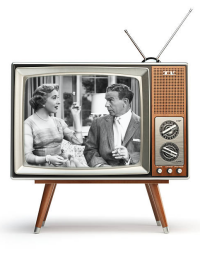
 For some time now I’ve been pondering the role of television in our lives. As with all human art forms, television definitely reflects us. The challenging question is how much it affects us.
There seems little question it affects us in the short term. It can make us laugh or cry. It can make us feel romantic, thrilled, or angry. Presumably we return to normal afterwards, but does long term exposure to television’s peculiar form of reality affect how we think?
I wonder if the real question is how can it not?
This is the first of a series of “by the seat of my pants” posts exploring my perceptions of how television has (indeed) affected our thinking and by extension our culture. My gut sense (for what little that’s worth) is that, given some nuances, the effect hasn’t been positive overall.
We’ll see how it goes, though. I’ve had notes on this for ages and a draft started seven months ago that I couldn’t seem to whip into sensible shape. Television has been in our lives for four generations, so it’s a huge topic to try to get a handle on.
Therefore, not letting perfection (or anything close) be the enemy of semi-adequate, I’m gonna do the modern thing and mostly just wing it (along with my usual wingman, Wikipedia).
And now, on with the show…
Intro
Many streaming platforms offer older TV shows, and this turns out a mixed blessing for me. On the one hand, the warm nostalgia of seeing those shows after so many years. On the other hand, a growing and painful awareness of how bad most of those sitcoms were.
By “bad” I mean:
- Dumb plots and dumb characters.
- Characters lying to friends and loved ones.
- Childish behavior in adult characters.
- Snarky, cutting dialog treated as normal.
The list isn’t ranked because all four bullet points disturb me equally. They’re bad enough as just reflections of our culture. That they might present a social norm people emulate worries me.
Dramas don’t usually have these issues the way comedies do because the latter leverage them for comic effect. (The snarky dialog infesting action movies exists for comic relief.) There is also that lying in dramas typically has dramatic consequences compared to comedies where all is forgiven and forgotten by the end of the half hour.
I’m not saying dramas aren’t worth examining, but for now I’m exploring television’s situation comedies, our beloved sitcoms.
Today is a good day to begin. Exactly 80 years ago, on November 29, 1946, the BBC aired what is considered the world’s first sitcom, Pinwright’s Progress. It starred James Hayter as Mr. J. Pinwright, owner of the “smallest multiple store in the world” and comprised only ten 30-minute episodes. Each episode was broadcast live (as was common then) and no recordings survive.
The show established the sitcom mode of recurring characters, situational humor (as opposed to context-free jokes or gags), and episodic storytelling (originally usually without arcs over episodes). One axis I judge sitcoms on looks at situational humor versus gag lines and snark with the former being preferred.
The first sitcom in the USA was Mary Key and Johnny, which aired from November 18, 1947, to March 11, 1950 (starting just shy of one year after Pinwright’s Progress). It was created by and starred Mary Kay Stearns and Johnny Stearns, who both played and were a married couple.
So, sitcoms have been a part of our culture for 80 years — four generations. Most of us grew up with television as a constant presence, the family storyteller, often the family babysitter. To the extent we accept the world it presents as real (or at least realistic), which modern filming technology makes very easy, how can it not affect the way we think, see the world, and interact with each other?
Our love of stories (because we love fiction) addicts us to TV (and movies and books). We’re drawn to narrative. With the editing and music of modern media, we experience these stories in a realistic and immersive way, so I think it’s hard to argue it doesn’t affect us. To a close approximation, television and movies offer us a brand of reality to inhabit.
The Effect of Television
Television obviously reflects us. The question here is how much it affects us.
The topic is controversial and much debated. With the rise, first of cable, and now of streaming platforms, the question seems ever more pressing (and yet somehow faded from public consciousness).
We’re ready (and pleased) to accept that Star Trek’s Lt. Nyota Uhura (played by Nichelle Nichols) inspired young Black women towards STEM careers, and that the show in general pushed young viewers towards STEM careers, but we often resist the idea that negative portrayals and behaviors can be likewise inspiring.
Negative portrayals aren’t always in obvious villains — and thus coded as negative — but are often found in regular characters. One aspect of this is the high degree of idiocy often required in sitcoms to enable the humor (idiot clown comedy). Another aspect is the high degree of deceit practiced by characters, usually with people they supposedly care about. These behaviors are frequently coded as endearing human traits.
[Which to some extent is true, but I wonder if we’ve gone too far in pulling everything down to the lowest common denominator and in the process have lost sight of our higher values. We went from Casual Fridays to Grunge World.]
There is also the snarky way sitcom characters talk to each other, the snark being meant as humor but note it’s almost always put-down humor. One thing that bothers me is how it is treated as normal dialog. The characters often don’t react to the snark and gags, either by taking insult or by laughing. I worry that it normalizes such dialog. (It certainly seems to have worked its way into politics.)
One thing I think made Cheers (1982-1993) a superior sitcom is how authentic the characters were in reacting to each other’s put-downs and snark. Watch how Diane and Carla interact, for instance. Compare that to most sitcoms where such dialog is treated as unremarkable.
That same authenticity of characters is found in M*A*S*H (1972-1983), another classic (and a personal favorite; see Hawkeye & Margaret).
Both shows lasted eleven seasons, and I think the authenticity and lack of endemic idiocy are part of the reason. I’m not saying those characters didn’t take a stupid pill once in a while (don’t we all), but they were generally people I would like to have been friends with. They came off as real, not surreal.
And hence their ability to affect our thinking.
Looking at the putative effect of television on us, it’s important to keep in mind that our background as viewers makes a huge difference. I’m sure those with considerable depth and breadth in their experience of fiction and humanity better weather negative influences. It’s viewers with little exposure to anything other than what I’ll call junk-food stories that seem most at risk.
Comedy is Harder than Drama
Digging a little deeper into comedy versus drama, I see two key differences:
Firstly, comedy is harder than drama. Making people laugh is a heavy lift — it goes beyond basic storytelling. Drama, except for science fiction, often reflects life as we know it. The stories may be exaggerated, even lurid or melodramatic, but at root they involve (mostly) realistic people in (mostly) realistic situations. Often dramas are judged in part by their realism.
There is an acting truth that comedians can usually successfully transition to drama, but dramatic actors often struggle with comedy. (Leslie Nielsen was a surprise exception that proves the rule.)
[But exactly how does an exception prove a rule?]
Secondly, comedy is frequently surreal or absurd. We accept ridiculous premises, situations, and behaviors we’d generally find difficult to swallow in dramas. The need for verisimilitude in how people are and act doesn’t exist as much in comedy. Yet, because the actors are real people, and the contexts equally realistic, sitcoms can be as immersive and engaging as dramas.
I think because comedy is hard, and because we often give the writing a pass for the sake of the joke, a great deal of comedy ends up too stupid (for me, anyway). My canonical example is The Three Stooges, who I always found too idiotic to watch. I see slapstick as the lowest form of comedy and have never liked it.
[Yes, absolutely there is a genius in the execution, but they starred three unbelievable idiots who were frequently abusive to each other. Even as a kid in the 1960s I wondered what people saw in them.]
Contrawise, I consider Airplane! (1980) tied with Monty Python and the Holy Grail (1975) for Funniest Movie Ever. (In both cases, when I saw them for the first time in the theater, I actually hurt myself laughing so hard.) What makes these sing to me whereas I am left stone cold by The Three Stooges? I think it’s because there actually is a high amount of intelligence and extraordinary writing evident in them and often in (at least some of) the characters.
The truth is, any form of comedy, indeed any form of writing, works when it is done well. That said, the requirements and constraints of sitcom comedy can act against good writing. If comedy is hard in general, sitcoms may be one of its most difficult forms to pull off not just well but consistently, in part due to the need to create lots of episodes.
Shows such as Cheers and M*A*S*H illustrate the heights sitcoms can rise to with quality writing. Sadly, Sturgeon’s Law applies, and such as these are rarities.
All the Lying!
The last year or so I’ve been slowly working my way through Bewitched (1964-1972). Back when it first aired, I was just hitting puberty and had a major crush on Samantha Stevens [see Childhood Crushes]. That crush endured throughout my life but is ever so slightly threatened now by my realization of Sam’s frequent deceits. And Darrin’s, and everyone else’s on the show.
And most shows. It’s nothing new, and it apparently never gets old.
Gracie and George often lied to each other in The Burns an Allen Show (1950-1958). Which, by the way, if you’ve never seen, you should seek out a few episodes. Burns and Allen were a famous married couple comedy duo that started in vaudeville and went on to film, radio, and television.
Lucy and Ricky also often lied to each other in I Love Lucy (1951-1957), yet another sitcom (the third so far mentioned) featuring a real-life married couple.
[Star Trek fans are forever indebted to Lucille Ball (1911–1989) because, without her, the Original Series would never have seen the light of day (see this Wiki link for details).]
As I said, it never seems to get old and is a staple in most sitcoms. It’s endemic. It often appears as a character trying to save face, or to “protect” someone, or to pretend to be someone else (either contra their established character or to actually spoof some other character).
Cheating is a form of lying, and for whatever reason, Americans often see various forms of cheating as acceptable behavior. For example, cheating on taxes is often admired as a win for the cheater. Drivers routinely cheat on speed limits (guilty but not excessively). Cheating in school, finance, and business is all too common.
“It’s just fiction,” and fair enough, but whatever the case, it’s impossible to deny that our culture, perhaps more than ever in history, is awash in spam and phishing. We’re constantly fending off the deceitful, not just those promoting a (perhaps questionable) product, but those practicing outright thievery [as happened to me this year].
So, does all the deceit on television merely reflect our casual dishonesty, or does the constant miasma of its depiction actually affect how we think about it? Specifically, does it normalize it and make it more acceptable?
[I suspect an unresolvable nature/nurture debate here.]
§
That’s enough for now. Not sure when I’ll pick this up again, but I do have more notes, so “Ah’ll be back.”
§ §
In closing, two things about Bewitched:
Firstly, the usual superhero paradoxes regarding powers — what they are, how powerful they are, when they work or not. Often these are due to the particular story. The inconsistencies and contradictions have bugged me since I was a kid reading Superman comics.
Secondly, what is Darrin’s problem? It would be amazing to be married to a real witch with magical powers! [In my imagination, she finally ditches Darrin and opens a Subway…]
Stay witchy, my friends! Go forth and spread beauty and light.
∇







You must be logged in to post a comment.