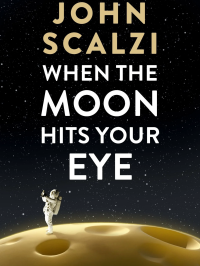
 I’ve posted quite a few Sci-Fi Saturday posts devoted to specific works, but it has been almost exactly four years since the last post carrying the “Sci-Fi Saturday” title. Such posts usually cover a number of works and therefore need a generic title.
As mentioned last post, I’ve been in a bit of a blogging lull lately. One reason is that I’ve been reading and watching a fair amount this summer. Much of it, of course, is SF, so there is plenty to record here today (hence the generic title).
Starting with a seriously strange book.
I’ve posted about John Scalzi (1969–) before. I first encountered him back in 2019 when I read his wonderfully delicious Star Trek pastiche, Redshirts (2012) [see Scalzi: Redshirts]. I originally read it as a library loan but liked it so much that I bought it and read it again.
[I was a very young teenager when Star Trek aired the late 1960s and already a science fiction fan, so the show was ambrosia to me.]
A few months later I read and really enjoyed (and also bought) The Android’s Dream (2006) [see A Bit of Huang and Laurie for more details].
So, I was thinking, “I really like this Scalzi guy,” but in early 2021 I read his Interdependency trilogy and didn’t care for it [see Scalzi: The Interdependency]. In his defense, he wrote it during COVID and confesses it wasn’t his best work. It did put me off trying his Old Man’s War series, at least until I really need something to read (and there is always a lot in the queue).
Later in 2021 I read his Lock In books, Lock In (2014) and Head On (2018). I recall liking them okay. Overall, I was still thumbs-up on Scalzi.
Still am (very much so) after reading When the Moon Hits Your Eye (2025) — definitely one of the stranger books I’ve read. As hard SF goes, this one is about as hard as a warm brick of brie. It might be labeled as magical realism, but I’m dubious. I see it more as straight-up surrealism.
Except that it’s entirely realistic except for its central premise: one day, during the moment of the new Moon, the Moon — along with all the Moon rocks on Earth — turns into (a never-specified type of) cheese. What NASA throughout insists on calling “an organic matrix” of some kind.
[One of the really clever things about the story is that Scalzi never specifies the type of cheese, and NASA never admits that it even is cheese (though it clearly is).]
Each chapter is one day of the lunar cycle, and they are episodic in character and style. Most introduce a new character and describe their reaction to the change. A few characters appear in several chapters, but most don’t. Various chapters are presented in different styles, chat messages or news reports, for instance.
I won’t spoil the ending, though if you have a strong sense of narrative, you might guess at what happens (I did). I want to mention that a key tension point involves a consequence of a cheese Moon. Being organic, it compresses under its own weight and begins to heat up. This disassociates the “organic matrix” resulting in, among other substances, a fair amount of greasy water. Which the heat turns to steam. Which results in huge steam geysers. One of which blows a very large chunk of “organic matrix” away from the Moon.
And towards Earth. It’s much bigger than the dinosaur killer asteroid, so it looks like life on Earth’s near-term fate is to die due to cheese bombardment.
Very hard to put down and it gets a Wow! rating.
§
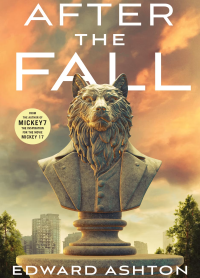 Despite having read (and enjoyed) six of his books, I haven’t posted much about Edward Ashton (1968–). Poor guy, he doesn’t yet rate a Wikipedia page even though one of his books was adapted into a recent movie.
The sole time I wrote about him [see TV Tuesday 12/9/25] was to express my strong dislike of that adaptation, Mickey 17 (2023), which is based on Ashton’s Mickey7 (2022). As is usually the case, the book is much better. And it has a sequel, Antimatter Blues (2023). Ashton may not have gotten a Wikipedia page, but those two novels of his did (I assume because of the movie).
Since then — this year, in fact — I’ve read four more of his books and liked them all. In order of reading:
The Fourth Consort (2025) is a dark comedy billed as “part first contact story, part dark comedy, and part bizarre love triangle” and that it “asks an important question: how far would you go to survive? And more importantly, how many drinks would you need to go there?” I found it an offbeat enjoyable space opera.
Mal Goes to War (2024) is about an Ai (named Mal; guess what it’s short for). Mal lives in cyberspace and mostly ignores the human world. Which, in America, is divided in a bitter civil war. When digital links are cut, Mal is trapped in the body of a cyborg in that war. A fun romp.
The End of Ordinary (2017) is about a genetic engineer. And corn. And a dark conspiracy. Turns out there’s more going on with a seemingly harmless strain of genetically engineered corn. Inventive. Very inventive.
After the Fall (2026) is about an alien invasion that happened one hundred years before events in the book and twenty years after the supposed fall of human civilization. The aliens — the “Greys” but think elephants not super skinny dudes with huge eyes — claim they saved us from Certain Doom. In return, they treat us as pets. One book blurb reads:
Humans must be SILENT.
Humans must be OBEDIENT.
Humans must be GOOD.
Another asks ‘would humans make good pets’ (and I’m pretty sure narrative determination pre-answers that one; this is a humans über alles story). As with all Ashton’s books so far, I found this an enjoyable read and an interesting rumination on pets. I give it an Ah! rating.
Reminds me a bit of a story idea I had long ago told from a dog’s point of view but without revealing the main character is a dog. I wanted it to come off as if a human was living among gods (or hugely powerful aliens). I’ve long wondered what it is like for dogs to live with these magical beings that provide food, shelter, and love [see Animal Gods].
§
 I’ve mentioned William Gibson (1948–) here a number of times [see this list of posts]. Last year I wrote a TV Tuesday post about the Amazon adaptation of his recent novel, The Peripheral (2014), the first book of an intended trilogy.
[“Recent” in terms of his body of work. As in that and the second book is all he’s written in a while. In his defense, he’s 78. We may never see the third book.]
I only read the first book because of the TV series. I put off reading the second book, Agency (2020), until the third book was out.
[I learned a lesson regarding incomplete series back with the Riverworld books by Philip José Farmer. I learned it good and proper with The Wheel of Time books by Robert Jordan (which I bailed on around book eight after book six in which almost nothing happened). I prefer a series to be complete so I can read them all.]
After deciding I might never see Jackpot (TBD), the third book, I decided to read Agency. Which turns out to be only somewhat related to The Peripheral; only a few characters from the future timeline appear. Even so, I wanted to reread the first book.
As I have said before, Gibson can be a challenge to read. His descriptions and dialog often require some parsing. I’ve found it’s usually worth the effort. He does fulfill my primary ask with stories: take me someplace different.
One thing I like about the Jackpot series (interesting that the series is named after the last thus-far unwritten book) is that it handles time travel, normally an incoherent notion, in the only way it could make any physical sense at all. When you reach out to the past, from that moment a new timeline is created that branches off your past into a new future (because in your past, no such time travel occurred). This removes the time travel paradoxes: killing your ancestor or receiving new information from nowhere.
That said, three good time travel movies: Looper (2012), Primer (2004), and most recently, Beyond the Infinite Two Minutes (2020). The first one is my favorite time-travel movie (stars Bruce Willis and directed by Rian Johnson). The second one is perhaps the best time-travel movie ever made but is opaque and requires a guide to follow (plus, it’s hard to find). The third one is a delightful treat, a low-budget indie production from Japan that I’ve seen three times and enjoyed each time [see Infinite Two Minutes].
§
I read two books that didn’t do much for me…
§
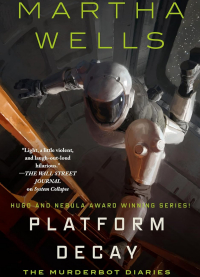 The first, Platform Decay (2026), by Martha Wells (1964–), was merely kinda repetitious and not hugely creative. Sort of a standard characters-need-to-invade-hostile-territory-and-rescue-someone(s)-or-steal-something story. It’s the eighth and most recent novel from her The Murderbot Diaries series (which also sports a few short stories).
After reading eight of these, I’d give the whole thing an Eh! rating. Diverting if you like them, increasingly boring if you don’t.
The titular character, Murderbot, is a highly weaponized cyborg with a very negative attitude towards humans. He would vastly prefer to be watching his shows (which he downloads from “the feed” by the gigabyte). His bad attitude comes, in part, from being a product that is rented out as a security “consultant” (aka muscle). Such units always contain a “governor module” that essentially enslaves them to their owners and users.
Murderbot has managed to eliminate his governor module and is essentially free. But if anyone found that out, he’d be destroyed immediately. Self-willed advanced weapons systems with serious infiltration skills are too big a threat.
The series has been adapted on Apple TV (which I don’t, and won’t, subscribe to, so can say nothing about it).
§
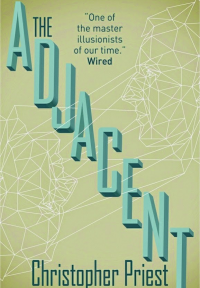 I actively disliked the second book, The Adjacent (2013) by Christopher Priest (1943–). Which is a pity because I rather liked The Prestige (1995). And, for that matter, the same-named movie adaptation by Christopher Nolan [see TV Tuesday 2/24/26].
Priest is more a literary author than a science fiction author (even more so than Iain Banks), and I’m not big on literary science fiction. Some of it is good, even excellent, but a lot of it… well, maybe those authors should stick to their lane and leave SF to those with a better feel for it. [See, for instance: VanderMeer: Annihilation and “King”: FKA USA.]
The story takes place in three different times: the near future, the present, and one-hundred years ago. It’s sort of a Many Worlds Interpretation story; in the present a theoretical physicist develops a new way of diverting matter, and this ends up having consequences that echo through history.
This may say more about me than the author, but I found it incoherent and incompetent. And the diverting matter thing seems too much an echo of the SF gimme from The Prestige. Also from that book, the trick of including some genuine historical characters (Tesla in The Prestige and H.G. Wells in this one).
It gets a Meh! rating, though I might try some of his more highly regarded books (Wiki does not list The Adjacent among his Notable Works).
§
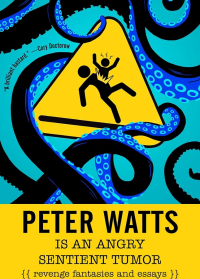 I haven’t yet made up my mind about Peter Watts (1958–). Perhaps it says something that one of his books, a collection of short stories and essays is titled Peter Watts Is an Angry Sentient Tumor: Revenge Fantasies and Essays (2019). The “angry sentient tumor” in question is his brain — which is perfectly normal (within the broad spectrum of humanity) but which he views as a malignant growth, an evolutionary adaptation, that complicates life for us all.
Besides a couple of short story collections, I’ve read three of his novels this year. My mixed feelings come from the combination of inventive ideas told in seriously depressing and dour ways. His text — almost every adjective or adverb — reeks of negativity. And his characters and plots aren’t particularly loveable.
But he certainly is creative.
The Freeze-Frame Revolution (2018) takes place on a spaceship that is run by an Ai and has multiple crews in deep freeze that can be revived when human hands are necessary. The story involves a rebellion by the humans under the watchful “benevolent” eye of the Ai. It’s a slow-motion rebellion because the rebels are only awake for short periods.
Starfish (1999), his first novel and one that received some acclaim, is about a crew of people physically altered to work maintaining a power station on a deep-sea rift (using the heat to generate electricity). It’s mainly a psychological study that considers the type of people they selected and the effect of deep-sea isolation and rapture. It began as a short story, was expanded into a novel with a number of sequels.
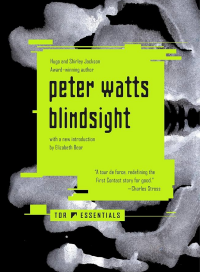 Blindsight (2006) received even more acclaim (and has its own Wiki page). This is another people-on-a-spaceship story. At its center, the main character, Siri Keeton, is a philosopher’s zombie. (Usually referred to as a philosophical zombie, but that’s a nonsensical notion because these zombies, or any zombies, are far from being philosophical.)
If that wasn’t enough, the ship’s captain is a vampire. A real one. Seems vampires are an ancient subspecies of humans that died out long ago due to their life-threatening aversion to right angles (which never appear in nature). But their species was revived because vampires are a bit like the Mentats in the Dune books: their brains are superior in data capacity, judgement, and speed.
Making the philosophical atmosphere pretty thick, the ship is named Thesus. Siri, the main character (and narrator), because half his brain was replaced with machinery when he was a child, is effectively the “Chinese Room” described by John Searle [see The Giant File Room for my post about it].
The book is certainly of interest to anyone interested in consciousness, though I think those with little exposure to it would get more out of it. It was interesting, but I can’t say I learned anything or found any new ideas for consideration.
I will say I’m mostly thumbs-up on Watts, but his writing is very dour and dismal. It may be understandable given his personal history (which includes contracting a flesh-eating disease). From his point of view, it may indeed seem the universe is only a cold and bitter place.
Myself, I think there are at least some warm moments by the fire.
§ §
Stay reading, my friends! Go forth and spread beauty and light.
∇








September 5th, 2026 at 2:24 pm
Got the post out in time to start reading Operation Bounce House (2026) by an author new to me, Matt Dinniman, who wrote the popular Dungeon Crawler Carl series (eight books). I thought I’d give Operation Bounce House a try before diving into a series.
September 5th, 2026 at 4:36 pm
I thought DCC was still ongoing?
September 5th, 2026 at 6:22 pm
I assume so, since Dinniman is quite young (born in the 1970s), and the eight book just came out this year. Since the author and the series are likely to outlive me, if I’m going to read the series at all, I might as well do it now-ish. Especially with eight available. I’m not hugely grabbed by Operation Bounce House yet, but I’ve just started. Most likely scenario: I might read a few of the Dungeon Crawler books just to check them out, but it probably ultimately isn’t something I’ll glom onto.
September 5th, 2026 at 4:27 pm
Wouldn’t the cheese melt upon re-entry though? It’s cheese, not an asteroid, so I can’t see it being world ending. Unless Scalzi plays around with physics even more and just ignore reality. I mean, if the moon turned to cheese, our tides would essentially cease and a lot of life would be dying very quickly. In all fairness, I don’t like Scalzi as a person so that affects my perceptions of any of his books. I’ll nitpick with a microscope if I have to 😀
I was a decent Bruce Willis fan and I also liked that kid from the tv show 3rd Rock from the Sun, so it seemed like a decent fit to me. Then I watched it and hated almost every moment of it. I found it depressing on almost every level and the very idea that suicide was the only option? That’s abhorrent, but it fits with Rian J’s world view for sure (just look at the hash he made out of the second star wars movie in the sequel trilogy, he destroyed the franchise beyond recovery). So I have a very different view of the movie than you 😀
I refused to read Murderbot mainly because when they were released they were short (some defined them as novellas) but at a premium price. That annoyed me so I avoided them then. THEN they became popular and so I avoided them because I hate reading what the common herd of readers reads and enjoys (I am a book snob and proud of it). Once the series ends and everyone forgets about it, I’ll probably try it then and then lambaste all those filthy casuals for abandoning the series so quickly after it stopped instead of erecting a shrine of words to the series 🙂
September 5th, 2026 at 6:17 pm
What’s important about things falling from orbit is the mass, size, and composition. Consider how heat shields allow spacecraft to fall to Earth without being burned up. The cheese chunk blown off the Moon was huge, many kilometers in diameter, plus it had a higher moisture content than rock. So, the leading surface would heat and burn away, but the larger mass would be relatively unaffected. Heat takes time to move from a hot front surface kilometers into the larger mass, but the thing is moving so fast there isn’t enough time for it to heat appreciably.
Ultimately, a very, very large mass hits the Earth going very, very fast. The energy of the impact turns the ground and the cheese to plasma, creating a worldwide firestorm. Life in the deepest parts of the ocean might have a chance to survive (until they starved because life above them vanished).
As for tides, they depend on mass, and the Moon was replaced with an equal mass of cheese, so the gravitational effects are unchanged. This does require a slightly larger Moon. IIRC, the radius expanded by 300 miles. Enough to change a Solar eclipse in the book from annular to total.
There is a contingent of people who really dislike Rian Johnson. Most them, as you say, because of Star Wars VIII. For me, though, he’s the guy behind Brick (2005), The Brothers Bloom (2008), Looper (2012), plus all three Knives Out movies (2019, 2022, 2025), and I’ve enjoyed all of them to one degree or another. As I mentioned, Looper is my favorite time-travel story because it actually makes sense, and for a time-travel story, that’s nearly unique.
That he was part of a trilogy of abominable films doesn’t bother on four counts: [1] Per the above, he makes pretty good films when not forced into mold by Disney and Kathleen Kennedy; [2] I thought all three of the sequel trilogy films were shite (because of the aforementioned Disney and Kennedy plus awful writing); [3] Even so, for my money the franchise was already ruined by the also shite prequel trilogy; [4] I was in my early 20s when Star Wars IV came out (saw it opening night) and never took to it like the younger generation did.
The thing about the original Star Wars trilogy (IV, V, and VI) is that it’s a kid’s fantasy dressed up as space opera. It’s the exciting tale of an evil emperor, who is supported by his powerful black (literally and metaphorically) wizard. It involves a desperate Princess and a lost Prince who doesn’t know he’s a Prince. It has a race of magical beings (warrior elves) who command “the force”. And there’s a white knight on a powerful steed accompanied by his faithful furry squire. Kids have Star Wars pajamas and sheets and wallpaper and toys. It grew beyond that, and some versions are fairly adult, but at heart it’s a kid’s fantasy story. Star Trek was for adults, though the J.J. Abrams era dragged it down into the usual infantile Hollywood bullshit.
That all said, Star Wars IV was a true game-changer. It showed the bean counters that science fiction, usually seen a niche for nerds, could be a huge money-maker. And it has been a big thing in movies and TV ever since. As I posted about, heh, a decade ago, I divide SF into the B.L. era (Before Lucas) and the Anno Stella Bella era (Year of Star Wars).
(Joseph Gordon-Levitt is “that kid” from 3rd Rock. He was slated to be the new Robin in the Batman films, but that ship seems to have sailed.)
I don’t think you’re missing anything with the Murderbot Diaries. If I had to pick a single word, I’d say “pedestrian”. Nothing particularly creative or new, and the writing is nothing to write home about.
September 5th, 2026 at 7:01 pm
I’ve historically enjoyed Scalzi’s stuff, but was underwhelmed by the Interdependency books, and, after Starter Villain, have been taking a pass on a lot of his more recent stuff, including When the Moon Hits You Eye; it just sounds too silly. I did read his latest Old Man’s War, and it was okay. The early books in that series are pretty good (or at least I remember them fondly), but the later ones feel like he’s only doing it because his publisher insists.
I enjoyed Mickey 7 and keep meaning to get back to Edward Ashton; those books sound interesting. We’ve talked about my struggles with Gibson, although I’m looking forward to the Neuromancer TV show, while hoping they don’t screw it up.
The Murderbot books start off well, but I agree, they seem increasingly repetitive. It sounds like she does plan to wrap up the series soon, and I recall seeing some positioning for it in this last book. The TV show isn’t bad, although they lay the hippie nature of the Preservation people pretty thick.
I read Blindsight many years ago and, while it was interesting, it also felt like a slog. Watts’ writing often left me confused. And I agree that his tone is pretty bleak. I recently tried to reread it to get to the sequel, but quickly concluded I wasn’t up for it again.
September 6th, 2026 at 9:32 am
What disappointed you about Starter Villain? I have that and The Kaiju Preservation Society in my Want to Read queue after reading somewhere that they’re “significant” Scalzi novels I should read. For both, my library has them as “Several Months” wait, so they’re apparently popular.
The premise of When the Moon Hits Your Eye is totally surreal, but given that, everything else fits easily under near-future Earth-based hard SF. FWIW, the book is definitely in the Scalzi win column for me.
Ashton, so far, has been in the win column for me, too, six-to-nothing. Easy-breezy style that moves along nicely.
Agree about Watts’s sometimes opaque writing. He’s kind of like Gibson that way. I’m never sure if they mean it to be confusing or if clarity is going over my head. Filmmaker Nicolas Roeg (who did The Man Who Fell to Earth) had the view that we don’t know everything that’s going on in life … so therefore, or in his films. Maybe with Gibson and Watts the confusion is intentional? Part of the mood setting? 🤷🏼♂️
September 6th, 2026 at 2:20 pm
I found The Kaiju Preservation Society entertaining in a light hearted way, but with Starter Villain I got about 40% in and decided it was too Austin Powers for my tastes. I might love it if someone adapted it into a movie, but I didn’t want to spend more time reading it. Just not my type of reading.
Yeah, the premise of When the Moon Hits Your Eye doesn’t draw me in. I might have been okay if it had been a story of some plausible disaster with the moon and its consequences. But turning to cheese? Just not an interesting scenario to me.
I love easy breezy style writing! It makes up for a lot of sins. I just read some old time pulpy stuff and loved it due to the straightforward writing. Wish there were more today doing it that way.
When it comes to confusion, a big part of it for me is: are we confused with the protagonist? If so, I’m usually down with that. When everyone in the story knows what’s going on, but I’m not given enough info to know what the viewpoint character knows? I usually find that kind of fiction annoying as hell. I’ll put up with it if there are other attractions, but only to an extent.
September 7th, 2026 at 5:45 pm
Our tastes in SF have a lot of similarities, but I’ve come to think I’m more open to the silly, light-hearted stuff, whereas you’re more open to the grimmer stuff. Or something like that. I know you’re not a Discworld fan. Have you ever read any Robert Asprin’s Myth series? At the other end of the spectrum, ever read any Stephen R. Donaldson? If not, you might like his stuff. Especially (perhaps) the Gap series.
I bailed on the Matt Dinniman’s Operation Bounce House after reading half of it and failing to be at all engaged with the characters or the story. The first Dungeon Crawler Carl book, which I have on hold with the library, should be available soon, but I’m not holding high hopes for it.
Interesting distinction between confused with versus confused about. Hadn’t really thought about it like that. I think, off the top of my head, with Gibson and Watts, it’s a (deliberately?) opaque writing style that confuses the reader about what the author means along with, in some cases, confusion by the protagonist. With Watts’s Blindsight, either it’s mentioned in the text itself or in something I read about the text, but apparently one should consider it a Unreliable Narrator story. All I can really say about it is that, as interesting as parts of it was, I found it rather a slog that didn’t live up to the billing of being a deep dive into consciousness.
September 7th, 2026 at 7:18 pm
You’re probably right about the difference between us on the silly vs grim spectrum. I actually don’t mind light hearted stories with a serious core, but I lose interest when the premise itself is silly. I’m more forgiving in film and TV, mostly I think because of the lighter time commitment (although the Star Trek:SNW episode I just watched still pushed me over the edge).
I did read one of Asprin’s Myth books and enjoyed it at the time. I used to like those kinds of books (including the Hitchhiker ones) when I traveled, but not so much otherwise. I’ve never read any Donaldson, but have certainly heard about his stuff. Maybe when my tastes cycle into fantasy again.
My cousin read the Dungeon Crawler Carl books and loved them, and I think I have a copy of the first book, but haven’t read it yet. I’ve never heard of Operation Bounce House. Hard to tell from the description if it would be my thing.
The consciousness aspect was what led a lot of people to recommend Blindsight to me years ago. I agree that it’s insights and speculations along those lines are underwhelming.
Is the difficulty of their writing intentional? Not sure. If it is, I would think they could cut it off when they wanted to. I’ve only read one each of their books, so no idea if their other stuff is easier to parse. I will say that it’s a common (and I think cheap) trick to make the text difficult to obscure sloppy plotting or worldbuilding. The idea is the reader fills in the details and ends up crediting the author, which I guess is valid since they did manage to trigger the idea in the reader’s mind, if they can avoid contradicting the reader’s construction.
September 7th, 2026 at 9:22 pm
Which, I take it, is why the Discworld books never attracted you. Flat disc world on four giant elephants standing on an even gianter space turtle. Very silly. Weirdly, that conception of a world is from mythology (different ones, I believe, but definitely from Hindu mythology). Pratchett loved mythology and used a lot of it his writing.
One thing about Donaldson if you explore him is you might want to have dictionary handy, especially for his Thomas Covenant series. The guy has a mind-blowing vocabulary. (One thing I love about e-books is the ability to highlight a word and look up a dictionary definition or even hit up the web.)
Operation Bounce House is about some settlers, farmers, on a colony planet. They got there by generation ship, but once there began construction on a gate for instantaneous transfer (a project that took decades). Now the gate is complete, but the Big Corporations of Earth want the planet for development and the colonists gone. The Big Corp with the job instigated “Operation Bounce House” in which gamers pay to (from Earth) remote-operate combat mechs on the planet. So, Big Corp gets paid to clear the planet and by their “army” for the privilege. At the halfway point, it’s all been from the POV of a farmer and his fellow farmers who live far from the single capitol city. They’ve determined to fight back, so it’s the story of that.
But I’ve read so many similar stories and nothing about the characters or situation (or tech) was engaging me at all, so at the 50% point I bailed. There seemed no mystery behind events, just a hopeless battle against impossible odds, so meh. (The reality is the Earth tech could easily win in a day if not hours, so there are some still artificial restraints like Big Corp supposedly being too stingy for full-on planetary wipeout.)
I think, at least in some cases, some authors just like playing with words. I think Banks is that way, for instance. The Rex Stout Nero Wolfe books I’m reading do that a bit; Stout was a more literary writer than most genre writers. That’s generally where I see the kind of word fest I’m talking about: in the more literary authors. I think that’s what’s going on with Gibson. He plays with language and tries to create something that stands out, something a bit different.
September 8th, 2026 at 8:06 am
That description for Operation Bounce House doesn’t draw me in. I’m sure the farmers fighting evil corporation pushes many people’s buttons, but I definitely need more.
The deficiencies you note sound similar to what I see in a lot of self published stuff. Often they have the shape of a good story, but it’s missing things, like mystery, dramatic tension, characters that you care about, or occasionally even meaningful conflict.
I know what you mean about authors liking word play. It seems like there are two types of authors and readers, those who enjoy pretty words, and those who want good storytelling. I don’t mind nice wordplay, but the story matters to me a lot more, and if the pretty words obscure a lame story, I’ll probably write off the author as not for me.
September 8th, 2026 at 9:38 am
Yeah, self-published books often do seem to me as if they really needed a good editor. (I don’t believe the Murderbot Diaries series is self-published, but I get that vibe from those books, that they need a good editor.)
Likewise. It’s a good thing Banks writes such good stories!
September 8th, 2026 at 11:46 am
Ironically, Martha Wells is a long time traditionally published author, albeit a midlist one until she broke out with Murderbot.
Banks does come up with pretty good stories. I just wish he could convey them with less words! (But then I wish the same thing with Asher, Hamilton, and Reynolds.)
September 8th, 2026 at 12:23 pm
Yeah, I figured anyone with a series adapted to a TV series probably isn’t self-published. 😁
Indeed. I thought his The Algebraist was really good, and I’m looking forward to reading more Culture stories when I have the time for Big Books.
September 8th, 2026 at 12:41 pm
I loved the Algebraist! Very disappointed that he didn’t write any other books in that universe.
September 8th, 2026 at 1:34 pm
Totally. It was a nice change from the Culture.
September 8th, 2026 at 5:59 pm
[…] recent Sci-Fi Saturday post listed the SF books I’ve been reading (so far) this year, and even more recent Mystery Monday […]
September 12th, 2026 at 4:22 pm
[…] The last edition of Sci-Fi Saturday reported on the science fiction books I’ve read recently (for a rather generous definition of “recently”). This edition reports on the recent science fiction movies (and some TV shows, mostly animated). […]