A little Math fun…
Hint: there is more than one answer.
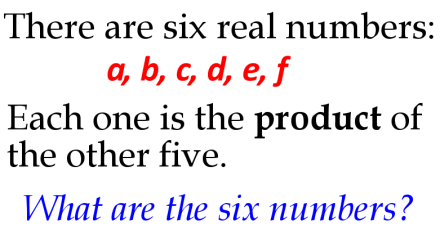
What caught my attention about this is that it’s something of a test of math intuition. Given some experience with numbers, the premise should raise your eyebrows a little. One answer (possibly two) may spring to mind along with the sense of being the only possible answer(s).
Which is basically correct, but there are some variations on one answer that creates additional correct answers.
To illustrate why the above premise should raise your eyebrows, consider a simpler version with just three numbers, a, b, and c, with each the product of the other two. That means we’re asserting:
![{a}={b}\cdot{c}\\[0.3em]{b}={a}\cdot{c}\\[0.3em]{c}={a}\cdot{b}](https://s0.wp.com/latex.php?latex=%7Ba%7D%3D%7Bb%7D%5Ccdot%7Bc%7D%5C%5C%5B0.3em%5D%7Bb%7D%3D%7Ba%7D%5Ccdot%7Bc%7D%5C%5C%5B0.3em%5D%7Bc%7D%3D%7Ba%7D%5Ccdot%7Bb%7D+&bg=f9fbf9&fg=000080&s=0&c=20201002)
We can rearrange the first line to give us a second definition of b:

Considering both definitions means:

We can divide both sides by a to remove it, leaving us with:

Which means c has to be its own inverse, which means c=1. The same logic applies to all three numbers, so it must be the case that: a=b=c=1.
We can verify this with a bit more algebra. Multiply both side by c (and flip the terms around) to give us:

Then take the square root of both sides to give us:

(Which hints at the extended answers, but I’ll come back to that.)
§
An intuition one might have about a bunch of numbers where each is the product of the others is the sense that, if a=b×c, then a must be larger than b or c, so it’s hard to see how b=a×c (or c=a×b) can work.
One might consider the idea of a small b and a large c conspiring to make a medium a, but then that small b can never be the product of two larger numbers.
If one has some familiarity with numbers, the immediate math intuition is the realization that it must be the case that a=b=c=1. This is because multiplication (of real numbers) is scaling: multiplying by less than one reduces; multiplying by more than one increases.
Or in the case of the original problem:

That the numbers are all the same should suggest the second answer:

Which may have suggested itself immediately. Note that all the numbers must be zero. Any non-zero value, say it was d, would give us:

And that applies to all six numbers, so any value being zero means they all must be zero.
§
That last bit of algebra above told us:
Which means we need to consider negative values of one.
In our simple a–b–c example, they can’t all be equal to -1 because -1×-1=+1, but that turns out to be a solution: a=+1, b=c=-1. Note this is the only solution with negative values. A single negative one can’t work; there must be negative values on both sides of the equals sign.
Turning to the six-number puzzle, a quick check shows that this works:

So, in this case all numbers being -1 does work, whereas it didn’t in the three-number example. The difference is because three is an odd number but six is an even number.
The a–b–c example has two numbers to the right side of the equals sign. If both are negative, the result is positive. If one is negative, the result is negative. This leads to all three outcomes:
![{+1}_{a}={-1}_{b}\cdot{-1}_{c}\\[0.3em]{-1}_{b}={+1}_{a}\cdot{-1}_{c}\\[0.3em]{-1}_{c}={+1}_{a}\cdot{-1}_{b}](https://s0.wp.com/latex.php?latex=%7B%2B1%7D_%7Ba%7D%3D%7B-1%7D_%7Bb%7D%5Ccdot%7B-1%7D_%7Bc%7D%5C%5C%5B0.3em%5D%7B-1%7D_%7Bb%7D%3D%7B%2B1%7D_%7Ba%7D%5Ccdot%7B-1%7D_%7Bc%7D%5C%5C%5B0.3em%5D%7B-1%7D_%7Bc%7D%3D%7B%2B1%7D_%7Ba%7D%5Ccdot%7B-1%7D_%7Bb%7D+&bg=f9fbf9&fg=000080&s=0&c=20201002)
In the six-number puzzle, there are five numbers to the right of the equals sign. If all are negative, the result is negative, so a=b=c=d=e=f=-1 is a valid solution.
If three numbers to the right of the equals are negative (leaving two positive), then the result must be negative. That means four of the six can be negative and two can be positive. When a positive number is on the left of the equals sign, all four negative numbers are on the right, so another valid solution is:

The same logic applies for two of the six being negative numbers: When both negative numbers are on the right, the result is positive. When one of the negative numbers is on the left, the remaining one on the right ensures a negative result.
So, yet another valid solution is:

Both are valid because number of negative numbers must always be even. That way, if all are on the right, the result is positive, and if one is on the left, the required negative result is ensured by the now odd number of negative values on the right.
Here, the only choices we have then are six, four, and two (and zero).
§
This gives us five basic answers:
![{a}={b}={c}={d}={e}={f}={1}\\[0.4em]{a}={b}={c}={d}={e}={f}={0}\\[0.4em]{a}={b}={c}={d}={e}={f}={-1}\\[0.4em]{a}={b}=1,\quad{c}={d}={e}={f}={-1}\\[0.4em]{a}={b}={c}={d}=1,\quad{e}={f}={-1}](https://s0.wp.com/latex.php?latex=%7Ba%7D%3D%7Bb%7D%3D%7Bc%7D%3D%7Bd%7D%3D%7Be%7D%3D%7Bf%7D%3D%7B1%7D%5C%5C%5B0.4em%5D%7Ba%7D%3D%7Bb%7D%3D%7Bc%7D%3D%7Bd%7D%3D%7Be%7D%3D%7Bf%7D%3D%7B0%7D%5C%5C%5B0.4em%5D%7Ba%7D%3D%7Bb%7D%3D%7Bc%7D%3D%7Bd%7D%3D%7Be%7D%3D%7Bf%7D%3D%7B-1%7D%5C%5C%5B0.4em%5D%7Ba%7D%3D%7Bb%7D%3D1%2C%5Cquad%7Bc%7D%3D%7Bd%7D%3D%7Be%7D%3D%7Bf%7D%3D%7B-1%7D%5C%5C%5B0.4em%5D%7Ba%7D%3D%7Bb%7D%3D%7Bc%7D%3D%7Bd%7D%3D1%2C%5Cquad%7Be%7D%3D%7Bf%7D%3D%7B-1%7D+&bg=f9fbf9&fg=000080&s=0&c=20201002)
But we also have a number of variations on the last two because we can mix-and-match which of the six numbers are negative.
The fourth answer has a=b=1, but we can also use a=d=1 or c=f=1. Since a=b=1 is the same as b=a=1 (and thus excluded), we’re seeking all possible unique two-number combinations of the six values, a through f. We need what’s known as “six-pick-two” (imagine a box of six items and all the unique ways you can pick out two of them). The (somewhat intimidating) formula and the shorthand form is:

Where n is the number of items (six in this case) and k is the number to pick (two in this case). Therefore:

Giving us 15 variations of the fourth answer.
The fifth answer has two negative numbers, and we can use the same math to give us all variations of two values being negative. Same math, same answer: 15.
We can double-check this by considering all combinations of picking four items from six, and indeed:

Bottom line, we have 33 possible answers (1+1+1+15+15) to the initial question about six numbers each the product of the other five.
§ §
Stay intuitive, my friends! Go forth and spread beauty and light.
∇








September 1st, 2026 at 4:19 pm
By the way: the formal name for “n-pick-k” is binomial coefficient, and it appears throughout mathematics (it’s associated with Pascal’s Triangle, for instance).
September 4th, 2026 at 5:24 pm
[…] of things that have been distracting me or dragging down my interest in blogging. I intended the recent math fun post for July, or for crying out loud at least in August, but it I put it off and put it off until the […]