 Neal Asher is one-third of the British triumvirate of science fiction authors who write stories that take place in a post-abundance distant future. The other two are Iain M. Banks and Alastair Reynolds. While they aren’t collaborators, their future realities have notable similarities.
I generally like their work and have written about all three [tags: Asher, Banks, & Reynolds]. Coincidentally, my preference for their work follows the alphabetical order of their last names. I’ve even said, contra Banks and Reynolds, that Asher has never disappointed me.
Until I read his Rise of the Jain trilogy.
I hasten to say that my disappointment isn’t strong and has more to do with my story preferences than anything in Asher’s writing. That said, the disappointment did lead to enough disengagement that certain writing quirks stood out more.
⇒ An interesting one is that Asher’s novels always* have 20 chapters.
[*Always since I noticed it and have been paying attention.]
⇒ Another is that some vocabulary words stand out: inchoate, protean, specialisms, antediluvian, Mandelbrot complexity. That last one catches my eye because why not the arguably more correct fractal complexity? I wonder of specialisms is the British version of specialties — I can’t recall seeing anyone use it before.
⇒ Names of referenced characters: EBS Heinlein, Gordon, Laumer drive. All names of science fiction authors: Robert Heinlein (of course), Gordon Dickerson, Keith Laumer. And I wonder if the reference to a “CM Run” links to C.M. Kornbluth (who wrote the 1951 short story “The Marching Morons” which the 2006 Mike Judge movie Idiocracy is based on).
[Idiocracy: made as slapstick satire but now our literal reality.]
⇒ I think it’s a good idea to read Asher’s Polity books in chronological order. His novels stand on their own, even ones that are part of an arc or trilogy, but the stories are much richer and clearer read in order.
[An example for those familiar with his work: I reread The Technician after reading all the Agent Cormac books, and it made much more sense.]
I suspect I’m not the only one who thinks this because both Asher’s homepage and his Wikipedia page have chronological timelines.
§
Getting back to the Rise of the Jain, my main complaint is that huge space battles comprise much of the three books. And not just big but against insurmountable odds, so the destruction and death totals are high. I don’t find great entertainment value in that.
It’s too big, too impersonal, and too abstract. The narrative does of course follow a handful of individuals involved in the action, but the descriptions of the battles bore me. The space battles in Star Wars were never a high point for me, and I’ve never really cared for battle anime. Fundamentally, I’m just not into battles or war. I like smaller stories.
I know many thrive on stories about putting everything on the line to defeat a seemingly invincible villain. It’s the main premise of Lord of the Rings (and many others). There is the undeniable rush of beating the odds at the end but the journey getting there — most of the story usually — for me puts a high cost on the trip.
[Speaking of LotR, I first noticed this preference watching the GCI death in the battle scenes and thinking about all the CGI spouses and children left behind. I began to ask myself, “Am I entertained?” and didn’t think I was much. A big part of the problem is how realistic and immersive movies are now.]
I don’t want to make too much of this. Given my love of action and martial arts films, I certainly have no issues with violent stories. I just like it on a smaller more personal scale. A fight between story characters, not a battle between armies.
And, as I said, I appreciate the payoff in defeating, at long last, an enemy who seems unbeatable. Importantly, it’s not that I disliked the trilogy in any way. Parts of it I enjoyed very much. It’s just that I didn’t like these books as much as I have all the others I’ve read so far (15 if my count is correct).
Famous Last Words: In a note-to-self comment I added to my Project Hail Mary Videos post, I wrote (regarding Asher and this trilogy):
Now I’m back in his Polity Universe reading his Rise of the Jain trilogy. The books are The Soldier (2018), The Warship (2019), and The Human (2020). I’m not quite halfway through the first book but am thoroughly engaged. (I’d gulp these down as fast as the others, but baseball has started, and that cuts into my reading time.)
The “others” in this case being the Owner trilogy, which is separate from his Polity books and which I wrote about in this Friday Notes post.
§
As listed in the above comment, Rise of the Jain comprises three books: The Soldier (2018), The Warship (2019), and The Human (2020).
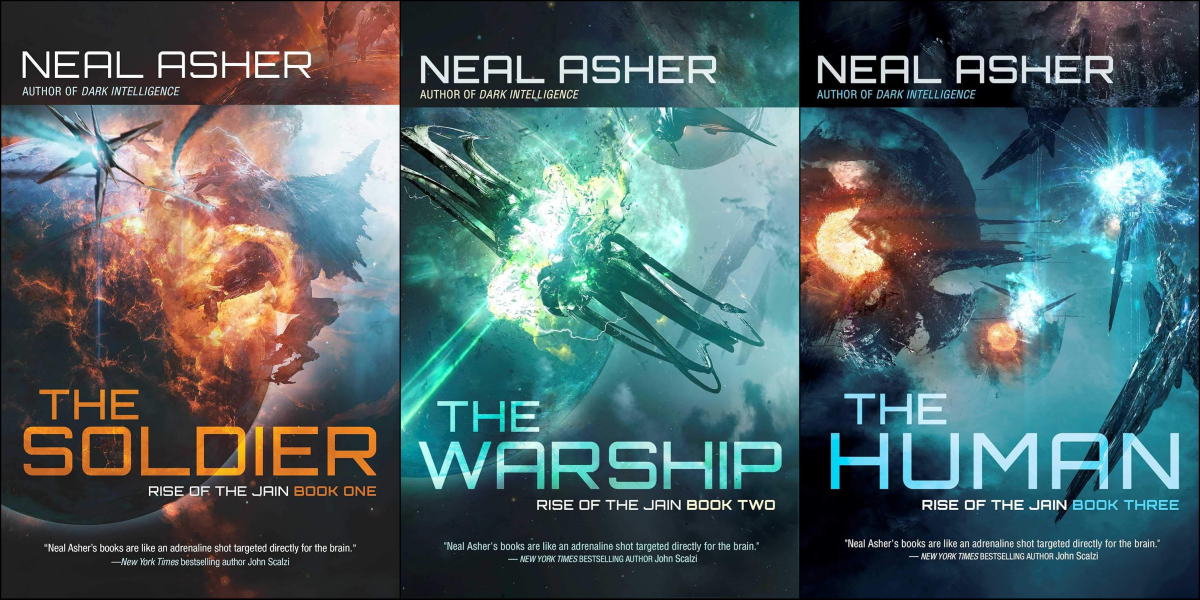
The events in the books take place in 2644 CE (Common Era), which places them late in Asher’s Polity timeline. In contrast, the Agent Cormac books all take place in the first half of the 2400th CE century, The Technician takes place in 2444 CE, and the Dark Intelligence trilogy takes place in 2450 CE. So, this story is two hundred years after.
And while the books can stand on their own, they do trade on much that has passed before. Describing just the plot basics requires explaining the Polity. And the Jain.
The Polity is the official sphere of human civilization in the galaxy. In the backstory of the Polity is the Quiet War, when Ai took over human governance (“quiet” because so few were killed — by then Ai pretty much controlled everything anyway). These Ai rule with a benevolent but iron (and sometimes merciless) fist because they actually do know best (their intelligence is much greater than ours). Energy and materials are abundant, so humans in the Polity can do what they wish or nothing at all.
Genetic and surgical body modifications of all kinds are common, and people use embedded nanosuites to stay healthy and very long-lived (so much so that boredom becomes an issue). In some cases, embedded tech gives them special abilities. In particular, people have “augs” (augmentations) installed: devices that give them direct mental access to the Polity’s computing, information, and Ai resources.
Ai ranges from sub-Ai that runs basic machines and weapons through golems (robots) and war drone to bigger ones that run starships. On the extreme end, the much larger ones that run planets or galactic sectors. The biggest of the bunch is Earth Central, which is in charge of everything. Various Ai, especially in golem and war drones, are important characters in Asher’s stories. The Dark Intelligence trilogy focuses on one, self-named Penny Royal, who ran a starship but was driven insane and turned bad.
Humans were, at first, the only living species in the galaxy. Then they encounter the prador, a warlike extremely xenophobic crab-like species that immediately sets out to destroy humanity. Eventually, things settle into an uneasy truce with a neutral zone between the territories of the two species (called “the Graveyard” because most of the war took place there). Far from being distant faceless enemies, the prador feature prominently in many of the stories (major characters in a few).
While the humans and prador seem to be the only extant species in the galaxy, the scant remains of three other civilizations have been identified. These are named (by humanity) the Atheter, the Csorians, and the Jain. The first is key to the plots of several books (comprising an overall arc — and hence why it’s good to read these in chronological order). Little is known or said about the Csorians. The Jain, however (in the form of their remaining technology), are a key threat.
The problem is that Jain technology is a deliberately poisoned chalice. At first, a “Jain node” (about the size of a walnut but packed with nano-, pico-, and femto-tech) confers amazing technical abilities on the user victim. It can take over machines, computers, and human minds. It can repair and build (and consume). At some point though, it subsumes the victim and generates new nodes. A single Jain node can take over and destroy a technical civilization. Which is their function: to destroy technological civilizations.
The Jain were insanely warlike; Jain nodes are their ultimate weapon.
§
Events in Rise of the Jain center around what seems to be a star system in the process of forming. There is an unignited star surrounded by an accretion disk of matter… and Jain tech.
[A Jain node is a “seed” that requires an intelligent mind to activate. Jain tech is machines the seed (or other Jain tech) creates. These range from simple (but ultra-high tech) machines to semi-self-aware robots.]
The Polity Ai have concerns about outright destroying the Jain tech, but they also concerned that, if the star ignites (which it has begun to a few times but failed), the stellar wind will blow the Jain tech into the galaxy. Normally, the response to anything Jain is immediate sterilization of everything it came into contact with, but the Polity Ai have reasons for thinking it might be a bad idea in this case.
Instead, they surround the system with heavily armed watch platforms, each controlled by its own Ai. Besides the weaponry, the platforms also have battalions of attack ships. The order of the day is that nothing leaves the system. Or even approaches the platforms.
Meanwhile, the overseer in care of this defense system, along with some war drone friends of hers, is hatching a secret plan to wipe out the Jain tech once and for all.
And that’s just the setup to the story.
§
Explaining even the titles of the second and third books involves a spoiler, but (because it’s a pretty minimal reveal compared to the big ones) I can say the soldier named by the first book is a Jain tech war drone — a fearsome fighting machine capable of destroying small planets. And it’s just the opening act.
In some ways, this trilogy culminates a long arc from the Agent Cormac books, The Technician, and various books about the prador. Jain tech isn’t mentioned in the Dark Intelligence trilogy, but it appears to some extent in many other Polity books. It’s generally regarded as Seriously Bad News.
I won’t get into the plot. Some of the most basic aspects (like even the titles of books two and three) involve spoilers. I do have some overall reactions. I usually find Asher’s books so engaging that I’m carried away and don’t make notes. I was disengaged just enough with Rise of the Jain that I did…
⇒ Asher, Banks, and Reynolds (and many other authors) provide considerable detailed descriptions of actions and objects. I’m not a fan. I don’t read for vivid depictions of fantastic creatures, plants, machines, planets, spaceships, or aliens (though I realize some love that stuff). I read to see what happens. I’m all about action and dialog.
⇒ Somewhat related are the repetitions of story points already known to the reader. In some cases, it almost feels like chapters from some doled-out serial where people need to be reminded what happened last week. Or perhaps Asher sees his plots as complicated enough that it’s helpful to remind people.
⇒ Someone once (on behalf of many of us) asked Daniel Abraham and Ty Franck how the (incredibly and fictionally good) engines on the ships worked. Their answer was perfect: “Very efficiently.” In Asher’s Polity energy seems almost free, particularly when it comes to nano-tech. The weapons, in particular, use prodigious amounts of energy.
[But then so did the very selectively annihilating hand-held phasers on Star Trek, and don’t get me started on the energy levels involved with transporters.]
⇒ The Polity has both “runcibles” (teleportation portals) and “U-space” (under-space) through which ships can fly to effectively accomplish faster-than-light travel. The runcibles also leverage U-space but require a black hole and an Ai to run, so runcibles are like train stations or airport rather than Star Trek transporters.
Even so, I found myself often questioning the timing in the story. Characters seem to get around a bit too quickly sometimes. Plot requirements seem to sometimes deny that “Space is big. Really big.”
⇒ I question Asher’s knowledge of science sometimes. At one point he makes an analogy to how a tsunami wrecks sailing ships, but in the open ocean tsunamis are just gentle swells. It’s when the approach shore that the wave energy builds into something. Even then it’s usually more like a huge killer tidal surge than the 100-foot-tall surf wave depicted in fiction.
There were a few other times I found myself thinking, “Gee, for a hard SF writer, your science seems a bit weak.”
⇒ A pet peeve of mine: the super-hacker fallacy. Sometimes a person but usually a special chip or software that can hack into any system no matter how well protected. Jain tech is this on super steroids.
⇒ Because people can have fairly indestructible implants that record their memories, a lot of major characters get to die and come back. Which undercuts the drama somewhat. The main character in the Dark Intelligence trilogy, Thorvald Spear, died during the war with the prador but his implant was recovered so his mind could be downloaded into a new body.
§
While I enjoyed Rise of the Jain, and it does wrap up some long-standing threads, I felt the same dissonance regarding all the death and destruction as some of his Ai and human characters. (It doesn’t drive me insane as it did Penny Royal and other Ai, but I don’t love it.)
§ §
 Above, I mentioned the Dark Intelligence trilogy (formally called the Transformation trilogy) a number of times. It was my first exposure to Asher and the Polity, and now I’m rereading it as part of a chronological trip through Asher’s books.
(I’m halfway through the third book and itching to stop writing this post and get back to the story.)
As with The Technician, it makes much more sense and is a much richer reading experience having read the earlier books.
The story is largely about the Penny Royal, who controlled a warship but was driven insane during the war and became a “black Ai” — as in black-hat villain. It has become powerful enough to stand up to the Polity Ai.
The trilogy is largely about Penny Royal redressing its past crimes and cleaning up its messes, including Room 101, a giant space factory that manufactured war materials from bombs to warships and whose Ai was also driven insane during the war.
This introduction to Asher’s Polity delighted me the first time around, and I’m very much enjoying the reread, especially now that I’ve read the books that lead up to it.
§ §
Stay sane, my friends! Go forth and spread beauty and light.
∇





June 27th, 2026 at 5:54 pm
There is a 4th Owner’s book, but it’s not directly tied into the original trilogy. It’s more of a standalone. He also wrote one or two standalone Polity books after this Jain trilogy. I wasn’t a huge fan of them. If you end up reading them, be prepared for descriptions of bowel movements and water absorption rates
June 27th, 2026 at 6:11 pm
Yeah, World Walkers. My library doesn’t have it. ☹️
Indeed, quite a few books chronologically follow Rise of the Jain. I’ve got Jack Four (2800 CE) queued up, but there’s also The Skinner (3056 CE) and The Voyage of the Sable Keech (3078 CE) and then Orbus (3220 CE) and Hilldiggers (3230 CE). Plus, he’s written some post-Polity stories (like The Bosch). Recently he published Dark Diamond (2644 CE) and Dark Agent (2644 CE), both of which feature Agent Cormac and Captain Blite.
So, I got plenty of Asher to read, yet! 😁
June 27th, 2026 at 6:14 pm
Ahhh yes, Jack Four. That’s the one I was referring to. Asher gets obsessed with old man biology 😀
My library has some sort of cooperation with an ebook place, does yours do that? That might open up options for world walkers for you.
June 28th, 2026 at 10:42 am
Not as far as I know. They have some notable gaps in their collection, too. And it’s weird because a few years ago they went from being a county library to being part of some larger system.
June 28th, 2026 at 11:05 am
Well, if you read ebooks, I’m always willing to lend a copy here and there.
When it comes to Asher, I’m not quite a disciple, but it gets close to that line 😀
June 28th, 2026 at 12:09 pm
I do like his work. It satisfies my itch for hard SF space opera very nicely.
June 28th, 2026 at 6:59 am
Interestingly, my preference for those authors is actually in reverse alphabetical. I’ve also added Peter Hamilton to that list, at least for his most recent stuff, although where I slot him depends on how old the book is.
I enjoyed the Rise of the Jain trilogy, although the last book was a bit much. It wasn’t so much all the death and destruction as that being pretty much the whole book, one big ongoing battle IIRC. Battles can be entertaining, but they get tedious if they go on too long.
And I definitely agree on all the detailed descriptions, something I knock all these authors on, but really feel it with both Asher and Banks, and can’t get through Hamilton’s older stuff due to it.
June 28th, 2026 at 10:50 am
Yep, exactly. And by the time you get to that final exhausting battle, you’ve been through a number of lesser battles in the first two books. As you say, tedious.
I may have read some Hamilton short stories in collections; the name is familiar, but I’ve never read any of his novels.
June 28th, 2026 at 11:53 am
To be honest, the only thing of Hamilton’s I’ve really read all the way through is Exodus: The Archimedes Engine, but I enjoyed it enough that I have the sequel queued up, although I need to finish another book first.
June 28th, 2026 at 12:13 pm
My library has both The Archimedes Engine and Helium Sea (and a lot of other of his books). I added them to my Possibles list!