Category Archives: Science

I’ve got stuff on my mind!
My post last month about Dr. Gregory Berns and his studies of animal minds ran long because I also discussed Thomas Nagel and his infamous paper. Dr Berns referenced an aspect of that paper many times. It seemed like a bone of contention, and I wanted to explore it, so I needed to include details about Nagel’s paper.
The point is, at the end of the post, there’s a segue from the “Sebald Gap” between humans and animals to the idea we can never really even understand another human (let alone an animal). My notes for the post included more discussion about that, but the post ran long so I only mentioned it.
It’s taken a while to circle back to it, but better late than never?
Continue reading
10 Comments | tags: animal minds, human mind, mind, theory of mind | posted in Philosophy, Science
 Lately I’ve been playing a little game of What’s the Wavelength? The question is certainly a bit evocative. Wavelength could refer to many things: a favorite radio station or, metaphorically extended, a favorite anything. It might even evoke an old news meme, although the supposed question posed that time was about frequency (which is just the inverse of wavelength).
Wavelength might even apply to one’s political, social, sexual, musical, or whatever, alignment, but in this case I mean it literally and physically. Under quantum mechanics — our best description of small-scale physical reality — everything manifests as a wave. That means everything has a wavelength — the de Broglie wavelength.
I’ve been curious about it for a couple of reasons.
Continue reading
11 Comments | tags: de Broglie wavelength, matter wave, wave-particle duality | posted in Physics, Wednesday Wow
 The notion of emergence — because it is so fundamental — pops up in a lot of physics related discussions. (Emergence itself emerges!) A couple of years ago I posted about it explicitly (see: What Emerges?), but I’ve also invoked it many times in other posts. It’s the very basic idea that combining parts in a certain way creates something not found in the parts themselves. A canonical example is how a color image emerges from red, green, and blue pixels.
Also often discussed is reductionism, the Yin to the Yang of emergence. One is the opposite of the other. The color image can be reduced to its red, green, and blue pixels. (The camera in your phone does exactly that.)
Recently I’ve been thinking about the asymmetry of those two, particularly with regard to why (in my opinion) determinism must be false.
Continue reading
48 Comments | tags: emergence, emergent property, physical determinism, reductionism | posted in Physics

particles & their momenta
Over the decades I’ve seen various thinkers assert that entropy causes something — usually it’s said that entropy causes time. Alternately that entropy causes time to only run in one direction. I think this is flat-out wrong and puts the trailer before the tractor. (Perhaps due to a jack-knife in logic.)
The problem I have is that I don’t understand how entropy can be viewed as anything but a consequence of the dynamical properties of a system evolving over time according to the laws of physics. Entropy is the result of physical law plus time.
It’s a “law” only in virtue of the laws of physics.
Continue reading
23 Comments | tags: arrow of time, entropy, time | posted in Physics
 Back in 1974 Thomas Nagel published the now-famous paper What is it like to be a bat? It was an examination of the mind-body problem. Part of Nagel’s argument includes the notion that we can never really know what it’s like to be a bat. As W.G. Sebald said, “Men and animals regard each other across a gulf of mutual incomprehension.”
But in What It’s Like to Be a Dog: And Other Adventures in Animal Neuroscience (2017) neuroscientist Gregory Berns disagrees. In his opinion Nagel got it wrong. The Sebald Gap closes from both ends. Firstly because animal minds aren’t really that different from ours. Secondly because we can extrapolate our experiences to those of dogs, dolphins, or bats.
I think he has a point, but I also think he’s misreading Nagel a little.
Continue reading
21 Comments | tags: animal minds, brain mind problem, dogs, theory of mind | posted in Books, Science
 When I was in high school, bras were of great interest to me — mostly in regards to trying to remove them from my girlfriends. That was my errant youth and it slightly tickles my sense of the absurd that they’ve once again become a topic of interest, although in this case it’s a whole other kind of bra.
These days it’s all about Paul Dirac’s useful Bra-Ket notation, which is used throughout quantum mechanics. I’ve used it a bit in this series, and I thought it was high time to dig into the details.
Understanding them is one of the many important steps to climb.
Continue reading
16 Comments | tags: bra-ket notation, inner product, matrix multiplication, outer product, QM101, quantum mechanics | posted in Math, Physics
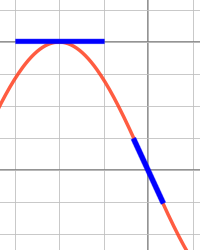 Today is the first Earth-Solar event of 2021 — the Vernal Equinox. It happened early in the USA: 5:37 AM on the east coast, 2:37 AM on the west coast. Here in Minnesota, it happened at 4:37 AM. It marks the first official day of Spring — time to switch from winter coats to lighter jackets!
Have you ever thought the Solstices seem more static than the Equinoxes? The Winter Solstice particularly, awaiting the sun’s return, does it seem like the change in sunrise and sunset time seems stalled?
If you have, you’re not wrong. Here’s why…
Continue reading
28 Comments | tags: derivatives, equinox, sine wave, Solstice, spring equinox, Summer Solstice, vernal equinox, Winter Solstice | posted in Life, Math
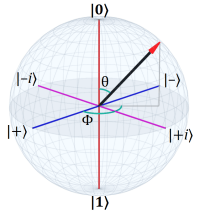
One small hill I had to climb involved the object I’ve been using as the header image in these posts. It’s called the Bloch sphere, and it depicts a two-level quantum system. It’s heavily used in quantum computing because qubits typically are two-level systems.
So is quantum spin, which I wrote about last time. The sphere idea dates back to 1892 when Henri Poincaré defined the Poincaré sphere to describe light polarization (which is the quantum spin of photons).
All in all, it’s a handy device for visualizing these quantum states.
Continue reading
17 Comments | tags: Bloch sphere, QM101, quantum computing, quantum mechanics, quantum spin | posted in Math, Physics
Popular treatments of quantum mechanics often treat quantum spin lightly. It reminds me of the weak force, which science writers often mention only in passing as ‘related to radioactive decay’ (true enough). There’s an implication it’s too complicated to explain.
With quantum spin, the handwave is that it is ‘similar to classical angular momentum’ (similar to actual physical spinning objects), but different in mysterious quantum ways too complicated to explain.
Ironically, it’s one of the simpler quantum systems, mathematically.
Continue reading
41 Comments | tags: QM101, quantum mechanics, quantum spin | posted in Math, Physics
Unless one has a strong mathematical background, one new and perhaps puzzling concept in quantum mechanics is all the talk of eigenvalues and eigenvectors.
Making it even more confusing is that physicists tend to call eigenvectors eigenstates or eigenfunctions, and sometimes even refer to an eigenbasis.
So the obvious first question is, “What (or who) is an eigen?” (It turns out to be a what. In this case there was no famous physicist named Eigen.)
Continue reading
14 Comments | tags: eigenstate, eigenvalue, eigenvector, matrix transform, QM101, quantum mechanics | posted in Math, Physics




You must be logged in to post a comment.