Category Archives: Science

QM 101: Fun with Photons

Last time I explored the quantum spin of photons, which manifests as the polarization of light. (Note that all forms of light can be polarized. That includes radio waves, microwaves, IR, UV, x-rays, and gamma rays. Spin — polarization — is a fundamental property of photons.)

I left off with some simple experiments that demonstrated the basic behavior of polarized light. They were simple enough to be done at home with pairs of sunglasses, yet they demonstrate the counter-intuitive nature of quantum mechanics.

Here I’ll dig more into those and other experiments.

Continue reading


QM 101: Photon Spin

Earlier in this QM-101 series I posted about quantum spin. That post looked at spin 1/2 particles, such as electrons (and silver atoms). This post looks at spin in photons, which are spin 1 particles. (Bell tests have used both spin types.) In photons, spin manifests as polarization.

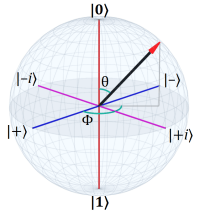
Photon spin connects the Bloch sphere to the Poincaré sphere — an optics version designed to represent different polarization states. Both involve a two-state system (a qubit) where system state is a superposition of two basis states.

Incidentally, photon polarization reflects light’s wave-particle duality.

Continue reading


BB #74: Which MWI?

I finished The Quantum Labyrinth: How Richard Feynman and John Wheeler Revolutionized Time and Reality (2017), by Paul Halpern. As the title implies, the book revolves around the careers and lives of John A. Wheeler (1911–2008) and Richard Feynman (1918–1988). After Feynman graduated from MIT he became Wheeler’s teaching assistant at Princeton. The two men, despite very different personalities, became life-long friends and collaborators.

One of Wheeler’s many claims to fame is his promotion of Hugh Everett’s PhD thesis, The Theory of the Universal Wave Function. That paper, of course, is the seed from which grew the Many Worlds Interpretation of Quantum Mechanics.

The thing is, there are two major versions of the MWI.

Continue reading


BB #73: Wavefunction Collapse

I’m two-thirds through my second Paul Halpern book this month. Earlier I read his book about cosmology, Edge of the Universe: A Voyage to the Cosmic Horizon and Beyond (2012), which was okay. Now I’m reading The Quantum Labyrinth: How Richard Feynman and John Wheeler Revolutionized Time and Reality (2017), which I’m enjoying a bit more. In part because cosmology has changed more since 2012 than quantum physics has since 2017. (Arguably, the latter hasn’t changed much since the 1960s.)

I wrote about Halpern’s book, Einstein’s Dice and Schrödinger’s Cat (2015), last year. As the title implies, it focuses on two great names from physics. Quantum Labyrinth (as its title also implies) also focuses on two great physics names.

But today’s Brain Bubble (as the title implies) is about wavefunction collapse.

Continue reading


Sideband #73: Complex 4D

I’ve written a number of posts about four-dimensional Euclidean space, usually in the context of one of my favorite geometrical objects, the tesseract. I’ve also mentioned 4D Euclidean spaces as just one of many possible multi-dimensional parameter spaces. In both cases, the familiar 2D and 3D spaces generalize to additional dimensions.

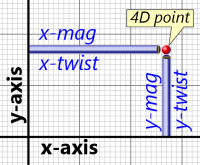
This post explores a specialized 4D space that uses complex numbers along each axis of a 2D nominally Euclidean space. Each X & Y coordinate has two degrees of freedom, a magnitude and a phase. This doesn’t make 4D spaces easier to visualize, but it can offer a useful way to think about them.

It also connects back to something I wrote about in my QM-101 series.

Continue reading


MWI: Questions, part 3

This is the third part of a series examining the Many Worlds Interpretation of Quantum Mechanics (the MWI of QM). The popularity of the MWI in books, blogs, and science videos, especially among the science-minded, tends to keep in present in some corner of my mind. Blog posts are a way to shoo it out.

The first part introduced the topic and talked about cats. The second part discussed the Schrödinger equation, wavefunctions, decoherence, and the question of how multiple instances of matter can coincide. That question, to me, is a central issue I have with MWI.

This time I dig into quantum superposition and touch on a few other topics.

Continue reading


MWI: Questions, part 2

Last time I started exploring questions I have about the Many Worlds Interpretation of Quantum Mechanics (the MWI of QM). Obviously I’m not a fan; quite the opposite. It presents as parsimonious, hung on the single hook of a universal wavefunction, but I think it gets more complicated and cumbersome when examined. I can’t say it’s broken, but I don’t find it very attractive.

I suspect most people, even in physics, don’t care. A few have invested themselves in books or papers, but these interpretations don’t matter to real physics work. The math is the math. But among the philosophical, especially the ontological, it’s food for debate.

Being both philosophical and ontological, I do smell what’s cooking!

Continue reading


MWI: Questions, part 1

Back in January, in a post about unanswered questions in physics, I included the Many Worlds Interpretation of Quantum Mechanics (the MWI of QM). I wish I hadn’t. Including it, and a few other more metaphysical topics, took space away from the physical topics.

I did it because I’ve had notes for an MWI: Questions post for a long time, but shoehorning it in like that was a mistake. Ever since, I’ve wanted to return and give it the attention of a full post. I’m reminded about it constantly; the concept of “many worlds” has become such a part of our culture that I encounter it frequently in fiction and in fact (and in other blog posts).

Its appeal is based on a simplicity, but to me it doesn’t seem at all that simple.

Continue reading


Knowing Other Minds

I’ve got stuff on my mind!

My post last month about Dr. Gregory Berns and his studies of animal minds ran long because I also discussed Thomas Nagel and his infamous paper. Dr Berns referenced an aspect of that paper many times. It seemed like a bone of contention, and I wanted to explore it, so I needed to include details about Nagel’s paper.

The point is, at the end of the post, there’s a segue from the “Sebald Gap” between humans and animals to the idea we can never really even understand another human (let alone an animal). My notes for the post included more discussion about that, but the post ran long so I only mentioned it.

It’s taken a while to circle back to it, but better late than never?

Continue reading


What’s the Wavelength?

Lately I’ve been playing a little game of What’s the Wavelength? The question is certainly a bit evocative. Wavelength could refer to many things: a favorite radio station or, metaphorically extended, a favorite anything. It might even evoke an old news meme, although the supposed question posed that time was about frequency (which is just the inverse of wavelength).

Wavelength might even apply to one’s political, social, sexual, musical, or whatever, alignment, but in this case I mean it literally and physically. Under quantum mechanics — our best description of small-scale physical reality — everything manifests as a wave. That means everything has a wavelengththe de Broglie wavelength.

I’ve been curious about it for a couple of reasons.

Continue reading