Category Archives: Books
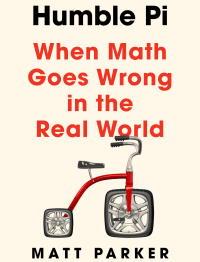 I just finished Humble Pi (2019), by Matt Parker, and I absolutely loved it. Parker, a former high school maths teacher, now a maths popularizer, has an easy breezy style dotted with wry jokes and good humor. I read three-quarters of the book in one sitting because I couldn’t stop (just one more chapter, then I’ll go to bed).
It’s a book about mathematical mistakes, some funny, some literally deadly. It’s also about how we need to be better at numbers and careful how we use them. Most importantly, it’s about how mathematics is so deeply embedded in modern life.
It’s my third maths book in a month and the only one I thoroughly enjoyed.
Continue reading
2 Comments | tags: Matt Parker, numbers, Parker Square | posted in Books, Math
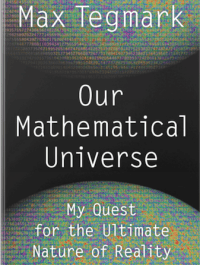 I finally finished Our Mathematical Universe (2014) by Max Tegmark. It took me a while — only two days left on the 21-day library loan. I often had to put it down to clear my mind and give my neck a rest. (The book invoked a lot of headshaking. It gave me a very bad case of the Yeah, buts.)
I debated whether to post this for Sci-Fi Saturday or for more metaphysical Sabbath Sunday. I tend to think either would be appropriate to the subject matter. Given how many science fiction references Tegmark makes in the book, I’m going with Saturday.
The hard part is going to be keeping this post a reasonable length.
Continue reading
34 Comments | tags: anthropic principle, block universe, doomsday argument, Mathematical Universe Hypothesis, Max Tegmark, MUH, MWI | posted in Books, Philosophy, Physics
‘X’ is for… ??
I’ve written about secret codes before. The Pigpen cipher was pretty simplistic, almost more a child’s game, but the Playfair cipher was a bit more interesting. That one came from a murder mystery novel by Dorothy L. Sayers. Today I thought I’d show you another simple code from another mystery novel.
1829 2125 0038 2226 1600 2125 0027 1722 4200 1829 1600 4219 2518 1617 1900 4122 3916 3200 3700 4019 0025 2016 0028 1724 2718 2241 4400 2118 0020 2516 2500 1829 1600 1819 2316 1517 2118 1617 0038 2226 1643 0015 2921 3829 0030 2025 1800 2425 2521 2841 2500 4120 4240 1617 2500 1822 0018 2916 0031 1619
Stop! See if you can decode the above before continuing.
Continue reading
8 Comments | tags: Bernie Rhodenbarr, cipher, code, decipher, Kinsey Millhone, Lawrence Block, Sara Paretsky, secret codes, substitution cipher, Sue Grafton, V.I Warshawski | posted in Books, Mystery Monday
 Neal Stephenson, like Greg Egan, is a hard science fiction author who never fails to delight me with something new and tasty. Both Stephenson and Egan seem able to leave footprints in otherwise well-trodden ground. Stephenson, in particular, often makes me LOL.
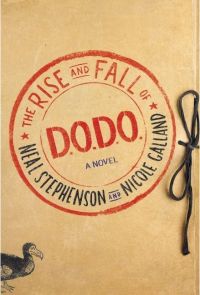
That’s not an acronym I use very often, but it seems especially appropriate here given this post is about The Rise and Fall of D.O.D.O., by Neal Stephenson and Nicole Galland. The book has so many tongue-in-cheek military acronyms (DODO, DTAP, DEDE, MUON, etc) that it has a glossary at the back.
The story concerns parallel worlds, wave-function collapse, and witches.
Continue reading
7 Comments | tags: hard SF, Neal Stephenson, Nicole Galland, science fiction, science fiction books, SF, SF Books, The Rise and Fall of D.O.D.O., witches | posted in Books, Sci-Fi Saturday
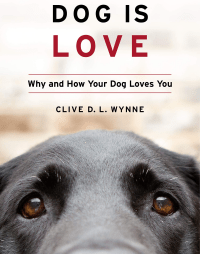 Recently I read Dog is Love, Why and How Your Dog Loves You (2019), by Clive D.L. Wynne, an animal behavior scientist who specializes in dogs. Despite the loaded word “love” in the title, this is a science book about a search for hard evidence.
Dr. Wynne is a psychology professor at Arizona State University and director of their Canine Science Collaboratory. He’s written several other books about animal cognition: The Mental Lives of Animals (2001), Do Animals Think (2004), Evolution, Behavior and Cognition (2013).
The book is the story of Wynne’s search for exactly what it is that makes dogs special and how they got that way.
Continue reading
27 Comments | tags: Clive Wynne, dogs, love, wolves | posted in Books, Science
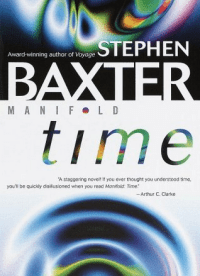 Recently I posted about Manifold: Time, the first book in a trilogy by Stephen Baxter, a writer new to me. As I wrote, I wasn’t very whelmed, but a bad meal at a new restaurant can be a fluke — it’s only fair to give the chef at least one more chance. (A single data point doesn’t mean much.) And I did find the overall themes a little intriguing.
As it turned out, I rather enjoyed the second one, Manifold: Space. The story stayed grounded and engaged me throughout, plus there were several cool science fiction ideas I’d never encountered before (which is kinda the point of reading hard SF). So a definite thumbs up on book number two.
Unfortunately, the third book, Manifold: Origin, didn’t do much for me.
Continue reading
9 Comments | tags: Fermi Paradox, Stephen Baxter | posted in Books, Sci-Fi Saturday
 My voracious reading habit has deep roots in libraries. The love of reading comes from my parents, but libraries provided a vast smörgåsbord to browse and consume. Each week I’d check out as many books as I could carry. I discovered science fiction in a library (the Lucky Starr series, with Isaac Asimov writing as Paul French, is the first I remember).
Modern adult life, I got out of the habit of libraries (and into book stores and now online books). But now the Cloud Library has reinvigorated my love of all those free books, especially the ones I missed along the way.
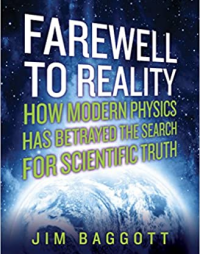
For instance, Farewell to Reality: How Modern Physics Has Betrayed the Search for Scientific Truth (2014), by Jim Baggott.
Continue reading
13 Comments | tags: Farewell to Reality, Jim Baggott, library, Many Worlds Interpretation, MWI, theoretical physics | posted in Books, Philosophy, Physics
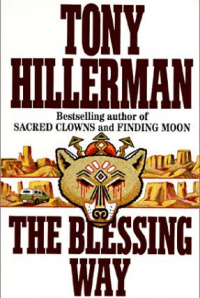 Yá’át’ééh! Fans of the Hillerman books will immediately recognize the three names in the title as Joe Leaphorn, Jim Chee, and Bernadette Manuelito (a relatively new addition who doesn’t yet have her own Wiki page). All three are (fictional) police officers working for the (real) Navajo Tribal Police in the American southwest.
I have to call them just “the Hillerman books” now, because after father Tony Hillerman died, daughter Anne Hillerman took up the series and has so far contributed five very worthy stories of her own. (Her vision of the series puts Bernie Manuelito front and center and thus adds fresh air to the 18 books her father wrote.)
I’m a fan of detective novels, especially murder mystery detective novels, and these are without question my second favorite mystery books of all time.
Continue reading
27 Comments | tags: Anne Hillerman, Bernadette Manuelito, Jim Chee, Joe Leaphorn, Navajo Nation, Tony Hillerman | posted in Books, Mystery Monday
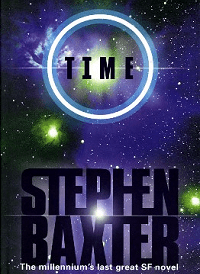 Yesterday, courtesy of Cloud Library, I finished Manifold: Time (1999), by Stephen Baxter. It’s my first exposure to Baxter, who has written 60 science fiction novels — none of which I’ve read. Per his Wiki bibliography, he’s written only a half-dozen short stories, also none of which I’ve read. (There are SF authors I’ve only met in short story collections. He isn’t one of them.)
Time is the first of the Manifold trilogy (which has a fourth book, Phase Space); the second and third books are Space (2000) and Origin (2001). Each of the books tells a separate story in a separate universe.
I enjoyed the first book, but I can’t say I was hugely whelmed.
Continue reading
25 Comments | tags: hard SF, science fiction, science fiction books, SF, SF Books, Stephen Baxter | posted in Books, Sci-Fi Saturday
 Here’s yet another unplanned post, mostly because there was something important I forgot to mention yesterday, but also because I started watching three different Netflix shows (or maybe call it two-and-a-half), and all three are fit for a Sci-Fi Saturday post, so here I am again.
I dither about three because one of them wasn’t new, it was season two I started of Siempre Bruja. But I hadn’t yet seen any of Lost in Space or the new Chilling Adventures of Sabrina. I’ve been suspicious of the former, and the latter isn’t quite my cup of tea on several counts.
But first you should know about (Your) CloudLibrary!
Continue reading
32 Comments | tags: Always a Witch, Angely Gaviria, cloudlibrary, science fiction, science fiction TV, SF, Siempre Bruja | posted in Books, Sci-Fi Saturday




You must be logged in to post a comment.