 Back in 2014 I decided that a blog that almost no one reads wasn’t good enough, so I created a blog that no one reads, my computer programming blog, The Hard-Core Coder. (I was afraid the term “hard-core” would attract all sorts of the wrong attention, but apparently those fears were for naught. No one has ever even noticed, let alone commented. Yay?)
In the seven years since, I’ve only published 83 posts, so the lack of traffic or followers isn’t too surprising. (Lately I’ve been trying to devote more time to it.) There is also that the topic matter is usually fairly arcane.
But not always. For instance, today’s post about Unicode.
Continue reading
24 Comments | tags: alphabet, binary, computer programming, letters, Unicode | posted in Computers
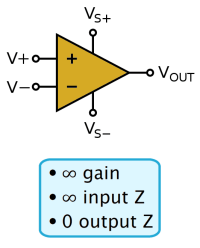 My notes don’t include what triggered the thought, but I think it was something in one of the Lee Smolin books I read recently. My recent post, Analog Computing, brought the idea to mind again, because analog computers often use op amps. I was reminded yet again while reading about SPADs.
I’m talking about the very useful rules of thumb (heuristics) I learned to help understand, even design, electronic circuitry. They’re shortcuts in the sense of being only approximately true, but their simplified view can make a circuit much easier to understand.
I thought I’d pass them on for those interested in electronic design.
Continue reading
8 Comments | tags: electrical current, electronics, transistor, voltage, volts | posted in Sideband
 It’s actually an old debate — in fact, it’s a variation on the Ship of Theseus — but modern day science fiction gives it a new spin. At root it’s a question about exactly where our identity as self-aware conscious beings actually resides. I don’t find it paradoxical so much as intriguing.
Recently Sabine Hossenfelder jumped into the discussion with a video asking whether Captain Kirk dies every time he uses the transporter. Not just him, of course, but everyone who uses it.
As with trees falling in forests, the answer depends on defining key terms. This case depends on exactly what we mean by “dies” and “Kirk” — the latter being the Ship of Theseus.
Continue reading
16 Comments | tags: Captain Kirk, Sabine Hossenfelder, Star Trek, transporters | posted in Opinion, Science
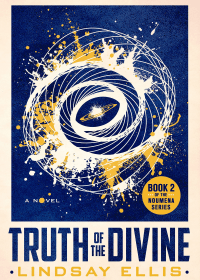 Last year I read and very much enjoyed Axiom’s End (2020), a debut novel by film critic and YouTuber Lindsay Ellis. It’s the first book of her Noumena series, which is about powerful aliens showing up on an unsuspecting Earth. It made the New York Times Best Seller list and generated a fair amount of favorable attention.
Earlier this year I preordered the second book, The Truth of the Divine (2021), and it finally dropped last month. I had high hopes and much anticipation about where Ellis would take her story. Sadly, I found myself sorely disappointed by this second installment. This isn’t a positive review.
For balance I’ll mention two books I did enjoy, Neuromancer (1984), by William Gibson, and a new comedy by David Brin.
Continue reading
21 Comments | tags: David Brin, Lindsay Ellis, science fiction, science fiction books, SF, SF Books, William Gibson | posted in Books, Sci-Fi Saturday
 For broadcast networks that still observe such archaic traditions, the new “season” has begun doling out episodes. Over the years I’ve watched fewer network shows, although this year I’ve actually added two new ones (at least temporarily). I’m still watching the old three… and still questioning why I do.
It would be easy to dump the three old giant dinosaurs, CBS, NBC, and ABC. I haven’t watched the smaller ones (TNT, USA, etc) in years. Other than baseball, regularly scheduled TV broadcasts are decades in my past. I’m solidly about streaming these days — Netflix, Hulu, Prime. I’m considering adding Apple TV and HBO Max.
I’ve definitely taken to binge watching!
Continue reading
23 Comments | tags: anime, CSI, Gibbs' Rules, James Spader, Japanese anime, Jethro Gibbs, Mark Harmon, Michael Weatherly, Nadine Velazquez, NCIS, Reservation Dogs | posted in TV Tuesday
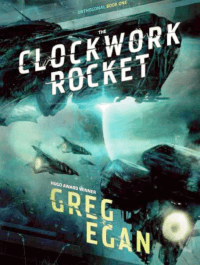
Orthogonal, book #1
Generally I like my SF hard, even diamond hard. I don’t disdain fantasy; some of my favorite stories are fantastic. (As I’ve said often, Terry Pratchett’s Discworld series is my #1, my proverbial desert island companion.) But I definitely lean towards harder SF.
Growing up it was, of course, the Holy Trinity, Asimov, Clarke, Heinlein, but there was also Clement, Niven, and many others who stirred a large measure of science into their fiction. More recently the list of hard SF authors includes Forward, Steele, Stephenson, and a particular favorite of mine, Greg Egan.
I can safely say his Orthogonal series is as hard as science fiction gets.
Continue reading
13 Comments | tags: Greg Egan, hard SF, science fiction, science fiction books, SF, SF Books | posted in Sci-Fi Saturday
 Here’s a blast from the past, a re-post (of a re-post) of a post I wrote many years ago on another platform. (Long, long ago on a blog far, far away.) Creative writing isn’t really my thing, but I don’t hate how this turned out. I originally posted it here in 2011, and re-cycled it in 2012, 2013, and 2014. I meant to do it every year but forgot. Since it’s been a while, I thought I’d give it another go.
The original writing exercise was to write a short piece from the point of view of a pumpkin. The exercise was given to us just before Halloween. (Same guy who gave us an exercise to write a piece from the point of view of our car.)
Most writers took the tack that pumpkins suffered horribly at this time of year. Naturally, I took a different tack, and so I give you…
Continue reading
12 Comments | tags: dirt, Gourdian, gourds, humor, Jack-O-Lantern, kiss a Gourdian, orange, pumpkins, re-post, vines | posted in Writing
 My dad and my dad’s dad were Lutheran ministers, and my dad’s brother taught theology at a Lutheran seminary. Lotta preachers on the paternal side of the tree. (Lotta teachers on the maternal side; mom and sis among them. I grew up with preachers and teachers.)
All of which gave me something of an insider view of religion and the organizational church. It also provided a cornerstone I’ve built on through much of my life: a reconciliation between the Yin of my science side and the Yang of my spiritual side.
One interesting place the two meet is Pascal’s Wager.
Continue reading
43 Comments | tags: atheism, belief, deism, faith, God, Pascal's Wager, theism | posted in Religion, Sunday Sermons
 There is a key rule of thumb (or heuristic) in science known as the Copernican Principle. It essentially says: “We’re not special.” (The “we” in question being the human race.) It’s named after Nicolaus Copernicus, who, in 1543, forever banished the Earth and its thin film of humanity from the center of the universe.
Ever since, the science view of humanity is that it’s just part of the landscape, nothing particularly special, a mere consequence of energy+time creating increasing organization in systems. We may be complex, perhaps even a little surprisingly so, but we’re still nothing special.
Yet it seems to me that, at least in some ways, we really are.
Continue reading
20 Comments | tags: dark energy, dark matter, Drake Equation, entropy, Fermi Paradox | posted in Science
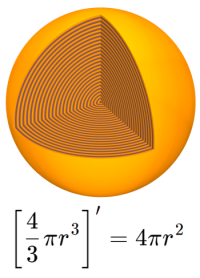 I’ve always had a strong curiosity about how things work. My dad used to despair how I’d take things apart but rarely put them back together. My interest was inside — in understanding the mechanism. (The irony is that I began my corporate career arc as a hardware repair technician.)
My curiosity includes a love of discovery, especially unexpected ones, and extra especially ones I stumble on myself. It’s one thing to be taught a neat new thing, but a rare delight to figure it out for oneself. It’s like hitting a home run (or at least a base-clearing double).
Recently, I was delighted to discover something amazing about spheres.
Continue reading
12 Comments | tags: derivatives, geometry, holographic principle | posted in Math, Sideband




 Logos con carne