Tag Archives: AI
 Here are my notes for Chestnut, episode two, season one, of Westworld. As with the previous notes, these are longer posts than I usually allow, but they’re intended as something useful for me, so they are what they are.
The first episode was linear, seeming to cover five days while it introduced the idea of the host loops, the main Delos people, and the Man in Black. The second episode (along with those after) isn’t linear at all — yet it is deliberately constructed to appear linear (especially at key points). This episode also introduces a key idea: that of suffering.
Note that in all these posts: Serious Series Spoilers!
Continue reading
1 Comment | tags: AI, Anthony Hopkins, artificial intelligence, Bernard Lowe, Dolores Abernathy, Ed Harris, Evan Rachel Wood, HBO, Jeffery Wright, Jonathan Nolan, Lisa Joy, Maeve Millay, Robert Ford, robotics, robots, science fiction, science fiction TV, SF, Thandie Newton, Westworld (TV series) | posted in TV
To prepare for season two of HBO’s Westworld (by husband-and-wife team Jonathan Nolan and Lisa Joy), I’m very thoroughly watching the first season again… and taking careful notes!
By “thoroughly” I mean that I plan to watch each episode multiple times. I’ve just watched the first episode three times (twice in a row last night, once the night before), and I plan to watch it again so my buddy can see how absolutely stunning it looks on my new LG 65″ OLED TV in 4K HDR off the Blu-Rays I bought. (And it is truly stunning that way! I gasped when I first started watching.)
I’m transcribing my notes from last night here, in part, because my handwriting is so bad I just have to type them up, but also to share them for whatever they may be worth. Obviously: Serious Series Spoilers!
Continue reading
8 Comments | tags: AI, Anthony Hopkins, artificial intelligence, Bernard Lowe, Dolores Abernathy, Ed Harris, Evan Rachel Wood, HBO, Jeffery Wright, Jonathan Nolan, Lisa Joy, Maeve Millay, Robert Ford, robotics, robots, science fiction, science fiction TV, SF, Thandie Newton, Westworld (TV series) | posted in TV
The previous posts avoided spoilers and talked about HBO’s Westworld in general terms of its themes and characters — stuff that is apparent just from the trailers and basic setup. This post isn’t like that! Do not read this post unless you’ve seen all of season one!
Or unless you really like spoilers or just don’t care about the series. But if you do, you should trust me on this: You do not want this spoiled! It may even be all the better if you avoid any interweb discussion … the fans really did figure out some of the secrets before their big reveal. (On the other hand, the show’s creators have made it clear the truth was always in plain view. And so it was.)
Here are my questions and observations about the last episode and the season as a whole. I think we all have a few questions…
Continue reading
10 Comments | tags: AI, Anthony Hopkins, artificial intelligence, Bernard Lowe, Dolores Abernathy, Ed Harris, Evan Rachel Wood, HBO, Isaac Asimov, Jeffery Wright, Jonathan Nolan, killer robots, Lisa Joy, Maeve Millay, Robert Ford, robotics, robots, robots-as-menace, robots-as-pathos, science fiction, science fiction TV, SF, Thandie Newton, Westworld (TV series) | posted in Sci-Fi Saturday, TV
In the previous post I wrote about some of the general themes I saw in HBO’s Westworld. Such big picture topics are inherent in the basic description of the series — intelligent robots used as playthings — and don’t require spoiling plot points or character revelations. Everything I wrote about in the last post is part of the general context of the show.
In this post I want to look more closely at things that struck me in particular, but it requires exposing certain aspects of character or implementation that could count as spoilers if one is very strictly trying to avoid knowing anything about the show.
But if you have some idea about what’s going on, maybe just from trailers, this post shouldn’t spoil anything for you. I won’t give away any of the big secrets or reveals.
Continue reading
16 Comments | tags: AI, Anthony Hopkins, artificial intelligence, Bernard Lowe, Dolores Abernathy, Ed Harris, Evan Rachel Wood, HBO, Isaac Asimov, Jeffery Wright, Jonathan Nolan, killer robots, Lisa Joy, Maeve Millay, Robert Ford, robotics, robots, robots-as-menace, robots-as-pathos, science fiction, science fiction TV, SF, Thandie Newton, Turing Test, Westworld (TV series) | posted in Sci-Fi Saturday, TV
Way back in 1958, science fiction author and critic Theodore Sturgeon coined the term Sturgeon’s Revelation. Which is that “90% of film, literature, consumer goods, etc. is crap.” This became known as Sturgeon’s Law while Theodore’s actual law (from a 1956 story) — that “nothing is always absolutely so” — is forgotten. (Philosopher Daniel Dennett expanded the Law to say that 90% of everything is crap!)
I’ve always found this applies especially to science fiction TV. And in this Anno Stella Bella era, there is a lot of SF TV, so naturally there is a lot of crap. (Honestly, I don’t even pay attention to the SyFy channel anymore.)
Happily: HBO’s Westworld … not crap! In fact, it’s a gem that offers many facets worthy of (non-spoiler) thought and discussion…
Continue reading
8 Comments | tags: AI, Anthony Hopkins, artificial intelligence, Bernard Lowe, Dolores Abernathy, Ed Harris, Evan Rachel Wood, Frankenstein, HBO, Isaac Asimov, Jeffery Wright, Jonathan Nolan, killer robots, Lisa Joy, Maeve Millay, movie violence, Prometheus, Robert Ford, robotics, robots, robots-as-menace, robots-as-pathos, science fiction, science fiction TV, SF, Thandie Newton, The Chinese Room, Turing Test, TV violence, violence, Westworld (TV series) | posted in Sci-Fi Saturday, TV
 Credit where credit is due, both the major ideas in this post come from Fareed Zakaria on his CNN Sunday program, GPS. If you follow TV news at all, you know Sunday mornings have such long-running standards as Meet the Press (on NBC since 1947!) and Face the Nation (on CBS since 1954). (Or was it Meet the Nation and Face the Press?)
Zakaria is one of the good ones: very intelligent, highly educated, calm and measured. He’s well worth listening to. (I’ve realized one attraction to TV news is the chance to — at least sometimes — hear educated, intelligent talk. It’s a nice respite from most TV entertainment.)
Two things on Zakaria’s last episode really rang a bell with me.
Continue reading
23 Comments | tags: AI, computer code, digital computer, DNA, electrons, Face the Nation, Fareed Zarkaria, fire, genetic code, genetics, internet, interweb, language, mechanical physics, Meet the Press, printing press, quantum physics, robotics | posted in Science, The Interweb, TV
 Over the last few weeks I’ve written a series of posts leading up to the idea of human consciousness in a machine. In particular, I focused on the difference between a physical model and a software model, and especially on the requirements of the software model.
The series is over, I have nothing particularly new to add, but I’d like to try to summarize my points and provide an index to the posts in this series. It seems I may have given readers a bit of information overload — too much information to process.
Hopefully I can achieve better clarity and brevity here!
Continue reading
30 Comments | tags: AI, algorithm, brain, brain mind problem, chaos theory, computationalism, computer model, computer program, consciousness, human brain, human consciousness, human mind, information theory, mind, My brain is full, stored program computer, Theory of Consciousness, Von Neumann architecture | posted in Computers
 Last time we considered the possibility that human consciousness somehow supervenes on the physical brain, that it only emerges under specific physical conditions. Perhaps, like laser light and microwaves, it requires the right equipment.
We also touched on how Church-Turing implies that, if human consciousness can be implemented with software, then the mind is necessarily an algorithm — an abstract mathematical object. But the human mind is presumed to be a natural physical object (or at least to emerge from one).
This time we’ll consider the effect of transcendence on all this.
Continue reading
58 Comments | tags: AI, algorithm, brain mind problem, computationalism, computer model, computer program, consciousness, human brain, human consciousness, human mind, mind, software model, Theory of Consciousness, transcendental numbers, Yin and Yang | posted in Computers
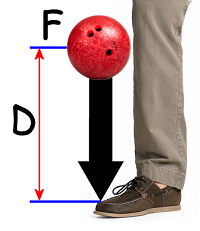
“Ouch!”
Over the past few weeks we’ve explored background topics regarding calculation, code, and computers. That led to an exploration of software models — in particular a software model of the human brain.
The underlying question all along is whether a software model of a brain — in contrast to a physical model — can be conscious. A related, but separate, question is whether some algorithm (aka Turing Machine) functionally reproduces human consciousness without regard to the brain’s physical structure.
Now we focus on why a software model isn’t what it models!
Continue reading
41 Comments | tags: AI, algorithm, bowling ball, brain mind problem, Church-Turing thesis, computationalism, computer model, computer program, consciousness, hot resistor, human brain, human consciousness, human mind, laser light, magnetron, microwaves, mind, software model, Theory of Consciousness | posted in Computers
 Last time I introduced four levels of possibility regarding how mind is related to brain. Behind Door #1 is a Holy Grail of AI research, a fully algorithmic implementation of a human mind. Behind Door #4 is an ineffable metaphysical mind no machine can duplicate.
The two doors between lead to physical models that recapitulate the structure of the human brain. Behind Door #3 is the biology of the brain, a model we know creates mind. Behind Door #2 is the network of the brain, which we presume encodes the mind regardless of its physical construction.
This time we’ll look more closely at some distinguishing details.
Continue reading
14 Comments | tags: AI, algorithm, brain, calculator, computationalism, computer model, computer program, consciousness, enchanted loom, human brain, human consciousness, LTP, neural correlates, qualia, self-awareness, slide rule, software model, synapse | posted in Computers







 Logos con carne