Category Archives: Books
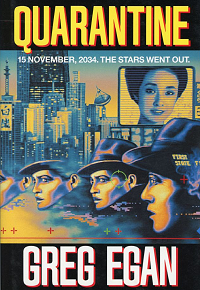 Last week I read Quarantine (Greg Egan, 1992), a science fiction novel that explores one of the more vexing conundrums in basic physics: the measurement problem. Egan’s stories (novels and shorts) often explore some specific aspect of physics (sometimes by positing a counterfactual reality, as in the Orthogonal series).
In Quarantine, Egan posits that the human mind, due to a specific set of neural pathways, is the only thing in reality that collapses the wave-function, the only thing that truly measures anything. All matter, until observed by a mind, exists in quantum superposition.
Unfortunately, it’s difficult to explore how this ties into the plot without spoiling it, so I’ll have to tread lightly.
Continue reading
15 Comments | tags: Greg Egan, quantum mechanics, science fiction, science fiction books | posted in Books, Sci-Fi Saturday
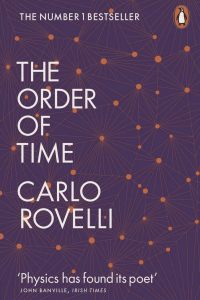 In the last week or so I read an interesting pair of books: Through Two Doors at Once, by author and journalist Anil Ananthaswamy, and The Order of Time, by theoretical physicist Carlo Rovelli. While I did find them interesting, and I’m not sorry I bought them (as Apple ebooks), I can’t say they added anything to my knowledge or understanding.
I was already familiar with the material Ananthaswamy covers and knew of the experiments he discusses — I’ve been following the topic (the two-slit experiment) since at least the 1970s. It was nice seeing it all in one place. I enjoyed the read and recommend it to anyone with an interest.
I had a little trouble with the Rovelli book, perhaps in part because my intuitions of time are different than his, but also because I found it a bit poetic and hand-wavy.
Continue reading
25 Comments | tags: Anil Ananthaswamy, arrow of time, Carlo Rovelli, is time fundamental, light, photons, Planck Length, Planck Time, spacetime, time, two slit experiment | posted in Books, Physics
 Oh, the advantages of finally getting around to starting to clean out the garage (which, in Minnesota, is strictly a summer activity).
I just knew I had a copy of Gödel, Escher, Bach: An Eternal Golden Braid, by Douglas Hofstadter. (Full disclosure, it’s a copy someone lent me decades ago that I never returned because it took me so long to get around to reading it. By then I’d lost touch with the co-worker who’d given it to me.)
Lately, I’ve been wanting to go at it again (and finish it this time), but I couldn’t find the copy I was sure I had. Turned out to be, along with a few other long-missing friends, in a box of books in the garage; one I’d just left out there with some other boxes (and luckily, no weather damage).
So added bonus to finally starting a chore I’ve been putting off for years!
15 Comments | tags: Douglas Hofstadter, GEB | posted in Books, Life
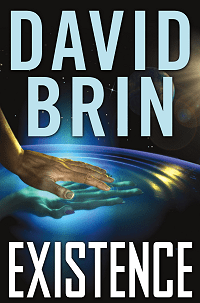 Recently I wrote that I was reading Existence (David Brin, 2012), a novel I found so striking I had to post about it before I was even halfway through. Now I’ve finished it, and I still think it’s one of the more striking books I’ve read recently. (Although a little blush came off the rose in the last acts.)
Central to the story is the Fermi Paradox, with a focus on all the pitfalls an intelligent species faces. The tag line of the book, a quote attributed to Joseph Miller, is, “Those who ignore the mistakes of the future are bound to make them.” Brin’s tale suggests that it’s well neigh impossible for an intelligent species to survive their own intelligence.
I’ll divide this post into three parts: Mild spoilers; Serious spoilers; and Giving-away-the-ending spoilers. I’ll warn you before each part so you can stop reading if you choose.
Continue reading
13 Comments | tags: David Brin, Fermi Paradox, Great Filter, social change | posted in Books, Sci-Fi Saturday
I’m not quite halfway through Existence, by David Brin, but I’m enjoying it so much I have to start talking about it now. For one thing, it’s such a change from the Last Chronicles, which was a hard slog with a disappointing ending. (Still worth the journey, though.)
The novel is a standalone, not part of his Uplift Universe, but it apparently can be viewed as a kind of prequel to that reality. However: so far no alien contact, humanity is still on Earth, and computers are not conscious (but AI is very, very good). The year, as far as I can tell, seems to be in the 2040s or 2050s.
At heart, the novel’s theme is the Fermi Paradox; it examines many of the potential Great Filters that might end an intelligent species. But now an alien artifact has been found, a kind of message in a bottle that appears to contain a crowd of alien minds…
Continue reading
18 Comments | tags: David Brin, Fermi Paradox, Great Filter, Isaac Asimov, Kiln People, Startide Rising, Sundiver | posted in Books, Sci-Fi Saturday, Society
 Earlier this week I posted about all the TV (5.0!) that I watched while dog-sitting Bentley. There I mentioned how days were allocated to reading in hopes of reducing what has grown to be a rather long To-Read list. (Not to mention the books in my To-Buy list; I really do need to spend more time reading.)
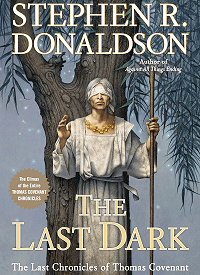
Central to the plan was, at long last, finishing The Chronicles of Thomas Covenant, by Stephen R. Donaldson. Specifically, finishing The Last Chronicles, the third (presumably final) set of the series (“set” because while the first two were trilogies, the third is a tetralogy, with four books).
Unfortunately, for various reasons (or various naps), I only managed to get halfway through the second book.
Continue reading
7 Comments | tags: Linden Avery, Stephen R. Donaldson, Thomas Covenant, white gold ring, wild magic | posted in Books, Sci-Fi Saturday
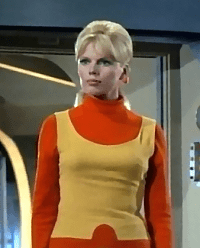
Judy, Judy, Judy!
I’ve been a fan of science fiction since the early 1960s. I was already an avid fan and ready audience for Lost in Space (1966–68; Judy was one of my earliest childhood crushes), It’s About Time (1966–67), and I was glued to the TV set enthralled when Kirk, Spock, and the rest, first boldly went in 1966.
By then I’d already consumed all I could of Asimov, Clarke, Heinlein, along with Verne, Wells, and Burroughs (I didn’t discover Tolkien or Howard until high school a few years later).
Movies like The Day the Earth Stood Still (1951), 20,000 Leagues Under the Sea (1954), and Forbidden Planet (1956), all had me avid for 2001: A Space Odyssey (1968).
It’s been a whole lot of years, and a whole lot of science fiction, is my point.
Continue reading
22 Comments | tags: cyberpunk, Edgar Rice Burroughs, H.G. Wells, Isaac Asimov, Jules Verne, Lost in Space, Neal Stephenson, Robert E. Howard, science fiction, science fiction books, science fiction movies, science fiction TV, SF, SF Books, SF Movies, Snow Crash, William Gibson | posted in Books, Movies, Sci-Fi Saturday, TV
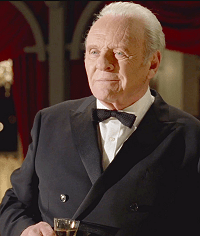 At one point in HBO’s Westworld (don’t worry, no spoilers) Robert Ford (Anthony Hopkins) gives a speech about stories, about the value of fiction. He references a belief that fiction elevates — or at least illuminates to good value — the human condition. The belief also holds that those who read a lot of fiction are in some sense “better” people.
The idea is controversial on several grounds. Firstly, it’s hard to define what makes people “better,” and you can’t measure or test what you can’t define. Secondly, even if “better” is defined, not everyone will agree with the definition. Thirdly, there’s a nature-nurture aspect that makes comparisons like this very hard to tease out of any data you can gather.
Maybe a place to start exploring the idea is to first define “fiction” and go from there…
Continue reading
8 Comments | tags: facts, false, Fiction, lies, storytelling, theory of mind, true, truth, wisdom | posted in Books, Movies, TV, Writing
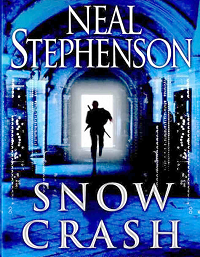 Fair Warning: Next week I have some political and social foaming at the mouth to do over current events and modern society, but that can wait. The weather recently has been too nice for my hot-collar wardrobe. The swelter is supposed to return next week; the forecast is for serious ranting with scattered raving.
For the weekend, for Science Fiction Saturday in particular, for all my disdain of movie and TV science fiction (especially TV SF, most of which does nothing for me), literary science fiction is very alive and quite well!
Recently I’ve been enjoying three authors in particular…
Continue reading
10 Comments | tags: Diaspora, Greg Egan, Hannu Rajaniemi, Neal Stephenson, Permutation City, Seveneves, Snow Crash, The Quantum Thief | posted in Books, Sci-Fi Saturday
 Here’s something that caught my eye: Researchers at the University of Vermont, in the Computational Story Lab (!), did an interesting word content analysis on 1,700 stories downloaded from Gutenberg. Each story had been downloaded at least 150 times by readers.
The researchers used “sentiment analysis” that measures the positive or negative emotional impact of words. Using a sliding window, they attempted to characterize the “emotional arcs” of each story. Their goal was to see if there were common patterns.
Turns out, there are!
Continue reading
26 Comments | tags: emotional arcs, printed word, seven plots, stories, story plots, storytelling, text, words | posted in Books, Writing




You must be logged in to post a comment.