Tag Archives: Theory of Consciousness
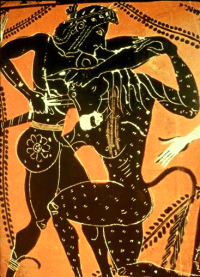 In Greek mythology, the hero Theseus, who slew the Minotaur and escaped its maze, returned from Crete to Athens where the Athenians preserved his ship in seaworthy state for more than a thousand years. It was an emblem of courage and a reminder of a national hero that many Greeks considered more legendary than mythological.
The Ship of Theseus was carefully maintained. Parts that rotted away were replaced with exact replicas. And in a ship made almost entirely of wood, crude iron, rope, and sail, everything rots, so eventually everything gets replaced.
Which makes the identity of the ship an interesting question.
Continue reading
42 Comments | tags: brain mind problem, consciousness, Discworld, human brain, human consciousness, human mind, identity, Ship of Theseus, Theory of Consciousness, Theseus | posted in Philosophy, Sci-Fi Saturday
 Over the last few weeks I’ve written a series of posts leading up to the idea of human consciousness in a machine. In particular, I focused on the difference between a physical model and a software model, and especially on the requirements of the software model.
The series is over, I have nothing particularly new to add, but I’d like to try to summarize my points and provide an index to the posts in this series. It seems I may have given readers a bit of information overload — too much information to process.
Hopefully I can achieve better clarity and brevity here!
Continue reading
30 Comments | tags: AI, algorithm, brain, brain mind problem, chaos theory, computationalism, computer model, computer program, consciousness, human brain, human consciousness, human mind, information theory, mind, My brain is full, stored program computer, Theory of Consciousness, Von Neumann architecture | posted in Computers
 Last time we considered the possibility that human consciousness somehow supervenes on the physical brain, that it only emerges under specific physical conditions. Perhaps, like laser light and microwaves, it requires the right equipment.
We also touched on how Church-Turing implies that, if human consciousness can be implemented with software, then the mind is necessarily an algorithm — an abstract mathematical object. But the human mind is presumed to be a natural physical object (or at least to emerge from one).
This time we’ll consider the effect of transcendence on all this.
Continue reading
58 Comments | tags: AI, algorithm, brain mind problem, computationalism, computer model, computer program, consciousness, human brain, human consciousness, human mind, mind, software model, Theory of Consciousness, transcendental numbers, Yin and Yang | posted in Computers
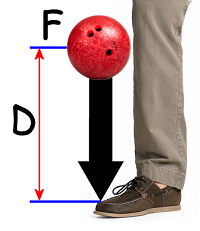
“Ouch!”
Over the past few weeks we’ve explored background topics regarding calculation, code, and computers. That led to an exploration of software models — in particular a software model of the human brain.
The underlying question all along is whether a software model of a brain — in contrast to a physical model — can be conscious. A related, but separate, question is whether some algorithm (aka Turing Machine) functionally reproduces human consciousness without regard to the brain’s physical structure.
Now we focus on why a software model isn’t what it models!
Continue reading
41 Comments | tags: AI, algorithm, bowling ball, brain mind problem, Church-Turing thesis, computationalism, computer model, computer program, consciousness, hot resistor, human brain, human consciousness, human mind, laser light, magnetron, microwaves, mind, software model, Theory of Consciousness | posted in Computers
 I have mentioned before that I like to observe a Sabbath of some kind, a day of rest and difference. Years of religious indoctrination cause me to see Sunday as that day. More than forty years of work life reenforced that view (although I often worked Sundays in my very first job). Ultimately the actual day isn’t important; it’s the idea of taking a weekly break from normal that I think is crucial to mental well-being.
There is also for me, not a religious component, but a moral one nevertheless. I observe certain restrictions on my Sabbath (I don’t watch anything violent, for example), and I try to connect with my gentler side. (I’m actually a gentle soul at heart. The world has had the effect of giving me a crusty, pointy exterior.)
So today, no Python, no POV-Ray, no math (no rants).
Continue reading
4 Comments | tags: Carlos Castaneda, dinosaur water, faith, metaphysics, Sabbath, spirituality, Sunday, Theory of Consciousness, Thomas Aquinas, Timothy Leary, W.G. Sebald | posted in Life, Religion
 If you have read this blog much, you know that a topic that interests me greatly is the nature of consciousness. How is it that a three-pound clump of cells, a brain, gives rise to the rich experience of consciousness, our minds? Cognitive scientist David Chalmers termed this “the hard problem” of consciousness, and as it stands we really have no idea what consciousness is (and yet we all experience it all the time).
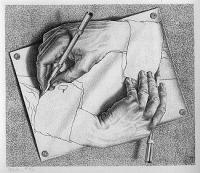
Back in 1979 cognitive scientist Douglas Hofstadter wrote Gödel, Escher, Bach, a book that attempts to answer the question. GEB, as it became known, was a large book most took as a random tour of interesting scientific ideas. But GEB did have a theme, so 25 years later Hofstadter wrote another (much shorter) book to re-state his case.
That book is called I Am a Strange Loop, and it has much worth considering!
Continue reading
46 Comments | tags: brain, David Chalmers, Douglas Hofstadter, experience, GEB, mind, Paris Hilton, Philosophical zombie, Theory of Consciousness | posted in Philosophy, Science
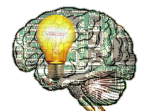 This may be the first actual Brain Bubble I’ve ever posted! The original intent was to provide a mechanism for sudden (short) thoughts I wanted to record or put out there. But the BB posts quickly turned into mini collections of thought bubbles.
But today I started trying to get into Immanuel Kant (again), and that naturally led to a bit of Wiki Walking.
It was when I got to the article about the subject-object problem that a sudden brain bubble burst!
Continue reading
2 Comments | tags: brain mind problem, David Chalmers, Immanuel Kant, subject-object problem, Theory of Consciousness | posted in Brain Bubble, Philosophy, Science
 My recent post about how the Big Bang and “Let there be Light” seem equally fantastic to me triggered an interesting comment from a reader. A detailed response requires more elbow room than a comment allows, so here’s a follow-up article instead.
One of the points involved that our scientific ideas, no matter how inaccurate they may turn out to be, are at least based on evidence. And to the credit of science, when we recognize errors in our interpretation of the evidence, science changes to accommodate the new interpretation.
This has been, as I mentioned in that post, hugely successful. One of the failures of our spiritual metaphysics is that it clings to frameworks defined thousands of years ago and often stubbornly refuses to accommodate new information.
Continue reading
7 Comments | tags: atheism, big bang, brain mind problem, Gandhi, Kurt Gödel, Lee Smolin, Max Planck, quantum physics, Roger Penrose, Sheldon Glashow, spacetime, spirituality, String theory, theism, Theory of Consciousness, Yin and Yang | posted in Philosophy, Physics, Religion, Science
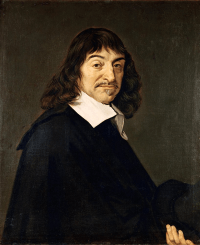 In my first post I mentioned René Descartes and his seminal statement, “Cogito ergo sum.” I think, therefore I am. Because this statement and the ideas that spring from it lie at the heart of my philosophy and interests, it is a fitting topic for my second post. I also mentioned beginnings; these beginning posts explore such core topics as form my core and inform my mind.
And mind is the topic at hand. “I think, therefore I am,” concerns one of the most central, most personal, most mysterious, most fantastic aspects of our existence. It concerns something each of us shares every waking moment, but which remains–thus far–completely unknown.
That every moment mystery is that we think and experience. Each of us has a voice inside their head; an «I» that is us. It’s the driver of the car that says, “I’m hungry,” or “I’m going to the library.”
Continue reading
14 Comments | tags: Cogito ergo sum, Isaac Asimov, positronic brain, René Descartes, Star Trek, Theory of Consciousness | posted in Basics, Philosophy
“In the beginning was the Word, and the Word was…”
Many of you will recognize that as the first words of John 1:1 in the Christian New Testament Bible. There’s also a cross-reference to the very first words of that Bible (Old Testament in this case), “In the beginning God created the heavens and the earth.”
This is about words and about beginnings.
Others might recognize it as a conflation of the lead-in to a Moody Blues tune, OM, from In Search of the Lost Chord, and the title of a song from another album, In the Beginning, from On the Threshold of a Dream.
(Yes “album.” I’m old!)
Continue reading
23 Comments | tags: brain, brain mind problem, computationalism, computer guy, human brain, human mind, logos, Marriage, Moody Blues, rational mind, René Descartes, Theory of Consciousness, theory of mind | posted in Baseball, Basics, Books, Computers, Life, Movies, Opinion, Philosophy, Politics, Rant, Science, Society, The Interweb, TV






 Logos con carne