Tag Archives: human brain
 After a weekend of transistorized baseball, it’s time to get back to wandering through pondering consciousness. I laid down a few cobblestones last week; time to add a few more to the road. Eventually I’ll have something on which I can drive an argument.
There are a number of classic, or at least well-known, arguments for and against computationalism. They variously involve Pixies, different kinds of Zombies, people trapped in different kinds of rooms, and rock walls that compute. (In fact, they compute rooms that trap Pixies. And everything else.)
Today I’m going to ruminate on the world’s most unfortunate file clerk.
Continue reading
91 Comments | tags: brain, brain mind problem, computationalism, consciousness, human brain, human consciousness, human mind, John Searle, mind, The Chinese Room, Theory of Consciousness, theory of mind | posted in Computers, Philosophy, Science
When it comes to consciousness, one of the top challenges is defining what it is. (Some insist it doesn’t even exist, which makes defining it even more of a challenge.) Part of the problem is that there is no single correct definition. There never really has been.
There is also that there is sentience (essentially the ability to feel pain as pain) and there is sapience (roughly: wisdom). Lots of animals are sentient, but sapience seems to be a property of human consciousness.
Which raises the question: Are humans just a point on a spectrum, or is there some sort of “band gap” between higher and lower forms?
Continue reading
24 Comments | tags: brain, brain mind problem, consciousness, human brain, human consciousness, human mind, mind, Theory of Consciousness, theory of mind | posted in Opinion, Philosophy
Moving on from system states (and states of the system), today I’d like to fly over the landscape of different systems. In particular, systems that are — or are not — viewed as conscious.
Two views make this especially interesting. The first holds that everything is computing everything and — under computationalism — this includes conscious computations. The second (if I understand it) holds that anything that processes input data into some kind of output is conscious. (I’m not clear if the view also sees an input-output system as a computer.)
So I want to explore what I see as major landmarks in the landscape of systems that… well, about the only thing we can probably all agree on is that they do something.
Continue reading
14 Comments | tags: brain mind problem, cargo cult, computationalism, consciousness, human brain, human consciousness, human mind, interpretation, mind, positronic brain, Theory of Consciousness, theory of mind | posted in Computers, Philosophy, Science
My illusion of free will decided the month of May must be made for Mind (and maybe a dash of Mandelbrot). Lately, online discussions about consciousness have me pondering it again. I never posted on topics such as Chinese Rooms or Philosophical Zombies, largely because sensible arguments exist both ways, and I never decided exactly where I fell in the argument space.
It’s not that I’ve decided[1] on the topics so much as I’ve decided to write about them (and other topics). I’ve found that writing about a topic does a lot to clarify my mind about it. (Trying to teach a topic does that even more.)
I’ll start today with some personal observations and points of view.
Continue reading
11 Comments | tags: brain mind problem, cargo cult, computationalism, consciousness, human brain, human consciousness, human mind, interpretation, mind, Theory of Consciousness, theory of mind | posted in Computers, Philosophy, Science
 On the one hand, a main theme here is theories of consciousness. On the other hand, it’s been almost eight years blogging, and I’ve covered my views pretty well in numerous posts and comment threads. Our understanding of consciousness currently seems stuck pending new discoveries, either in answering hard questions, or in providing entirely new paths.
A while back I determined to step away from debates (even blogs) that center on topics with no resolution. Religion is a big one, but theories of mind is another. Your view depends on your axioms. Unless (or until) science provides objective answers, everyone is just guessing.
But it’s been three-and-a-half years, and, well,… I have some notes…
Continue reading
8 Comments | tags: AI, brain, brain mind problem, chaos theory, Cogito ergo sum, computationalism, computer model, computer program, consciousness, human brain, human consciousness, human mind, information theory, Isaac Asimov, mind, stored program computer, Theory of Consciousness, Von Neumann architecture | posted in Computers, Opinion, Science
 In Greek mythology, the hero Theseus, who slew the Minotaur and escaped its maze, returned from Crete to Athens where the Athenians preserved his ship in seaworthy state for more than a thousand years. It was an emblem of courage and a reminder of a national hero that many Greeks considered more legendary than mythological.
The Ship of Theseus was carefully maintained. Parts that rotted away were replaced with exact replicas. And in a ship made almost entirely of wood, crude iron, rope, and sail, everything rots, so eventually everything gets replaced.
Which makes the identity of the ship an interesting question.
Continue reading
42 Comments | tags: brain mind problem, consciousness, Discworld, human brain, human consciousness, human mind, identity, Ship of Theseus, Theory of Consciousness, Theseus | posted in Philosophy, Sci-Fi Saturday
A while back I realized I had an Engineer’s Mind. I’ve always had a sense of that. What I realized was the significance of the Engineer’s Mind category. And of other categories of Mind — for example an Artist’s Mind (which I didn’t discover I also had until high school; see My Life 2.0).
Having a given Mind doesn’t mean one is necessarily good at something (skill takes practice), but it does suggest a predisposition or talent for it. Our minds seem to come pre-wired in two ways: core wiring that makes us human; and “flavor” wiring that gives us (some of our) basic traits. For instance, some people have — or strongly do not to have — a Math Mind.
I’ve found Mind a useful metaphor as well as a game to play.
Continue reading
7 Comments | tags: art, artist, brain, engineer, engineering, engineers, human brain, human mind, mind, mind-set, teacher | posted in Basics, Life
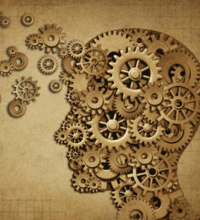 Over the last few weeks I’ve written a series of posts leading up to the idea of human consciousness in a machine. In particular, I focused on the difference between a physical model and a software model, and especially on the requirements of the software model.
The series is over, I have nothing particularly new to add, but I’d like to try to summarize my points and provide an index to the posts in this series. It seems I may have given readers a bit of information overload — too much information to process.
Hopefully I can achieve better clarity and brevity here!
Continue reading
30 Comments | tags: AI, algorithm, brain, brain mind problem, chaos theory, computationalism, computer model, computer program, consciousness, human brain, human consciousness, human mind, information theory, mind, My brain is full, stored program computer, Theory of Consciousness, Von Neumann architecture | posted in Computers
 Last time we considered the possibility that human consciousness somehow supervenes on the physical brain, that it only emerges under specific physical conditions. Perhaps, like laser light and microwaves, it requires the right equipment.
We also touched on how Church-Turing implies that, if human consciousness can be implemented with software, then the mind is necessarily an algorithm — an abstract mathematical object. But the human mind is presumed to be a natural physical object (or at least to emerge from one).
This time we’ll consider the effect of transcendence on all this.
Continue reading
58 Comments | tags: AI, algorithm, brain mind problem, computationalism, computer model, computer program, consciousness, human brain, human consciousness, human mind, mind, software model, Theory of Consciousness, transcendental numbers, Yin and Yang | posted in Computers
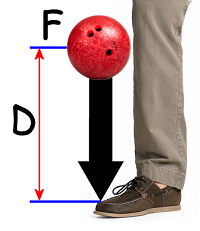
“Ouch!”
Over the past few weeks we’ve explored background topics regarding calculation, code, and computers. That led to an exploration of software models — in particular a software model of the human brain.
The underlying question all along is whether a software model of a brain — in contrast to a physical model — can be conscious. A related, but separate, question is whether some algorithm (aka Turing Machine) functionally reproduces human consciousness without regard to the brain’s physical structure.
Now we focus on why a software model isn’t what it models!
Continue reading
41 Comments | tags: AI, algorithm, bowling ball, brain mind problem, Church-Turing thesis, computationalism, computer model, computer program, consciousness, hot resistor, human brain, human consciousness, human mind, laser light, magnetron, microwaves, mind, software model, Theory of Consciousness | posted in Computers








 Logos con carne