Category Archives: Science
 I was gonna give us all the day off today, honestly, I was! My Minnesota Twins start their second game in about an hour, and I really planned to just kick back, watch the game, have a couple of beers, and enjoy the day. And since tomorrow’s March wrap-up post is done and queued, more of the same tomorrow.
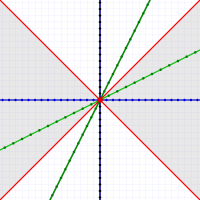
But this is too relevant to the posts just posted, and it’s about Special Relativity, which is a March thing to me (because Einstein), so it kinda has to go here. Now or never, so to speak. And it’ll be brief, I think. Just one more reason I’m so taken with matrix math recently; it’s providing all kinds of answers for me.
Last night I realized how to use matrix transforms on spacetime diagrams!
Continue reading
Leave a comment | tags: Albert Einstein, faster than light, light speed, matrix math, matrix transform, simultaneity, spacetime, Special Relativity, speed of light | posted in Math, Physics
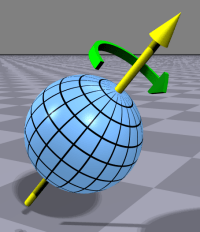 In the last installment I introduced the idea of a transformation matrix — a square matrix that we view as a set of (vertically written) vectors describing a new basis for a transformed space. Points in the original space have the same relationship to the original basis as points in the transformed space have to the transformed basis.
When we left off, I had just introduced the idea of a rotation matrix. Two immediate questions were: How do we create a rotation matrix, and how do we use it. (By extension, how do we create and use any matrix?)
This is where our story resumes…
Continue reading
4 Comments | tags: 3Blue1Brown, column vector, linear algebra, matrix math, matrix multiplication, rotation, unit vector, vectors | posted in Math, Sideband
For me, the star attraction of March Mathness is matrix rotation. It’s a new toy (um, tool) for me that’s exciting on two levels: Firstly, it answers key questions I’ve had about rotation, especially with regard to 4D (let alone 3D or easy peasy 2D). Secondly, I’ve never had a handle on matrix math, and thanks to an extraordinary YouTube channel, now I see it in a whole new light.
Literally (and I do mean “literally” literally), I will never look at a matrix the same way again. Knowing how to look at them changes everything. That they turned out to be exactly what I needed to understand rotation makes the whole thing kinda wondrous.
I’m going to try to provide an overview of what I learned and then point to a great set of YouTube videos if you want to learn, too.
Continue reading
20 Comments | tags: 3Blue1Brown, column vector, complex numbers, linear algebra, matrix math, matrix multiplication, rotation, trigonometry, unit vector, vectors | posted in Math, Sideband
I’ve been hinting all month about rotation, and the time has finally come to dig into the topic. As mentioned, my interest began with wanting to understand what it means to rotate a tesseract — particularly what’s really going on in a common animation that I’ve seen. What’s the math there?
This interest in rotation is part of a larger interest: trying to wrap my head around the idea of a fourth physical dimension. (Time is sometimes called the fourth dimension, but not here.) To make it as easy as possible, for now I’m focusing only on tesseractae, because “squares” are an easy shape.
After chewing at this for a while (the tesseract post was late 2016), just recently new doors opened up, and I think this journey is almost over!
Continue reading
3 Comments | tags: 2D, 3D, 3D space, 4D, coordinates, cube, dimensions, geometry, line, point, rectangular coordinates, right angle, rotation, square, tesseract | posted in Math
 To start the last week of March Mathness, because it’s a Monday, I’m going to go easy on y’all with some light, easy topics. (Maybe I can lull you into paying attention for the major topic of the month: matrix rotation.)
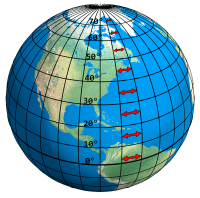
It has occurred to me that, if I’m talking about math in March, I absolutely must mention one of my all-time favorite mathematical objects, the Mandelbrot. I’ll try to get to that today, but the main topic is a simple something that I ran into while working on my 3D model of the big island of Hawaii.
The question was: How many miles are there per degree of latitude?
Continue reading
10 Comments | tags: circle of latitude, cosine, Earth, latitude, longitude, Mandelbrot, Maths Town, nautical mile, radius | posted in Math
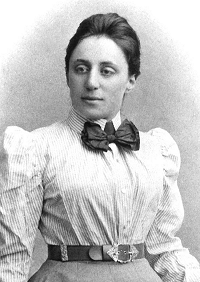 Last week we celebrated Albert Einstein’s birthday (he turned 140). Now we need another cake so we can celebrate the other March major mathematician’s birthday — Emmy Noether turns 137 today.
To my regret, despite that I frequently invoke her name (she co-starred with Albert in the Special Relativity series), her work in mathematics is pretty far above my head, and I’m simply not qualified to write about it. I can say that her work connects mathematical symmetry with physical conservation laws. She also made significant contributions to abstract algebra.
Just recently, I’ve begun to nibble at the edges of the latter in the form of group theory as a part of studying rotation.
Continue reading
21 Comments | tags: algebra, cube, Emmy Noether, group theory, mathematics, rotation, square, tesseract | posted in Math
 Back at the start of March Mathness I promised the math would be “fun” (really!), but anyone would be forgiven for thinking the previous two posts about Special Relativity weren’t all that much “fun.” (I really enjoy stuff like that, so it’s fun for me, but there’s no question it’s not everyone’s cup of tea.)
Trying to reach for something a bit lighter and potentially more appealing as the promised “fun,” I present, for your dining and dancing pleasure, a trio of number games that anyone can play and which might just tug at the corners of your enjoyment.
We can start with 277777788888899 (and why it’s special).
Continue reading
4 Comments | tags: 277777788888899, algorithm, calculation, Collatz conjecture, computation, Mandelbrot, mathematics, multiplicative persistence, Numberphile | posted in Math
 In the March Mathness post I mentioned that one reason I love March is that it contains the Vernal Equinox, the official astronomical start of Spring. More importantly to me, it means six months of more daylight than darkness, and as much as I’m a night person, I prefer long, sunny days.
Well, today is the day! The equinox happened at 21:58 UTC (two minutes before 5:00 PM locally). What’s better is that, after all the miserable bitter cold and all that snow in February and into March, the weather is indeed finally turning. Deeply embedded in our mythologies is the idea of spring rebirth; New Year’s parties aside, this, today, is the true new year.
And the forecast is for muon showers!
Continue reading
17 Comments | tags: Albert Einstein, equinox, muon, Special Relativity, spring, spring equinox, tau, vernal equinox | posted in Physics
Speaking of Special Relativity, back when I wrote the SR series, one topic I left along the wayside was the concept of the spacetime interval. It wasn’t necessary for the goals of the series, and there’s only so much one can fit in. (And back then, the diagrams I wanted to make would have been a challenge with the tool I was using.)
But now that we’re basking in the warm, friendly glow of March Mathness and reflecting on Special Relativity anyway, it seems like a good time to loop back and catch up on the spacetime interval, because it’s an important concept in SR.
It concerns what is invariant to all observers when both time and space measurements depend on relative motion.
Continue reading
7 Comments | tags: Albert Einstein, faster than light, frame of reference, light, light speed, simultaneity, spacetime, Special Relativity, speed of light | posted in Physics
 Earlier, in the March Mathness post, I mentioned Albert Einstein was born on March 14th. That’s also Pi Day, which deserved its own pi post (about pizza pi), so old Al had to wait for me to address a topic I’ve needed to address for several months.
To wit: Some guy was wrong on the internet.
That guy was me.
Back in 2015 (also celebrating Einstein’s birthday), I wrote a series of posts exploring Special Relativity. Near the end of the series, writing about FTL radio, I said (assuming an “ansible” existed) I wasn’t convinced it violated causality if the frames of reference were matched.
Continue reading
13 Comments | tags: Albert Einstein, ansible, causality, causality violation, faster than light, frame of reference, FTL, FTL radio, light, light speed, simultaneity, spacetime, Special Relativity, speed of light | posted in Physics







 Logos con carne