Tag Archives: computer model
 This is what I imagined as my final post discussing A Computational Foundation for the Study of Cognition, a 1993 paper by philosopher and cognitive scientist David Chalmers (republished in 2012). The reader is assumed to have read the paper and the previous two posts.
This post’s title is a bit gratuitous because the post isn’t actually about intentional states. It’s about system states (and states of the system). Intention exists in all design, certainly in software design, but it doesn’t otherwise factor in. I just really like the title and have been wanting to use it. (I can’t believe no one has made a book or movie with the name).
What I want to do here is look closely at the CSA states from Chalmers’ paper.
Continue reading
65 Comments | tags: algorithm, brain, brain mind problem, computation, computationalism, computer model, computer program, David Chalmers, finite state machine, human brain, human mind, mind, positronic brain, state diagram, state table, theory of mind | posted in Computers
This continues my discussion of A Computational Foundation for the Study of Cognition, a 1993 paper by philosopher and cognitive scientist David Chalmers (republished in 2012). The reader is assumed to have read the paper and the previous post.
I left off talking about the differences between the causality of the (human) brain versus having that “causal topology” abstractly encoded in an algorithm implementing a Mind CSA (Combinatorial-State Automata). The contention is that executing this abstract causal topology has the same result as the physical system’s causal topology.
As always, it boils down to whether process matters.
Continue reading
54 Comments | tags: algorithm, brain, brain mind problem, Church-Turing thesis, computation, computationalism, computer model, computer program, David Chalmers, human brain, human mind, mind, positronic brain, theory of mind | posted in Computers
I’ve always liked (philosopher and cognitive scientist) David Chalmers. Of those working on a Theory of Mind, I often find myself aligned with how he sees things. Even when I don’t, I still find his views rational and well-constructed. I also like how he conditions his views and acknowledges controversy without disdain. A guy I’d love to have a beer with!
Back during the May Mind Marathon, I followed someone’s link to a paper Chalmers wrote. I looked at it briefly, found it interesting, and shelved it for later. Recently it popped up again on my friend Mike’s blog, plus my name was mentioned in connection with it, so I took a closer look and thought about it…
Then I thought about it some more…
Continue reading
11 Comments | tags: algorithm, brain, brain mind problem, computation, computationalism, computer model, computer program, David Chalmers, human brain, human mind, mind, positronic brain, theory of mind | posted in Computers, Philosophy
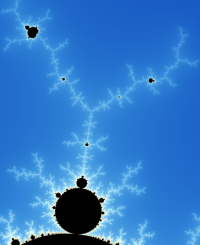
Mandelbrot Antennae
[click for big]
I realized that, if I’m going to do the Mandelbrot in May, I’d better get a move on it. This ties to the main theme of Mind in May only in being about computation — but not about computationalism or consciousness. (Other than in the subjective appreciation of its sheer beauty.)
I’ve heard it called “the most complex” mathematical object, but that’s a hard title to earn, let alone hold. Its complexity does have attractive and fascinating aspects, though. For most, its visceral visual beauty puts it miles ahead of the cool intellectual poetry of Euler’s Identity (both beauties live on the same block, though).
For me, the cool thing about the Mandelbrot is that it’s a computation that can never be fully computed.
Continue reading
11 Comments | tags: computation, computer model, computer program, fractals, Mandelbrot, Mandelbrot fractal, mathematics, Turing Halting Problem | posted in Computers, Math
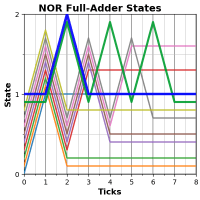
 Over the last three posts I’ve been exploring the idea of system states and how they might connect with computational theories of mind. I’ve used a full-adder logic circuit as a simple stand-in for the brain — the analog flow and logical gating characteristics of the two are very similar.
In particular I’ve explored the idea that the output state of the system doesn’t reflect its inner working, especially with regard to intermediate states of the system as it generates the desired output (and that output can fluctuate until it “settles” to a valid correct value).
Here I plan to wrap up and summarize the system states exploration.
Continue reading
2 Comments | tags: algorithm, computation, computationalism, computer model, computer program, consciousness, finite state machine, full-adder, state diagram, Theory of Consciousness, theory of mind | posted in Computers, Philosophy, Science
 I left off last time talking about intermediate, or transitory, states of a system. The question is, if we only look at the system at certain key points that we think matter, do any intermediate states make a difference?
In a standard digital computer, the answer is a definite no. Even in many kinds of analog computers, transitory states exist for the same reason they do in digital computers (signals flowing through different paths and arriving at the key points at different times). In both cases they are ignored. Only the stable final state matters.
So in the brain, what are the key points? What states matter?
Continue reading
16 Comments | tags: computation, computationalism, computer code, computer model, computer program, consciousness, full-adder, Theory of Consciousness, theory of mind | posted in Computers, Philosophy, Science
In the last post I talked about software models for a full-adder logic circuit. I broke them into two broad categories: models of an abstraction, and models of a physical instance. Because the post was long, I was able to mention the code implementations only in passing (but there are links).
I want to talk a little more about those two categories, especially the latter, and in particular an implementation that bridges between the categories. It’s here that ideas about simulating the brain or mind become important. Most approaches involve some kind of simulation.
One type of simulation involves the states of a system.
Continue reading
8 Comments | tags: algorithm, computation, computationalism, computer code, computer model, computer program, consciousness, full-adder, Theory of Consciousness, theory of mind, Turing Machine | posted in Computers, Philosophy, Science
 Imagine the watershed for a river. Every drop of water that falls in that area, if it doesn’t evaporate or sink into the ground, eventually makes its way, through creeks, streams, and rivers, to the lake or ocean that is the shed’s final destination. The visual image is somewhat like the veins in a leaf. Or the branches of the leaf’s tree.
In all cases, there is a natural flow through channels sculpted over time by physical forces. Water always flows downhill, and it erodes what it flows past, so gravity, time, and the resistance of rock and dirt, sculpt the watershed.
The question is whether the water “computes.”
Continue reading
16 Comments | tags: algorithm, computation, computationalism, computer code, computer model, computer program, consciousness, full-adder, Theory of Consciousness, theory of mind, Turing Machine | posted in Computers, Philosophy, Science
 On the one hand, a main theme here is theories of consciousness. On the other hand, it’s been almost eight years blogging, and I’ve covered my views pretty well in numerous posts and comment threads. Our understanding of consciousness currently seems stuck pending new discoveries, either in answering hard questions, or in providing entirely new paths.
A while back I determined to step away from debates (even blogs) that center on topics with no resolution. Religion is a big one, but theories of mind is another. Your view depends on your axioms. Unless (or until) science provides objective answers, everyone is just guessing.
But it’s been three-and-a-half years, and, well,… I have some notes…
Continue reading
8 Comments | tags: AI, brain, brain mind problem, chaos theory, Cogito ergo sum, computationalism, computer model, computer program, consciousness, human brain, human consciousness, human mind, information theory, Isaac Asimov, mind, stored program computer, Theory of Consciousness, Von Neumann architecture | posted in Computers, Opinion, Science
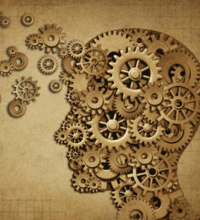 Over the last few weeks I’ve written a series of posts leading up to the idea of human consciousness in a machine. In particular, I focused on the difference between a physical model and a software model, and especially on the requirements of the software model.
The series is over, I have nothing particularly new to add, but I’d like to try to summarize my points and provide an index to the posts in this series. It seems I may have given readers a bit of information overload — too much information to process.
Hopefully I can achieve better clarity and brevity here!
Continue reading
30 Comments | tags: AI, algorithm, brain, brain mind problem, chaos theory, computationalism, computer model, computer program, consciousness, human brain, human consciousness, human mind, information theory, mind, My brain is full, stored program computer, Theory of Consciousness, Von Neumann architecture | posted in Computers






 Logos con carne