Category Archives: Science

Pancomputation II

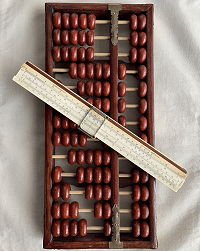
Computer cluster?

Last time I began exploring what we mean by the terms “computer” or “computation.” Upon examination, these turn out to be not entirely obvious, so some resort to the edge cases: Computers are Turing Machines; or Everything is a computer.

Even then the situation remains stubbornly not obvious. Turing Machines are abstractions quite different from what we typically call computers. Saying everything computes creates such a broad umbrella that it renders the notion of computation nearly useless.

This series explores the territory between those edge cases.

Continue reading


Pancomputation I

Two computers?

Earlier this year I wrote a trilogy of posts exploring digital dualism — the notion that a (conventional) computer has a physical layer that implements a causally distinct abstract layer. In writing those posts I found my definition of computation shifting slightly to embrace the notion of that dualism.

The phrase “a (conventional) computer” needs unpacking. What is a computer, and what makes one conventional? Computer science offers a mathematical view. Philosophy, as it often does, spirals in on the topic and offers a variety of pancomputation views.

In this series I’ll explore some of those views.

Continue reading


Flat Space of the Torus

Flat Earth!

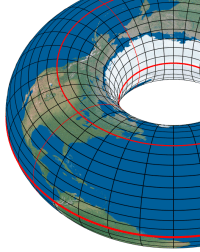
To describe how space could be flat, finite, and yet unbounded, science writers sometimes use an analogy involving the surface of a torus (the mathematical abstraction of the doughnut shape). Such a surface has no boundary — no edge.  And despite being embedded in three-dimensional space, the torus surface, if seen in terms of compensating surface metric, is indeed flat.

Yet a natural issue people have is that the three-dimensional embedding is clearly curved, not flat. It’s easy to see how wrapping a flat 2D sheet into a cylinder doesn’t distort it, but hard to see why wrapping a cylinder around a torus doesn’t stretch the outside and compress the inside.

In fact it does, but there are ways to eat our cake (doughnut).

Continue reading


BB #75: Gloves and Shoes

Speaking of Bell tests, I’ve noticed that science writers often struggle to find a good metaphor that illustrates just what’s so weird about the correlation between entangled particles. Bell tests are complex, and because they squat in the middle of quantum weirdness, they’re hard to explain in any classical terms.

I thought I had the beginnings of a good metaphor, at least the classical part. But the quantum part is definitely a challenge. (All the more so because I’m still not entirely clear on the deep details of Bell’s theorem myself.)

Worse, I think my metaphor fails the ping-pong ball test.

Continue reading


QM 101: Fun with Photons

Last time I explored the quantum spin of photons, which manifests as the polarization of light. (Note that all forms of light can be polarized. That includes radio waves, microwaves, IR, UV, x-rays, and gamma rays. Spin — polarization — is a fundamental property of photons.)

I left off with some simple experiments that demonstrated the basic behavior of polarized light. They were simple enough to be done at home with pairs of sunglasses, yet they demonstrate the counter-intuitive nature of quantum mechanics.

Here I’ll dig more into those and other experiments.

Continue reading


QM 101: Photon Spin

Earlier in this QM-101 series I posted about quantum spin. That post looked at spin 1/2 particles, such as electrons (and silver atoms). This post looks at spin in photons, which are spin 1 particles. (Bell tests have used both spin types.) In photons, spin manifests as polarization.

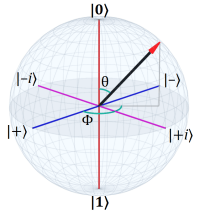
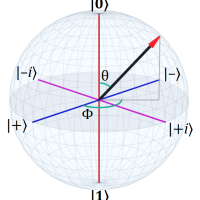
Photon spin connects the Bloch sphere to the Poincaré sphere — an optics version designed to represent different polarization states. Both involve a two-state system (a qubit) where system state is a superposition of two basis states.

Incidentally, photon polarization reflects light’s wave-particle duality.

Continue reading


BB #74: Which MWI?

I finished The Quantum Labyrinth: How Richard Feynman and John Wheeler Revolutionized Time and Reality (2017), by Paul Halpern. As the title implies, the book revolves around the careers and lives of John A. Wheeler (1911–2008) and Richard Feynman (1918–1988). After Feynman graduated from MIT he became Wheeler’s teaching assistant at Princeton. The two men, despite very different personalities, became life-long friends and collaborators.

One of Wheeler’s many claims to fame is his promotion of Hugh Everett’s PhD thesis, The Theory of the Universal Wave Function. That paper, of course, is the seed from which grew the Many Worlds Interpretation of Quantum Mechanics.

The thing is, there are two major versions of the MWI.

Continue reading


BB #73: Wavefunction Collapse

I’m two-thirds through my second Paul Halpern book this month. Earlier I read his book about cosmology, Edge of the Universe: A Voyage to the Cosmic Horizon and Beyond (2012), which was okay. Now I’m reading The Quantum Labyrinth: How Richard Feynman and John Wheeler Revolutionized Time and Reality (2017), which I’m enjoying a bit more. In part because cosmology has changed more since 2012 than quantum physics has since 2017. (Arguably, the latter hasn’t changed much since the 1960s.)

I wrote about Halpern’s book, Einstein’s Dice and Schrödinger’s Cat (2015), last year. As the title implies, it focuses on two great names from physics. Quantum Labyrinth (as its title also implies) also focuses on two great physics names.

But today’s Brain Bubble (as the title implies) is about wavefunction collapse.

Continue reading


Sideband #73: Complex 4D

I’ve written a number of posts about four-dimensional Euclidean space, usually in the context of one of my favorite geometrical objects, the tesseract. I’ve also mentioned 4D Euclidean spaces as just one of many possible multi-dimensional parameter spaces. In both cases, the familiar 2D and 3D spaces generalize to additional dimensions.

This post explores a specialized 4D space that uses complex numbers along each axis of a 2D nominally Euclidean space. Each X & Y coordinate has two degrees of freedom, a magnitude and a phase. This doesn’t make 4D spaces easier to visualize, but it can offer a useful way to think about them.

It also connects back to something I wrote about in my QM-101 series.

Continue reading


MWI: Questions, part 3

This is the third part of a series examining the Many Worlds Interpretation of Quantum Mechanics (the MWI of QM). The popularity of the MWI in books, blogs, and science videos, especially among the science-minded, tends to keep in present in some corner of my mind. Blog posts are a way to shoo it out.

The first part introduced the topic and talked about cats. The second part discussed the Schrödinger equation, wavefunctions, decoherence, and the question of how multiple instances of matter can coincide. That question, to me, is a central issue I have with MWI.

This time I dig into quantum superposition and touch on a few other topics.

Continue reading