Category Archives: Science
 I’ve mentioned before that, after ten years of retired idleness, this year I’ve applied myself to getting some long-standing items off my TODO list. I’m a lazy beaver, not a busy one, but I’ve been less lazy than usual in 2023. (Perhaps, in part, because, on several counts, I can’t believe it’s actually 2023. I remember a time when 2001 seemed far off… in the future.)
One long-standing item off my “Gee, I Oughta…” list was doing one of those DNA assessment things I’ve seen advertised for years. I was adopted as an infant, so I’ve never known my genetic heritage.
Now, at long last, I do. And a bunch of other stuff besides.
Continue reading
8 Comments | tags: ancestors, DNA, genetic code | posted in Life, Science
 This is one of those geeky posts more a “Dear Diary” (or “Dear Lab Notebook”) entry than a post I expect anyone anywhere will get anything out of. This — in part — is about how we define numbers using set theory, so it’s pretty niche and rarified. Tuning out is understandable; this is extra-credit reading.
This is also about having a double-lightbulb moment. I finally get why what always seemed an overly complicated approach is actually perfect. A smaller lightbulb involves easily solving a programming problem that confounded me previously.
Fun for me, but your mileage may vary.
Continue reading
3 Comments | tags: computer code, math theory, natural numbers, set theory | posted in Brain Bubble, Math
 Or do I mean Logic Square? Because it works either way. The Logic Square (or Square Logic) in question is a logic game created by Charles Lutwidge Dodgson (1832-1898) and introduced in his 1896 book Symbolic Logic Part I (a second part was published posthumously).
Dodgson was a capable mathematician, but most probably know him by his penname, Lewis Carroll, under which he wrote poetic fantasy fiction about a girl who goes on wild adventures.
But this is about his logic game. It’s like a square Venn diagram with game pieces.
Continue reading
5 Comments | tags: boolean logic, four-square, Lewis Carroll, logic, logic games, Venn diagram | posted in Basics, Math
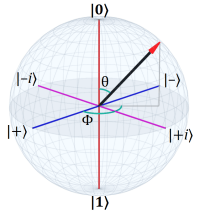 It’s been a while, but the two previous posts in this series (this one and this one) explored the mechanism behind partial differential equations that equate the time derivative (the rate of change), with the second spatial derivative (the field curvature). The result pulls exceptions to the average back to the average in proportion to how exceptional they are.
Such equalities appear in many classical physics equations where they have clear physical meaning. Heat diffusion (explored in the previous posts) is a good example.
In quantum mechanics, they also appear in the Schrödinger Equation.
Continue reading
6 Comments | tags: QM101, quantum mechanics, Schrödinger Equation, wave-function | posted in Math, Physics
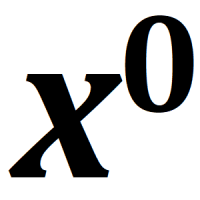 At some point in our early math education, we’re told that anything to the power of zero evaluates to one. 1°=1 and 5°=1 and 99°=1. Basically, x°=1 for all x. It’s typically presented as just a rule about taking anything to the power of zero, but it’s actually derived from a more basic rule about exponents.
Thinking about x° in connection with something else recently, it occurred to me there’s a second way to justify the notion that anything to the power of zero is one.
It also occurred to me 0ⁿ might be an implementation of the Dirac delta.
Continue reading
2 Comments | tags: Dirac delta, exponentiation, group theory, multiplication, Paul Dirac, zero | posted in Math
 I don’t know why I’m so fascinated that the rational numbers are countable even though they’re a dense subset of the uncountable real numbers. A rational number can be arbitrarily close to any real number, making you think they’d be infinite like the reals, but in fact, nearly all numbers are irrational (and an uncountable subset of the reals).
So, the rational numbers — good old p/q fractions — though still infinite are countably infinite (see this post for details).
More to the point here, a common way of enumerating the rational numbers, when graphed results in some pretty curves and illustrates some fun facts about the rational numbers.
Continue reading
4 Comments | tags: charts, fractions, graphs, rational numbers | posted in Brain Bubble, Math
 Zeno’s famous Paradoxes involve the impossibility of arriving somewhere as well as the impossibility of even starting to go somewhere. And that flying arrows have to be an illusion. [Time flies like an arrow, but fruit flies like a banana.]
If Zeno were alive today, he’d be over 2500 years old and would have seen his paradoxes explained in a variety of ways by a lot of very smart people. Yet at heart they still have some metaphysical oomph. And the thing is, at least in some contexts, Zeno was (sort of) right. There is something of a paradox here involving space and time.
Or at least something interesting to think about.
Continue reading
7 Comments | tags: rational numbers, real numbers, Zeno of Ela, Zeno's paradoxes | posted in Brain Bubble, Math, Philosophy
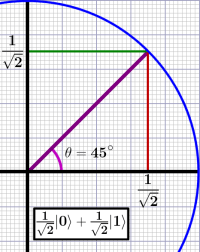 It’s actually obvious and might fall under the “Duh!” heading for some, but it only recently sunk in on me that the Born Rule is really just another case of the Pythagorean theorem. The connection is in the way the coefficients of a quantum superposition, when squared, must sum to unity (one).
For that matter, Special Relativity, which is entirely geometric, is yet another example of the Pythagorean theorem, but that’s another story. (One I’ve already told. See: SR #X6: Moving at Light Speed)
The obvious connection is the geometry behind how a quantum state projects onto the basis eigenvectors axes.
Continue reading
9 Comments | tags: geometry, Pythagoras, QM101, quantum mechanics, trigonometry | posted in Brain Bubble, Math, Physics
 In The Road to Reality (2004), Roger Penrose writes about a great analogy for symmetry breaking. Apparently, this analogy is rather common in the literature. (No, it’s not the thing about the pencil — this one involves an iron ball.) Once again, I find myself agreeing with Penrose about something; it is a great analogy.
Symmetry breaking (which can be explicit or spontaneous) is critical in many areas of physics. For instance, it’s instrumental in the Higgs mechanism that’s responsible for the mass of some particles.
The short post is for those interested in physics who (like I) have struggled to understand exactly what symmetry breaking is and why it matters.
Continue reading
5 Comments | tags: QM101, Roger Penrose, symmetry | posted in Brain Bubble, Physics
 I started 2022 with a post titled Things I Think Are True. It was an echo of the Hard Problems post I’d done to start 2021. That earlier post listed a (possibly surprising) number of open questions in physics. Not trivial questions, either, but big ones like: “What is time?” and “What is the shape and size of the universe?”
The post in 2022 was more of an opinion piece about things that, in the context of those open questions, I think are true. Pure speculation on my part, some of it close to mainstream thinking, some of it rather less so (but all, I would argue, grounded in what we do know).
This year, for contrast, I thought I’d make a list of stuff I don’t believe is true.
Continue reading
16 Comments | tags: causal determinism, computationalism, eternal inflation, ghosts, MWI, String theory, supersymmetry, time travel | posted in Opinion, Physics




You must be logged in to post a comment.