Category Archives: Science
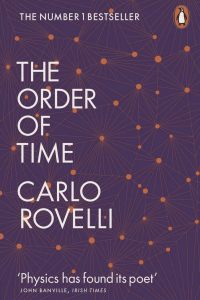 In the last week or so I read an interesting pair of books: Through Two Doors at Once, by author and journalist Anil Ananthaswamy, and The Order of Time, by theoretical physicist Carlo Rovelli. While I did find them interesting, and I’m not sorry I bought them (as Apple ebooks), I can’t say they added anything to my knowledge or understanding.
I was already familiar with the material Ananthaswamy covers and knew of the experiments he discusses — I’ve been following the topic (the two-slit experiment) since at least the 1970s. It was nice seeing it all in one place. I enjoyed the read and recommend it to anyone with an interest.
I had a little trouble with the Rovelli book, perhaps in part because my intuitions of time are different than his, but also because I found it a bit poetic and hand-wavy.
Continue reading
25 Comments | tags: Anil Ananthaswamy, arrow of time, Carlo Rovelli, is time fundamental, light, photons, Planck Length, Planck Time, spacetime, time, two slit experiment | posted in Books, Physics
Fourier Curve 1
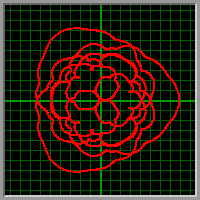
Don’t let the title put you off — this is one of the coolest things I’ve seen in a while. It’s because of math, but there’s no need to get all mathy to enjoy this, you just need to think about clocks. Or even wheels that spin ’round and ’round.
The fun thing is what happens when we connect one wheel to another in a chain of wheels of different sizes and turn rates. If we use the last wheel to trace out a pattern, we get something that resembles the Spirograph toy of old (which worked on a similar principle of turning wheels).
And if we pick the wheel sizes and spin rates just right, we can draw just about any picture we want.
Continue reading
4 Comments | tags: 3Blue1Brown, JPEG, sine wave | posted in Math, Wednesday Wow
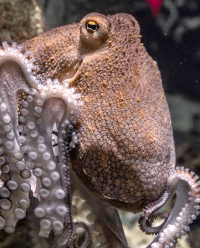 I’ve long been fascinated by stories about octopuses. I confess I’ve eaten a few, too, and it’s obviously a worse than eating dog, which I could never. (OTOH, properly done calamari is really yummy!)
It’s not just that octopuses (and it is octopuses, by the way; the root is Greek, not Latin) are jaw-dropping smart. It’s that their intelligence operates in a completely different brain than ours — an evolutionary branch that considerably predates the dinosaurs. It isn’t just the top brain and eight satellite brains; it’s that their entire body, in some sense, and especially their skin, is their brain.
Check out this 13-minute TED Talk by marine biologist Roger Hanlon:
Continue reading
46 Comments | tags: brain, intelligence, mind, octopus | posted in Science
 Happy Tau Day! It’s funny. I feels like I’ve written a lot of posts about pi plus few about it’s bigger sibling, tau. Yet the reality is that I’ve only ever written one Tau Day post, and that was back in 2014. (As far as celebrating Pi Day, I’ve only written three posts in eight years: 2015, 2016, & 2019.)
What I’m probably remembering is mentioning pi a lot here (which is vaguely ironic in that I won’t eat pie — mostly I don’t like cooked fruit, but there’s always been something about pie that didn’t appeal — something about baking blackbirds in a crust or something).
It’s true that I am fascinated by the number.
Continue reading
3 Comments | tags: Andrey Kolmogorov, Champernowne constant, Gregory Chaitin, Kolmogorov complexity, normal number, normal sequence, omega constant, pi, tau, tau day | posted in Math
Mandelbrot Antennae
[click for big]
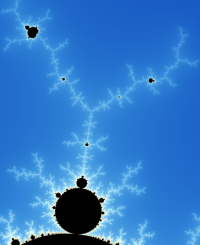
I realized that, if I’m going to do the Mandelbrot in May, I’d better get a move on it. This ties to the main theme of Mind in May only in being about computation — but not about computationalism or consciousness. (Other than in the subjective appreciation of its sheer beauty.)
I’ve heard it called “the most complex” mathematical object, but that’s a hard title to earn, let alone hold. Its complexity does have attractive and fascinating aspects, though. For most, its visceral visual beauty puts it miles ahead of the cool intellectual poetry of Euler’s Identity (both beauties live on the same block, though).
For me, the cool thing about the Mandelbrot is that it’s a computation that can never be fully computed.
Continue reading
11 Comments | tags: computation, computer model, computer program, fractals, Mandelbrot, Mandelbrot fractal, mathematics, Turing Halting Problem | posted in Computers, Math
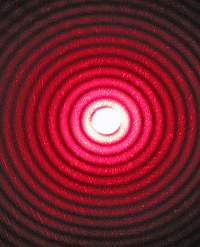 Last Friday I ended the week with some ruminations about what (higher) consciousness looks like from the outside. I end this week — and this posting mini-marathon — with some rambling ruminations about how I think consciousness seems to work on the inside.
When I say “seems to work” I don’t have any functional explanation to offer. I mean that in a far more general sense (and, of course, it’s a complete wild-ass guess on my part). Mostly I want to expand on why a precise simulation of a physical system may not produce everything the physical system does.
For me, the obvious example is laser light.
Continue reading
37 Comments | tags: brain mind problem, computationalism, consciousness, human brain, human consciousness, human mind, interpretation, laser light, mind, positronic brain, Theory of Consciousness, theory of mind | posted in Computers, Philosophy, Science
 I’ve been on a post-a-day marathon for two weeks now, and I’m seeing this as the penultimate post (for now). Over the course of these, I’ve written a lot about various low-level aspects of computing, truth tables and system state, for instance. And I’ve weighed in on what I think consciousness amounts to.
How we view, interpret, or define, consciousness aside, a major point of debate involves whether machines can have the same “consciousness” properties we do. In particular, what is the role of subjective experience when it comes to us and to machines?
For me it boils down to a couple of key points.
Continue reading
17 Comments | tags: algorithm, brain mind problem, computationalism, consciousness, human brain, human consciousness, human mind, interpretation, mind, positronic brain, Theory of Consciousness, theory of mind | posted in Computers, Philosophy, Science
 Philosophical Zombies (of several kinds) are a favorite of consciousness philosophers. (Because who doesn’t like zombies. (Well, I don’t, but that’s another story.)) The basic idea involves beings who, by definition, [A] have higher consciousness (whatever that is) and [B] have no subjective experience.
They lie squarely at the heart of the “acts like a duck, is a duck” question about conscious behavior. And zombies of various types also pose questions about the role subjective experience plays in consciousness and why it should exist at all (the infamous “hard problem”).
So the Zombie Issue does seem central to ideas about consciousness.
Continue reading
5 Comments | tags: brain mind problem, consciousness, human brain, human consciousness, human mind, mind, Philosophical zombie, qualia, Theory of Consciousness, theory of mind | posted in Computers, Philosophy, Science
 In one of the more horrific examples of virtual personal enslavement in the service of philosophy, another classic conundrum of consciousness involves a woman confined for her entire life to a deep dungeon with no color and no windows to the outside. Everything is black, or white, or a shade of gray.
The enslaved misfortunate Mary has a single ray of monochromatic (artificial) light in her dreary existence: She has an electronic reader — with a black and white screen — that gives her access to all the world’s knowledge. In particular, she has studied and understands everything there is to know about color and how humans perceive it.
Then one day someone sends Mary a red rose.
Continue reading
13 Comments | tags: brain mind problem, consciousness, human brain, human consciousness, human mind, mind, qualia, Theory of Consciousness, theory of mind | posted in Computers, Philosophy, Science
After a weekend of transistorized baseball, it’s time to get back to wandering through pondering consciousness. I laid down a few cobblestones last week; time to add a few more to the road. Eventually I’ll have something on which I can drive an argument.
There are a number of classic, or at least well-known, arguments for and against computationalism. They variously involve Pixies, different kinds of Zombies, people trapped in different kinds of rooms, and rock walls that compute. (In fact, they compute rooms that trap Pixies. And everything else.)
Today I’m going to ruminate on the world’s most unfortunate file clerk.
Continue reading
93 Comments | tags: brain, brain mind problem, computationalism, consciousness, human brain, human consciousness, human mind, John Searle, mind, The Chinese Room, Theory of Consciousness, theory of mind | posted in Computers, Philosophy, Science









You must be logged in to post a comment.