Category Archives: Math
 It’s been a while since my last Sidebands post. That’s partly because I’ve been working on a project that I’m sure will become a multi-post series and thought it would be nice to start with #81. But I’m not done (or actually started on the writing) yet, and this one has also been lurking for a while.
Essentially, I needed to figure out how to join a cone to a sphere in a seamless way (as in the picture here). This requires the sides of the cone meet the sphere at a tangent point.
It’s yet another case of actually needing the trigonometry I learned in school.
Continue reading
3 Comments | tags: cones, POV-Ray, trigonometry | posted in Math, Sideband
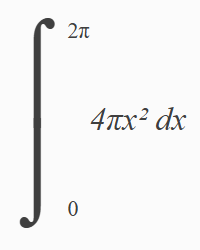 I don’t mean the social kind of integration, which I learned as a child, but the mathematical kind of integration, which I never learned in any of my math classes. I didn’t even take calculus until The Company sponsored some adult education classes for employees.
But those calc classes only got me through basic derivatives (of polynomials, mostly), so integration has been a bit of a mystery to me. Lately, though, I’ve been trying to pick up the basics.
This post just records my first attempts — my math lab book, so to speak.
Continue reading
4 Comments | tags: calculus, integrals | posted in Basics, Math
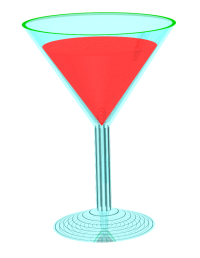 It’s happy hour and you and a friend go out for drinks. The bar is serving a new drink that catches your eye, and you both order one. They’re served in martini glasses (which are upside down hollow cones) and look quite tasty (see picture).
More to the point here, the glasses look acceptably full. Not a lot of “headroom” between the top of the drink and the top of the glass. Your friend, a mathematician, bets you they can pour all of your drink into their glass without spilling a drop.
Should you take that bet?
Continue reading
6 Comments | tags: cones, fun with numbers | posted in Math, Wednesday Wow
 Earlier this year, I posted about that math gag that seems to prove (very mathematically) that 2=0 (an alternate version “proves” 1=0 using the same trick: a covert division by zero, an operation whose undefined result breaks the chain of logic).
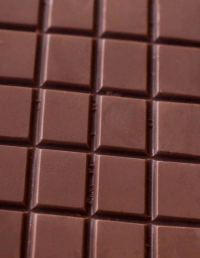
Today I’m posting about another somewhat common mathematical (or rather, geometrical) gag — one involving chocolate! In the form of a magical chocolate bar that lets us remove an infinite number of bite-sized pieces but somehow remains the same size. It seems impossible.
And of course, it is. In this post I reveal the magician’s trick!
Continue reading
22 Comments | tags: chocolate, fun with numbers, geometry, old tricks, triangle, tricks | posted in Math
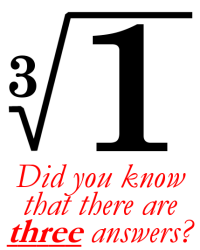 Thinking back on your math classes, you may recall that the square root of a number has two answers, one positive and one negative. For example, the square root of +9 is both +3 and -3 (the first one is known as the principal square root). Squaring +3 gives you +9, of course, but so does squaring -3.
Square roots aren’t the only roots of a number. For example, the (principal) cube root of +8 is +2 because +2³ = +2 × +2 × +2 = +8.
But just as square roots have two answers, cube roots have three (and fourth roots have four and so on and so on).
Continue reading
3 Comments | tags: complex numbers, complex plane, cube roots, Euler's Formula | posted in Brain Bubble, Math
 Today (3/14) is Pi Day. People everywhere (or at least math geeks everywhere) are baking decorated pies (or cakes or cookies) to celebrate. And while this is yet another math-y post, it’s not about pi. I’m more of a tau guy, anyway, so I celebrate Tau Day (6/28), because I get twice the (pizza) pie.
Today is also Albert Einstein’s birthday, which I’ve always thought was a cool coincidence. He’s 145 now (and still being widely misquoted).
But this post isn’t about him either.
Continue reading
10 Comments | tags: Albert Einstein, pi day, tau day, trigonometry, two slit experiment | posted in Brain Bubble, Math
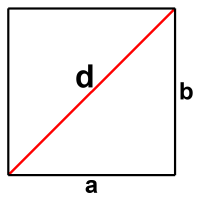 Consider the lowly square, a four-sided shape with sides of equal length meeting at right angles. The embodiment of what we’re referring to when we refer to square miles, square kilometers, square inches, or square whatevers. The two-dimensional version of any one-dimensional length.
A trivially easy shape to draw, all you need is a straight edge and a compass — the latter for ensuring your corners are right angles (see Plato’s Divided Line for more on using a straight edge and compass). The only simpler shape is the circle.
Yet the simple square threw early mathematicians into a serious tizzy!
Continue reading
12 Comments | tags: irrational numbers, Pythagoras, square | posted in Brain Bubble, Math
 You may have, at some point, seen one of those bits where a series of seemingly simple math operations somehow end up proving that 1=0 or something equally clearly wrong. Most of them accomplish their joke by sneaking in a hidden division by zero. From that point on, all bets are off (see Divide by Zero).
Recently, on a YouTube channel I follow, I saw a clever example that uses a much sneakier trick. It’s harder to spot because the operation it uses is legit in two of the three possible cases.
The gag, of course, uses the third one.
Continue reading
7 Comments | tags: fun with numbers, imaginary unit, numbers | posted in Brain Bubble, Math
 You may remember learning way back in grade school that you can’t divide by zero. You may remember being told that division by zero is undefined. But have you ever wondered why we can’t divide by zero? Couldn’t the answer just be zero? We get zero when we multiply by zero, so why not when we divide?
But dividing is the opposite (or inverse) of multiplying, so if multiplying by zero gives zero, then maybe dividing by zero gives us… infinity? But infinity isn’t a number (it’s an idea), so that doesn’t work, either.
In this post I’ll dig into why division by zero is undefined.
Continue reading
4 Comments | tags: division, fractions, zero | posted in Basics, Math, Sideband

nx vs xn vs nx (for n=42)
You’ve probably heard the phrase “exponential growth” in reference to something that grows very fast. A common example is bacteria in a petri dish. More relevant in daily life, perhaps, the spread of a highly communicable disease or a “viral” meme. These things all can have exponential growth.
You may also have heard the phrase “geometric growth” and wondered how — if at all — it differs from the exponential form. Recently I found myself curious enough about the difference to dig into it a little and find out once and for all.
This post records my simple exploration.
Continue reading
3 Comments | tags: exponential function, geometric function, linear function | posted in Math, Sideband






You must be logged in to post a comment.