About Wyrd Smythe
The canonical fool on the hill watching the sunset and the rotation of the planet and thinking what he imagines are large thoughts.
 This past Sunday I watched and very much enjoyed the last ever episodes of The Good Place (CBS). I’ve avoided articles about it in my newsfeed, but a headline or two suggested some fans weren’t satisfied. (A rant for another time: Clickbait headlines and headlines with spoilers. So annoying.)
Maybe some fans just didn’t want the show to end, which I get, but I appreciate knowing when and how to make a graceful exit. I like the way the show’s creator, Michael Shur, effectively said, ‘This much and no more.’
As it turns out, it’s not the only show I watch that’s ending. Several of them are. (And there’s one or two I really wish would call it quits.)
Continue reading
7 Comments | tags: Fresh Off the Boat, James Spader, Madam Secretary, Michael Shur, NCIS, South Park, The Blacklist, The Good Place, The Simpsons, Will & Grace | posted in TV
 This post, and several that follow, veer into fairly trivial territory. Which, I suppose, is relative. To some, all my posts may be trivial, whereas to me none of them are. At least not totally, although some are less con carne than others. As it turns out, this week I’m serving salads.
More accurately, cleaning out my closet or, even more accurately, collection of — not even half, but — lightly baked post ideas. I’m one who jots down thoughts in case they grow into something interesting. Some do, but others never grow much beyond the seed.
Case in point: the difference, if any, between aspects and properties.
Continue reading
9 Comments | tags: aspect, epistemology, Many Worlds Interpretation, MWI, ontology, property, wave-function | posted in Brain Bubble
 In this corner, philosopher John Searle (1932–), weighing in with what I like to call the Giant File Room (GFR). The essential idea is of a vast database capable of answering any question. The question it poses is whether we see this ability as “consciousness” behavior. (Searle’s implication is that we would not.)
In that corner, philosopher and mathematician Kurt Gödel (1906–1978), weighing in with his Incompleteness Theorems. The essential idea there is that no consistent (arithmetic) system can prove all possible truths about itself.
It’s possible that Gödel has a knockout punch for Searle…
Continue reading
24 Comments | tags: algorithm, Incompleteness Theorems, John Searle, Kurt Gödel, The Chinese Room | posted in Philosophy, Science
 One bit of blogging advice is to pick a single topic and focus on that. The idea is to attract and keep those interested in the topic. I tried that with my first blog, a baseball blog, and I have a separate blog for computer programming. (For the record, neither attracted anyone, so maybe it’s me. 😮 )
This blog does have a central topic — “Stuff That Really Interests Me” — but my tastes are pretty eclectic. Math theory, 3D modeling, and basic physics fascinate me, but so does baseball, beer, and Hawaiian volcanoes. (Not to mention the Mandelbrot and science fiction, both very dear to my heart.)
Right now I’m into commercial aviation.
Continue reading
6 Comments | tags: aircraft, aircraft pilots, airplanes, ATC, flight, flying, High Flight, solo flight | posted in Life

Appearing soon at my place!
Monday is laundry day — a rare bit of regularity in my retired life. Faithful readers (all three of you) will recall I had a bit of electrical excitement last fall. (That’s been fine ever since, and I’m happy to have the new smoke detectors. I had no idea they are only good for about ten years. Their tiny radioactive source wears out eventually.)
I’ve known for months I needed a new clothes washer and a new clothes dryer. For one thing, they came with the place, so they’re at least 16 years old. More to the point, the dryer was taking two hours to get clothes completely dry, and the agitator in the washing machine was broken — it only worked with extremely light loads.
Yesterday, it died a definite death.
Continue reading
20 Comments | tags: Best Buy, Maytag, Not Thrilled with Best Buy, The Home Depot, washer-dryer | posted in Life, Rant
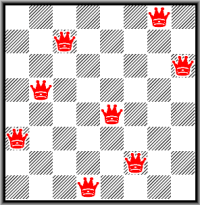
One solution to the puzzle.
I’ve written a lot lately about the physical versus the virtual. I’ve also written about algorithms and the role they play. In this post, I revisit both by exploring what is, for me, an old friend: The Eight Queens Puzzle. The goal is to place eight chess queens on a chessboard such that none can take another in a single move.
The puzzle is simple enough, yet just challenging enough, that it’s a good problem for first-year student programmers to solve. That’s where I met it, and it’s been a kind of “Hello, World!” algorithm for me ever since.
I thought it might be a fun way to explore a simple virtual reality.
Continue reading
14 Comments | tags: abstract system, algorithm, chess, chess queen, chessboard, computationalism, eight queens puzzle, information system, physical system, virtual reality | posted in Computers

Math version 1.0
This image here of the Mandelbrot fractal might look like one of the uglier renderings you’ve seen, but it’s a thing of beauty to me. That’s because some code I wrote created it. Which, in itself, isn’t a deal (let alone a big one), but how that code works kind of is (at least for me).
The short version: the code implements special virtual math for calculating the Mandelbrot. That the image looks anything at all like it should shows the code works.
Yet according to that image, something wasn’t quite right.
Continue reading
9 Comments | tags: algorithm, Mandelbrot, Mandelbrot fractal, virtual reality | posted in Computers
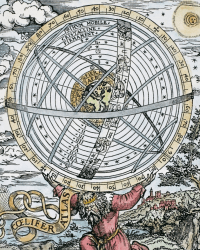 Lately I’ve been hearing a lot of talk about (philosophical) idealism. I qualify it as philosophical to distinguish it from casual meaning of optimistic. In philosophy, idealism is a metaphysical view about the nature of reality — one that I’ve always seen as in contrast to realism.
What caught my eye in all the talk was that I couldn’t always tell if people were speaking of epistemological or ontological idealism. I agree, of course, with the former — one way or another, it’s the common understanding — but I’m not a fan of the various flavors of ontological idealism.
It seems downright Ptolemaic to me.
Continue reading
34 Comments | tags: Cogito ergo sum, excluded middle, idealism, panpsychism, Ptolemy, realism, reality, René Descartes, solipsism, virtual reality | posted in Philosophy
 There are, firstly, the unique sort of jaw-droppers I usually have in mind for Wednesday Wow. Secondly, there are the little, almost hidden, daily wonders with so much behind them. But it occurred to me there is yet another category, one that is both daily and also jaw-dropping.
It has to do with the human mind and the kind of art it can create. It also has to do with how we respond to that art. What is it that an artist puts into their best work, and what is it that we take from it? Whatever it is, profound or mundane, it can touch us deeply.
As with the greatest guitar solo, ever:
Continue reading
7 Comments | tags: Cliffs of Dover, Comfortably Numb, David Gilmour, Eric Johnson | posted in Music, Wednesday Wow
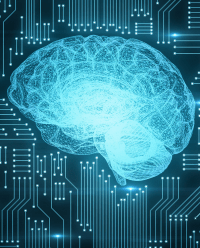 In the last post I explored how algorithms are defined and what I think is — or is not — an algorithm. The dividing line for me has mainly to do with the requirement for an ordered list of instructions and an execution engine. Physical mechanisms, from what I can see, don’t have those.
For me, the behavior of machines is only metaphorically algorithmic. Living things are biological machines, so this applies to them, too. I would not be inclined to view my kidneys, liver, or heart, as embodied algorithms (their behavior can be described by algorithms, though).
Of course, this also applies to the brain and, therefore, the mind.
Continue reading
43 Comments | tags: algorithm, brain, brain mind problem, computationalism, consciousness, human brain, human consciousness, human mind, mind, Theory of Consciousness, theory of mind | posted in Computers





 Logos con carne