Tag Archives: computer model
 Last time we considered the possibility that human consciousness somehow supervenes on the physical brain, that it only emerges under specific physical conditions. Perhaps, like laser light and microwaves, it requires the right equipment.
We also touched on how Church-Turing implies that, if human consciousness can be implemented with software, then the mind is necessarily an algorithm — an abstract mathematical object. But the human mind is presumed to be a natural physical object (or at least to emerge from one).
This time we’ll consider the effect of transcendence on all this.
Continue reading
58 Comments | tags: AI, algorithm, brain mind problem, computationalism, computer model, computer program, consciousness, human brain, human consciousness, human mind, mind, software model, Theory of Consciousness, transcendental numbers, Yin and Yang | posted in Computers
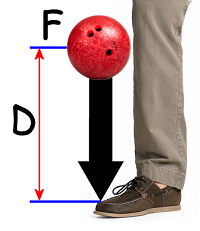
“Ouch!”
Over the past few weeks we’ve explored background topics regarding calculation, code, and computers. That led to an exploration of software models — in particular a software model of the human brain.
The underlying question all along is whether a software model of a brain — in contrast to a physical model — can be conscious. A related, but separate, question is whether some algorithm (aka Turing Machine) functionally reproduces human consciousness without regard to the brain’s physical structure.
Now we focus on why a software model isn’t what it models!
Continue reading
41 Comments | tags: AI, algorithm, bowling ball, brain mind problem, Church-Turing thesis, computationalism, computer model, computer program, consciousness, hot resistor, human brain, human consciousness, human mind, laser light, magnetron, microwaves, mind, software model, Theory of Consciousness | posted in Computers
 Last time I introduced four levels of possibility regarding how mind is related to brain. Behind Door #1 is a Holy Grail of AI research, a fully algorithmic implementation of a human mind. Behind Door #4 is an ineffable metaphysical mind no machine can duplicate.
The two doors between lead to physical models that recapitulate the structure of the human brain. Behind Door #3 is the biology of the brain, a model we know creates mind. Behind Door #2 is the network of the brain, which we presume encodes the mind regardless of its physical construction.
This time we’ll look more closely at some distinguishing details.
Continue reading
14 Comments | tags: AI, algorithm, brain, calculator, computationalism, computer model, computer program, consciousness, enchanted loom, human brain, human consciousness, LTP, neural correlates, qualia, self-awareness, slide rule, software model, synapse | posted in Computers
 Last week we took a look at a simple computer software model of a human brain. (We discovered that it was big, requiring dozens of petabytes!) One goal of such models is replicating consciousness — a human mind. That can involve creating a (potentially superior) new mind or uploading an existing human mind (a very different goal).
Now that we’ve explored the basics of calculation, code (software), computers, and (computer software) models, we’re ready to explore what’s involved in attempting to model a (human) mind.
I’m dividing the possibilities into four basic levels.
Continue reading
18 Comments | tags: AI, algorithm, brain, computationalism, computer model, computer program, consciousness, enchanted loom, human brain, human consciousness, human mind, Isaac Asimov, mind, physicalism, positronic brain, qualia, René Descartes | posted in Computers
 Last time we looked at the basic requirements for a software model of a computer and put a rough estimate on the size of such a model (about 2.5 terabytes). This time we’ll consider a software model of a human brain. Admittedly, there’s much we don’t know, and probably need for a decent model, but we can make some rough guesses as a reference point.
We’ll start with a few basic facts — number of neurons, number of synapses — and try to figure out some minimal requirements. The architecture of a viable software brain model is likely to be much more complicated. This is just a sketch, a Tinkertoy® or LEGO® version.
Even so, we’re gonna need a lot of memory!
Continue reading
10 Comments | tags: axon, computer model, dendrite, human brain, human connectome, human consciousness, human mind, long-term potentiation, LTP, neuron, petabyte, synapse, terabyte | posted in Computers
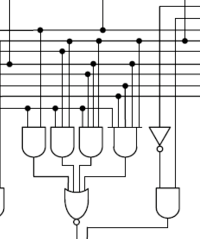 The computer what? Connectome. The computer’s wiring diagram. The road map of how all the parts are connected.
Okay, granted, the term, connectome, usually applies to the neural wiring of a biological organism’s brain, particularly to the human brain. But the whole point of this series of posts is to compare a human brain with a computer so that we can think about how we might implement a human mind with a computer. As such, “connectome” seems apropos.
Today we’ll try to figure out what’s involved in modeling one in software.
Continue reading
4 Comments | tags: computer model, connection map, connectome, human connectome, transistor, wiring diagram | posted in Computers
 The ultimate goal is a consideration of how to create a working model of the human mind using a computer. Since no one knows how to do that yet (or if it’s even possible to do), there’s a lot of guesswork involved, and our best result can only be a very rough estimate. Perhaps all we can really do is figure out some minimal requirements.
Given the difficulty we’ll start with some simpler software models. In particular, we’ll look at (perhaps seeming oddity of) using a computer to model a computer (possibly even itself).
The goal today is to understand what a software model is and does.
Continue reading
4 Comments | tags: algorithm, American checkers, checkers, complexity, computer model, computer program, English draughts, Kolmogorov complexity, software, software model, state space | posted in Computers





 Logos con carne