Tag Archives: computationalism
 Over the last few weeks I’ve written a series of posts leading up to the idea of human consciousness in a machine. In particular, I focused on the difference between a physical model and a software model, and especially on the requirements of the software model.
The series is over, I have nothing particularly new to add, but I’d like to try to summarize my points and provide an index to the posts in this series. It seems I may have given readers a bit of information overload — too much information to process.
Hopefully I can achieve better clarity and brevity here!
Continue reading
30 Comments | tags: AI, algorithm, brain, brain mind problem, chaos theory, computationalism, computer model, computer program, consciousness, human brain, human consciousness, human mind, information theory, mind, My brain is full, stored program computer, Theory of Consciousness, Von Neumann architecture | posted in Computers
 Last time we considered the possibility that human consciousness somehow supervenes on the physical brain, that it only emerges under specific physical conditions. Perhaps, like laser light and microwaves, it requires the right equipment.
We also touched on how Church-Turing implies that, if human consciousness can be implemented with software, then the mind is necessarily an algorithm — an abstract mathematical object. But the human mind is presumed to be a natural physical object (or at least to emerge from one).
This time we’ll consider the effect of transcendence on all this.
Continue reading
58 Comments | tags: AI, algorithm, brain mind problem, computationalism, computer model, computer program, consciousness, human brain, human consciousness, human mind, mind, software model, Theory of Consciousness, transcendental numbers, Yin and Yang | posted in Computers
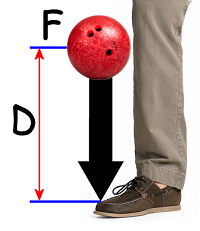
“Ouch!”
Over the past few weeks we’ve explored background topics regarding calculation, code, and computers. That led to an exploration of software models — in particular a software model of the human brain.
The underlying question all along is whether a software model of a brain — in contrast to a physical model — can be conscious. A related, but separate, question is whether some algorithm (aka Turing Machine) functionally reproduces human consciousness without regard to the brain’s physical structure.
Now we focus on why a software model isn’t what it models!
Continue reading
41 Comments | tags: AI, algorithm, bowling ball, brain mind problem, Church-Turing thesis, computationalism, computer model, computer program, consciousness, hot resistor, human brain, human consciousness, human mind, laser light, magnetron, microwaves, mind, software model, Theory of Consciousness | posted in Computers
 Last time I introduced four levels of possibility regarding how mind is related to brain. Behind Door #1 is a Holy Grail of AI research, a fully algorithmic implementation of a human mind. Behind Door #4 is an ineffable metaphysical mind no machine can duplicate.
The two doors between lead to physical models that recapitulate the structure of the human brain. Behind Door #3 is the biology of the brain, a model we know creates mind. Behind Door #2 is the network of the brain, which we presume encodes the mind regardless of its physical construction.
This time we’ll look more closely at some distinguishing details.
Continue reading
14 Comments | tags: AI, algorithm, brain, calculator, computationalism, computer model, computer program, consciousness, enchanted loom, human brain, human consciousness, LTP, neural correlates, qualia, self-awareness, slide rule, software model, synapse | posted in Computers
 Last week we took a look at a simple computer software model of a human brain. (We discovered that it was big, requiring dozens of petabytes!) One goal of such models is replicating consciousness — a human mind. That can involve creating a (potentially superior) new mind or uploading an existing human mind (a very different goal).
Now that we’ve explored the basics of calculation, code (software), computers, and (computer software) models, we’re ready to explore what’s involved in attempting to model a (human) mind.
I’m dividing the possibilities into four basic levels.
Continue reading
18 Comments | tags: AI, algorithm, brain, computationalism, computer model, computer program, consciousness, enchanted loom, human brain, human consciousness, human mind, Isaac Asimov, mind, physicalism, positronic brain, qualia, René Descartes | posted in Computers
 “In the beginning was the Word, and the Word was…”
Many of you will recognize that as the first words of John 1:1 in the Christian New Testament Bible. There’s also a cross-reference to the very first words of that Bible (Old Testament in this case), “In the beginning God created the heavens and the earth.”
This is about words and about beginnings.
Others might recognize it as a conflation of the lead-in to a Moody Blues tune, OM, from In Search of the Lost Chord, and the title of a song from another album, In the Beginning, from On the Threshold of a Dream.
(Yes “album.” I’m old!)
Continue reading
23 Comments | tags: brain, brain mind problem, computationalism, computer guy, human brain, human mind, logos, Marriage, Moody Blues, rational mind, René Descartes, Theory of Consciousness, theory of mind | posted in Baseball, Basics, Books, Computers, Life, Movies, Opinion, Philosophy, Politics, Rant, Science, Society, The Interweb, TV





 Logos con carne