I seem to be doing a lot of reblogging lately (a lot for me, anyway). But I’m on kind of a math kick right now, and this ties in nicely with all that.
 4 gravitons
You’ve probably seen it somewhere on your facebook feed, likely shared by a particularly wide-eyed friend: pi found hidden in the hydrogen atom!



From the headlines, this sounds like some sort of kabbalistic nonsense, like finding the golden ratio in random pictures.
Read the actual articles, and the story is a bit more reasonable. The last two I linked above seem to be decent takes on it, they’re just saddled with ridiculous headlines. As usual, I blame the editors. This time, they’ve obscured an interesting point about the link between physics and mathematics.
So what does “pi found hidden in the hydrogen atom” actually mean?
It doesn’t mean that there’s some deep importance to the number pi in nature, beyond its relevance in mathematics in general. The reason that pi is showing up here isn’t especially deep.
It isn’t trivial either, though. I’ve seen a few people…
View original post 546 more words
2 Comments | tags: math theory, mathematics, pi, quantum physics | posted in Math
 Source: A photographer edits out our smartphones to show our strange and lonely new world
As someone who has never owned a smartphone, and who thinks the rest of you often look, not just like idiots, but enslaved idiots, I really like this guy’s vision.
Right on!
40 Comments | tags: smartphones | posted in Life
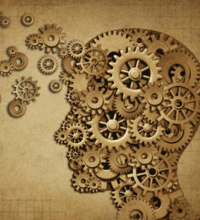 Over the last few weeks I’ve written a series of posts leading up to the idea of human consciousness in a machine. In particular, I focused on the difference between a physical model and a software model, and especially on the requirements of the software model.
The series is over, I have nothing particularly new to add, but I’d like to try to summarize my points and provide an index to the posts in this series. It seems I may have given readers a bit of information overload — too much information to process.
Hopefully I can achieve better clarity and brevity here!
Continue reading
30 Comments | tags: AI, algorithm, brain, brain mind problem, chaos theory, computationalism, computer model, computer program, consciousness, human brain, human consciousness, human mind, information theory, mind, My brain is full, stored program computer, Theory of Consciousness, Von Neumann architecture | posted in Computers
 If it hasn’t been apparent, I’ve been giving a bit of a fall semester in some computer science basics. If it seems complicated, well, the truth is all we’ve done is peek in some windows. From a safe distance. And most of the blinds were down.
I thought we’d finish (yes, finish!) with a bang and take a deep dive down into the lowest levels of a computer, both on the engineering side and on the abstract logic side. When they say, “It’s all ones and zeros,” these are the bits (in both senses!) they mean.
Attention: You need to be at least this ━▇━ geeky for this ride!
Continue reading
6 Comments | tags: adder, AND gate, binary, binary logic, calculation, calculator, computer chip, flip-flop, full-adder, half-adder, logic, NAND gate, NOR gate, NOT gate, OR gate, transistor, XOR gate | posted in Computers
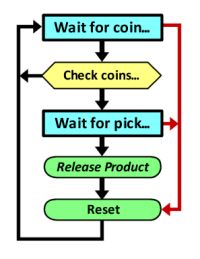 No, sorry, I don’t mean the Bletchey Bombe machine that cracked the Enigma cipher. I mean his theoretical machine; the one I’ve been referring to repeatedly the past few weeks. (It wasn’t mentioned at the time, but it’s the secret star of the Halt! (or not) post.)
The Turing Machine (TM) is one of our fundamental definitions of calculation. The Church-Turing thesis says that all algorithms have a TM that implements them. On this view, any two actual programs implementing the same algorithm do the same thing.
Essentially, a Turing Machine is an algorithm!
Continue reading
13 Comments | tags: Alan Turing, algorithm, Church-Turing thesis, flowchart, state diagram, Turing Halting Problem, Turing Machine, Universal Turing Machine | posted in Computers
 Last time we considered the possibility that human consciousness somehow supervenes on the physical brain, that it only emerges under specific physical conditions. Perhaps, like laser light and microwaves, it requires the right equipment.
We also touched on how Church-Turing implies that, if human consciousness can be implemented with software, then the mind is necessarily an algorithm — an abstract mathematical object. But the human mind is presumed to be a natural physical object (or at least to emerge from one).
This time we’ll consider the effect of transcendence on all this.
Continue reading
59 Comments | tags: AI, algorithm, brain mind problem, computationalism, computer model, computer program, consciousness, human brain, human consciousness, human mind, mind, software model, Theory of Consciousness, transcendental numbers, Yin and Yang | posted in Computers
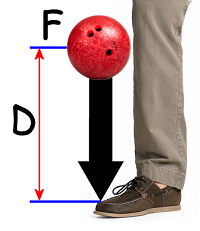
“Ouch!”
Over the past few weeks we’ve explored background topics regarding calculation, code, and computers. That led to an exploration of software models — in particular a software model of the human brain.
The underlying question all along is whether a software model of a brain — in contrast to a physical model — can be conscious. A related, but separate, question is whether some algorithm (aka Turing Machine) functionally reproduces human consciousness without regard to the brain’s physical structure.
Now we focus on why a software model isn’t what it models!
Continue reading
41 Comments | tags: AI, algorithm, bowling ball, brain mind problem, Church-Turing thesis, computationalism, computer model, computer program, consciousness, hot resistor, human brain, human consciousness, human mind, laser light, magnetron, microwaves, mind, software model, Theory of Consciousness | posted in Computers
 As a diversion for the weekend: Have you ever wondered why computers run so hot? No? Okay, I’ll tell you. It’s actually kind of a hoot. (We’ll get back to the more serious topic of algorithms and AI, and wrap up that series, next week.)
You kind of have to wonder. Humankind has gone from oil and gas lamps to incandescent copper filaments, then to fluorescent lights, and now to LEDs. The trend here seems towards cooler more efficient light sources. But computers seem to need bigger and bigger fans!
The short answer: It’s all those short circuits!
Continue reading
16 Comments | tags: CMOS, computer chip, computer heat, CPU, CPU heat, digital, electronics, FET, hardware, heat, MOSFET, transitor | posted in Computers, Sideband
 Last time I introduced four levels of possibility regarding how mind is related to brain. Behind Door #1 is a Holy Grail of AI research, a fully algorithmic implementation of a human mind. Behind Door #4 is an ineffable metaphysical mind no machine can duplicate.
The two doors between lead to physical models that recapitulate the structure of the human brain. Behind Door #3 is the biology of the brain, a model we know creates mind. Behind Door #2 is the network of the brain, which we presume encodes the mind regardless of its physical construction.
This time we’ll look more closely at some distinguishing details.
Continue reading
14 Comments | tags: AI, algorithm, brain, calculator, computationalism, computer model, computer program, consciousness, enchanted loom, human brain, human consciousness, LTP, neural correlates, qualia, self-awareness, slide rule, software model, synapse | posted in Computers





 Logos con carne