 I’ve been watching the cable news a lot lately, and it fills me with dismay. I’m seeing coming to fruition a crop that I’ve been warning about for over 40 years. I’ve referred to it as the Death of a Liberal Arts Education.
As this crop of useless weeds chokes the life out of the nutritious and necessary political and social fauna and flora, I find that we’ve arrived at an even greater loss: Utter Dialectic Failure!
That’s a topic for future posts. Right now I want to ask:
Continue reading
16 Comments | tags: Anyone But Trump, Bernie Sanders, democracy, Democratic Party, democratic society, dialectic, Donald Trump, election 2016, GOP, Hillary Clinton, Marco Rubio, politicians, Republican Party, rhetoric, social change, social issues, social media, Ted Cruz, Trump is a loser, Trump is a monster, violent society | posted in Politics, Rant
 So now we have 12/2 to go along with 9/11. And while the death and injury this time isn’t of the magnitude it was 14 years ago. The hysteria seems to be greater. Only five days after the tragedy, the leading Republican candidate engages in a form of hate speech not seen in mainstream American politics since Joe McCarthy.
To say that I’m appalled doesn’t begin to describe it. That people cheer on and support this blustering carnival barker speaks directly to the decline of real American values and principles. Trump is a childish clown seeing how much he can get away with.
It’s the people who follow him that scare the crap out of me. The ignorance and lack of critical thought is — as I have long said — very dangerous.
Continue reading
46 Comments | tags: 12/2, 9-11, Anyone But Trump, democracy, Democratic Party, democratic society, Dick Cheney, Donald Sterling, Donald Trump, election 2016, GOP, Hillary Clinton, Joe McCarthy, Leon Wieseltier, Marco Rubio, politicians, Republican Party, social change, social issues, social media, Ted Cruz, terrorism, Trump is a loser, Trump is a monster | posted in Opinion, Politics
So what are the odds of reading two posts in short succession, both of which just demand to be reblogged? As I commented on the original post, speaking as a life-long deep reader, I agree with every word.
8 Comments | tags: intelligence, reading | posted in Books, Life
I seem to be doing a lot of reblogging lately (a lot for me, anyway). But I’m on kind of a math kick right now, and this ties in nicely with all that.
 4 gravitons
You’ve probably seen it somewhere on your facebook feed, likely shared by a particularly wide-eyed friend: pi found hidden in the hydrogen atom!



From the headlines, this sounds like some sort of kabbalistic nonsense, like finding the golden ratio in random pictures.
Read the actual articles, and the story is a bit more reasonable. The last two I linked above seem to be decent takes on it, they’re just saddled with ridiculous headlines. As usual, I blame the editors. This time, they’ve obscured an interesting point about the link between physics and mathematics.
So what does “pi found hidden in the hydrogen atom” actually mean?
It doesn’t mean that there’s some deep importance to the number pi in nature, beyond its relevance in mathematics in general. The reason that pi is showing up here isn’t especially deep.
It isn’t trivial either, though. I’ve seen a few people…
View original post 546 more words
2 Comments | tags: math theory, mathematics, pi, quantum physics | posted in Math
 Source: A photographer edits out our smartphones to show our strange and lonely new world
As someone who has never owned a smartphone, and who thinks the rest of you often look, not just like idiots, but enslaved idiots, I really like this guy’s vision.
Right on!
40 Comments | tags: smartphones | posted in Life
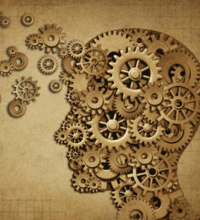 Over the last few weeks I’ve written a series of posts leading up to the idea of human consciousness in a machine. In particular, I focused on the difference between a physical model and a software model, and especially on the requirements of the software model.
The series is over, I have nothing particularly new to add, but I’d like to try to summarize my points and provide an index to the posts in this series. It seems I may have given readers a bit of information overload — too much information to process.
Hopefully I can achieve better clarity and brevity here!
Continue reading
30 Comments | tags: AI, algorithm, brain, brain mind problem, chaos theory, computationalism, computer model, computer program, consciousness, human brain, human consciousness, human mind, information theory, mind, My brain is full, stored program computer, Theory of Consciousness, Von Neumann architecture | posted in Computers
 If it hasn’t been apparent, I’ve been giving a bit of a fall semester in some computer science basics. If it seems complicated, well, the truth is all we’ve done is peek in some windows. From a safe distance. And most of the blinds were down.
I thought we’d finish (yes, finish!) with a bang and take a deep dive down into the lowest levels of a computer, both on the engineering side and on the abstract logic side. When they say, “It’s all ones and zeros,” these are the bits (in both senses!) they mean.
Attention: You need to be at least this ━▇━ geeky for this ride!
Continue reading
6 Comments | tags: adder, AND gate, binary, binary logic, calculation, calculator, computer chip, flip-flop, full-adder, half-adder, logic, NAND gate, NOR gate, NOT gate, OR gate, transistor, XOR gate | posted in Computers
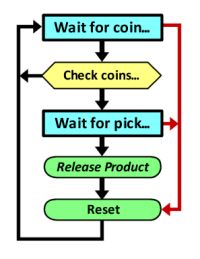 No, sorry, I don’t mean the Bletchey Bombe machine that cracked the Enigma cipher. I mean his theoretical machine; the one I’ve been referring to repeatedly the past few weeks. (It wasn’t mentioned at the time, but it’s the secret star of the Halt! (or not) post.)
The Turing Machine (TM) is one of our fundamental definitions of calculation. The Church-Turing thesis says that all algorithms have a TM that implements them. On this view, any two actual programs implementing the same algorithm do the same thing.
Essentially, a Turing Machine is an algorithm!
Continue reading
13 Comments | tags: Alan Turing, algorithm, Church-Turing thesis, flowchart, state diagram, Turing Halting Problem, Turing Machine, Universal Turing Machine | posted in Computers
 Last time we considered the possibility that human consciousness somehow supervenes on the physical brain, that it only emerges under specific physical conditions. Perhaps, like laser light and microwaves, it requires the right equipment.
We also touched on how Church-Turing implies that, if human consciousness can be implemented with software, then the mind is necessarily an algorithm — an abstract mathematical object. But the human mind is presumed to be a natural physical object (or at least to emerge from one).
This time we’ll consider the effect of transcendence on all this.
Continue reading
58 Comments | tags: AI, algorithm, brain mind problem, computationalism, computer model, computer program, consciousness, human brain, human consciousness, human mind, mind, software model, Theory of Consciousness, transcendental numbers, Yin and Yang | posted in Computers
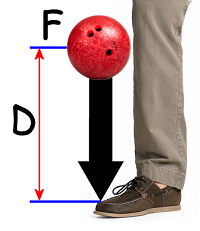
“Ouch!”
Over the past few weeks we’ve explored background topics regarding calculation, code, and computers. That led to an exploration of software models — in particular a software model of the human brain.
The underlying question all along is whether a software model of a brain — in contrast to a physical model — can be conscious. A related, but separate, question is whether some algorithm (aka Turing Machine) functionally reproduces human consciousness without regard to the brain’s physical structure.
Now we focus on why a software model isn’t what it models!
Continue reading
41 Comments | tags: AI, algorithm, bowling ball, brain mind problem, Church-Turing thesis, computationalism, computer model, computer program, consciousness, hot resistor, human brain, human consciousness, human mind, laser light, magnetron, microwaves, mind, software model, Theory of Consciousness | posted in Computers






 Logos con carne