About Wyrd Smythe
The canonical fool on the hill watching the sunset and the rotation of the planet and thinking what he imagines are large thoughts.
 Today’s earlier post got into only the beginnings of abacus operation — mainly how to add numbers. To demonstrate how they have more utility than just adding and subtracting, this Sideband tackles a multiplication problem.
This also illustrates a property of abacus operation that doesn’t arise with addition. With pen and paper, we multiply right-to-left to make carrying easier. Because of the way an abacus works, multiplication has to work left-to-right.
The process is simple enough, but has lots of steps!
Continue reading
3 Comments | tags: abacus, multiplication, speed of light | posted in Sideband
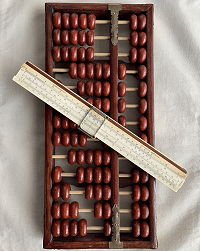
Ye Olden Tools of Yore
I’ve been meaning to write an Abacus post for years. I used one in my first job, back in high school, and they’ve appealed to me ever since. Many years ago I learned there were people who had no idea how an abacus worked. Until then I hadn’t internalized that it wasn’t common knowledge (maybe a consequence of learning something at an early age).
Recently, browsing through old Scientific American issues before recycling them, I read about slide rules, another calculating tool I’ve used, although, in this case, mainly for fun. My dad gave me his old slide rule from when he considered, and briefly pursued, being an architect.
So killing two birds with one stone…
Continue reading
28 Comments | tags: abacus, slide rule | posted in Life, Math
 Two things that get me out of bed every day and keep me going through a world I often find brutish, mean, and stupid, are my sense of curiosity and my sense of wonder. It’s another Yin-Yang thing: the Yin of the world’s crap balanced by the Yang of so many neat things to discover and explore.
Those neat things exist on all scales, from the vast to the tiny. (The crap, on the other hand, tends to come in human-sized, in fact in human-shaped, packages.) From quarks to galaxies, the universe is an interesting place.
For today’s Wednesday Wow, I bring you some smaller wonders…
Continue reading
15 Comments | tags: coffee cup lid, pasta, small wonders | posted in Wednesday Wow
 The ideas of free will, causality, and determinism, often factor into discussions about religion, morality, society, consciousness, or life in general. The first and last of these ideas seem at odds; if the world is strictly determined, there can be no free will.
But we are confronted with the appearance of free will — choices we make appear to affect the future. Even choosing not to make choices seems to affect our future. If reality is just a ride on fixed rails, then all that choosing must be a trick our brains play.
These questions are central to lives, but answers have remained elusive, in part from differing views of what the key ideas even mean.
Continue reading
23 Comments | tags: causal determinism, causal system, causality, determinism, deterministic, free will, physical determinism, physical system, physicalism, quantum physics | posted in Opinion, Philosophy
Since high school, I’ve wondered if the USA is just too big to ever make sense. How is it possible to govern a nation that ranges from Bangor to Baton Rouge and from Richmond to Redmond. Finding a political center to such a diverse group of people seems a daunting task.
As our nation grew, so did business, and now we have businesses “too big to fail” because their failure would wreck us. Our capitalistic approach to business seems based on unchecked obsessive growth. Bigger is always better!
The rise (or perhaps return) of local beer brewing offers an interesting lesson in how it’s possible some things should stay small and local.
Continue reading
14 Comments | tags: beer, craft beer, craft beer breweries, local breweries | posted in Opinion, Society

Complete Chaos!
One of my favorite discoveries in life is the Mandelbrot set. Considering it gives me a strong sense of the numinous. I’ve been enthralled by it ever since Fractint, an MS-DOS program that generated fractals. I’ve posted about it a lot here; today I want to take you into the heart of its chaotic behavior.
The Mandelbrot set has a number of properties that make it such a fascinating study: Firstly, it demonstrates chaos theory. Secondly, it demonstrates how complex patterns can arise from simple beginnings. Thirdly, it reveals a problem concerning real numbers. Fourthly, every pixel is a demonstration of Turing’s Halting Problem. It’s also infinitely complex and incredibly beautiful.
Today we’re going to explore the shore of the Mandelbrot lake.
Continue reading
7 Comments | tags: chaos, chaos theory, fractals, Mandelbrot, Mandelbrot fractal | posted in Science
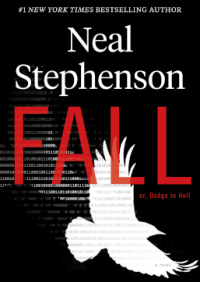 I’ve been a fan of Neal Stephenson since Snow Crash (1992), his third novel. I’ve read much of his work — the big exception being The Baroque Cycle, descriptions of which haven’t captured my interest yet. I like his writing enough that I’ll probably enjoy them if I ever take the plunge.
Stephenson writes pretty hard SF, which I love, and he explores such interesting ideas that I’m generally quite enthralled by what some see as fictionalized physics books. The thing is, I’d enjoy reading those physics books, so having it come coated in any kind of frosting is a win in my (pardon the pun) book.
I’ve just gotten started on his most recent novel, Fall; or, Dodge in Hell.
Continue reading
16 Comments | tags: Fall; or Dodge in Hell, hard SF, Neal Stephenson, science fiction, science fiction books, SF, SF Books, Snow Crash | posted in Books, Sci-Fi Saturday

Still half a meal!
When I was growing up, we didn’t have much money, but we were always blessed with food on the table, a place to sleep, and a roof over us. I have no complaints — nor even a sense — my life lacked luxury. It never lacked what was needed, and it never lacked love. That’s a pretty golden childhood.
But money was tight, and our ethic was “waste not, want not!” Two of the more grievous sins in our family were waste and inequitable distribution (everyone got a fair share of what there was). I heard a lot about those “starving children in India.”
Which is why it annoys me when characters waste food.
Continue reading
9 Comments | tags: cliches, food, tropes | posted in Brain Bubble, Movies, TV
 Philosopher and cognitive scientist Dave Chalmers, who coined the term hard problem (of consciousness), also coined the term meta hard problem, which asks why we think the hard problem is so hard. Ever since I was introduced to the term, I’ve been trying figure out what to make of it.
While the hard problem addresses a real problem — how phenomenal experience arises from the physics of information processing — the latter is about our opinions regarding that problem. What it tries to get at, I think, is why we’re so inclined to believe there’s some sort of “magic sauce” required for consciousness.
It’s an easy step when consciousness, so far, is quite mysterious.
Continue reading
34 Comments | tags: brain mind problem, consciousness, David Chalmers, human brain, human consciousness, human mind, mind, René Descartes | posted in Philosophy
I’m feeling lazy today and not at all like working on a post. But since I’m shooting for 899 by year’s end, and have 16 15 to go, I’m returning to an idea I had long ago but never really pursued. The idea, called Wednesday Wow, is writing posts (on Wednesdays, obviously) about things that really wowed me.
The truth is, lots of things do. For all my cynicism and misanthropy, life and people still fascinate and enthrall me. The various mysteries of physics and consciousness are engaging on their own, but life — for all its ups and downs — is one hell of a ride. (And, of course, I’ve been both blessed and lucky.)
Anyway, here are some wow things and a nice Christmas tune…
Continue reading
1 Comment | tags: Alison Krauss, mirrors, reflection, sound barrier, supersonic flight, The Wexford Carol, Yo-Yo Ma | posted in Wednesday Wow





 Logos con carne