Category Archives: Math
 One of the great philosophical conundrums involves the origin of numbers and mathematics. I first learned of it as Platonic vs Aristotelian views, but these days it’s generally called Platonism vs Nominalism. I usually think of it as the question of whether numbers are invented or discovered.
Whatever it’s called, there is something transcendental about numbers and math. It’s hard not to discover (or invent) the natural numbers. Even from a theory standpoint, the natural numbers are very simply defined. Yet they directly invoke infinity — which doesn’t exist in the physical world.
There is also the “unreasonable effectiveness” of numbers in describing our world.
Continue reading
8 Comments | tags: math theory, mathematics, natural numbers, nominalism, numbers, Plato, Platonic, Platonism, rational numbers, real numbers, Theory of Mathematics | posted in Math, Philosophy
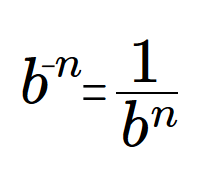 The last Sideband discussed two algorithms for producing digit strings in any number base (or radix) for integer and fractional numeric values. There are some minor points I didn’t have room to explore in that post, hence this follow-up post. I’ll warn you now: I am going to get down in the mathematical weeds a bit.
If you had any interest in expressing numbers in different bases, or wondered how other bases do fractions, the first post covered that. This post discusses some details I want to document.
The big one concerns numeric precision and accuracy.
Continue reading
3 Comments | tags: base 10, base 2, binary, binary digits, decimal, fractions, number bases | posted in Math, Sideband
Fractional base basis.
I suspect very few people care about expressing fractional digits in any base other than good old base ten. Truthfully, it’s likely not that many people care about expressing factional digits in good old base ten. But if you’re in the tiny handful of those with an interest in such things — and don’t already know all about it — read on.
Recently I needed to figure out how to express binary fractions of decimal numbers. For example, 3.14159 in binary. And I needed the real thing — true binary fractions — not a fake that uses integers and a virtual decimal point.
The funny thing is: I think I’ve done this before.
Continue reading
4 Comments | tags: base 10, base 2, binary, binary digits, decimal, fractions, number bases | posted in Math, Sideband
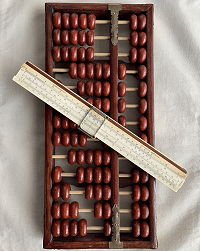
Ye Olden Tools of Yore
I’ve been meaning to write an Abacus post for years. I used one in my first job, back in high school, and they’ve appealed to me ever since. Many years ago I learned there were people who had no idea how an abacus worked. Until then I hadn’t internalized that it wasn’t common knowledge (maybe a consequence of learning something at an early age).
Recently, browsing through old Scientific American issues before recycling them, I read about slide rules, another calculating tool I’ve used, although, in this case, mainly for fun. My dad gave me his old slide rule from when he considered, and briefly pursued, being an architect.
So killing two birds with one stone…
Continue reading
28 Comments | tags: abacus, slide rule | posted in Life, Math
 Musicians practice; actors rehearse; athletes work out; and mathematicians play with numbers. Some of the games they play may seem as silly or pointless as musicians playing scales, but there is a point to it all. That old saying defining insanity as doing the same thing over and over and expecting different results was never really correct (or intended to be used as it often is).
An old joke is more on point: “How do you get to Carnegie Hall?” (Asked the first-time visitors to New York.) — “Practice, practice, practice!” (Replied the street musician they asked.) The point of mathematical play can be sheer exercise for the mind, sometimes can uncover unexpected insights, and once in a while can be sheer fun.
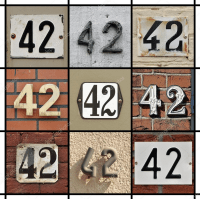
As when finally solving a 65-year-old puzzle involving the number 42!
Continue reading
8 Comments | tags: 42, Andrew Booker, Diophantine equation, discrete mathematics, mathematics, Numberphile | posted in Math
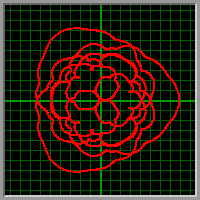
Fourier Curve 1
Don’t let the title put you off — this is one of the coolest things I’ve seen in a while. It’s because of math, but there’s no need to get all mathy to enjoy this, you just need to think about clocks. Or even wheels that spin ’round and ’round.
The fun thing is what happens when we connect one wheel to another in a chain of wheels of different sizes and turn rates. If we use the last wheel to trace out a pattern, we get something that resembles the Spirograph toy of old (which worked on a similar principle of turning wheels).
And if we pick the wheel sizes and spin rates just right, we can draw just about any picture we want.
Continue reading
4 Comments | tags: 3Blue1Brown, JPEG, sine wave | posted in Math, Wednesday Wow
 Happy Tau Day! It’s funny. I feels like I’ve written a lot of posts about pi plus few about it’s bigger sibling, tau. Yet the reality is that I’ve only ever written one Tau Day post, and that was back in 2014. (As far as celebrating Pi Day, I’ve only written three posts in eight years: 2015, 2016, & 2019.)
What I’m probably remembering is mentioning pi a lot here (which is vaguely ironic in that I won’t eat pie — mostly I don’t like cooked fruit, but there’s always been something about pie that didn’t appeal — something about baking blackbirds in a crust or something).
It’s true that I am fascinated by the number.
Continue reading
3 Comments | tags: Andrey Kolmogorov, Champernowne constant, Gregory Chaitin, Kolmogorov complexity, normal number, normal sequence, omega constant, pi, tau, tau day | posted in Math
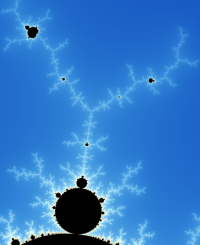
Mandelbrot Antennae
[click for big]
I realized that, if I’m going to do the Mandelbrot in May, I’d better get a move on it. This ties to the main theme of Mind in May only in being about computation — but not about computationalism or consciousness. (Other than in the subjective appreciation of its sheer beauty.)
I’ve heard it called “the most complex” mathematical object, but that’s a hard title to earn, let alone hold. Its complexity does have attractive and fascinating aspects, though. For most, its visceral visual beauty puts it miles ahead of the cool intellectual poetry of Euler’s Identity (both beauties live on the same block, though).
For me, the cool thing about the Mandelbrot is that it’s a computation that can never be fully computed.
Continue reading
11 Comments | tags: computation, computer model, computer program, fractals, Mandelbrot, Mandelbrot fractal, mathematics, Turing Halting Problem | posted in Computers, Math
 Previously, I wrote that I’m skeptical of interpretation as an analytic tool. In physical reality, generally speaking, I think there is a single correct interpretation (more of a true account than an interpretation). Every other interpretation is a fiction, usually made obvious by complexity and entropy.
I recently encountered an argument for interpretation that involved the truth table for the Boolean logical AND being seen — if one inverts the interpretation of all the values — as the truth table for the logical OR.
It turns out to be a tautology. A logical AND mirrors a logical OR.
Continue reading
9 Comments | tags: algorithm, AND gate, boolean logic, computation, computationalism, consciousness, human consciousness, interpretation, logic gate, NAND gate, NOR gate, OR gate, Theory of Consciousness, theory of mind, truth table | posted in Computers, Math, Philosophy
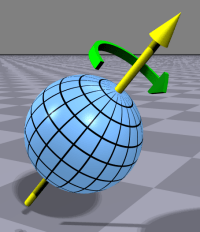 This is a Sideband to the previous post, The 4th Dimension. It’s for those who want to know more about the rotation discussed in that post, specifically with regard to axes involved with rotation versus axes about which rotation occurs.
The latter, rotation about (or around) an axis, is what we usually mean when we refer to a rotation axis. A key characteristic of such an axis is that coordinate values on that axis don’t change during rotation. Rotating about (or on or around) the Y axis means that the Y coordinate values never change.
In contrast, an axis involved with rotation changes its associated coordinate values according to the angle of rotation. The difference is starkly apparent when we look at rotation matrices.
Continue reading
5 Comments | tags: 2D, 3D, 4D, column vector, matrix math, matrix transform, rotation, rotation matrix, unit vector, vectors | posted in Math, Sideband







 Logos con carne