About Wyrd Smythe
The canonical fool on the hill watching the sunset and the rotation of the planet and thinking what he imagines are large thoughts.
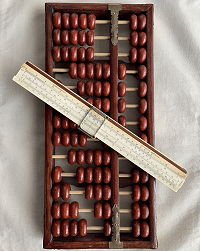
Two computers?
Earlier this year I wrote a trilogy of posts exploring digital dualism — the notion that a (conventional) computer has a physical layer that implements a causally distinct abstract layer. In writing those posts I found my definition of computation shifting slightly to embrace the notion of that dualism.
The phrase “a (conventional) computer” needs unpacking. What is a computer, and what makes one conventional? Computer science offers a mathematical view. Philosophy, as it often does, spirals in on the topic and offers a variety of pancomputation views.
In this series I’ll explore some of those views.
Continue reading
5 Comments | tags: analog computer, computation, digital computer | posted in Computers, Science
Flat Earth!
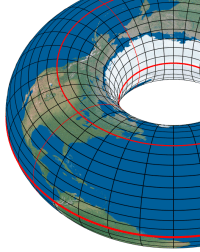
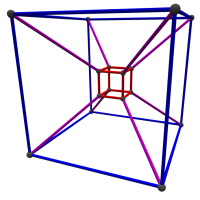
To describe how space could be flat, finite, and yet unbounded, science writers sometimes use an analogy involving the surface of a torus (the mathematical abstraction of the doughnut shape). Such a surface has no boundary — no edge. And despite being embedded in three-dimensional space, the torus surface, if seen in terms of compensating surface metric, is indeed flat.
Yet a natural issue people have is that the three-dimensional embedding is clearly curved, not flat. It’s easy to see how wrapping a flat 2D sheet into a cylinder doesn’t distort it, but hard to see why wrapping a cylinder around a torus doesn’t stretch the outside and compress the inside.
In fact it does, but there are ways to eat our cake (doughnut).
Continue reading
43 Comments | tags: 2D space, 3D space, cosmology, flat space, Flatland, space, torus | posted in Math
 Speaking of Bell tests, I’ve noticed that science writers often struggle to find a good metaphor that illustrates just what’s so weird about the correlation between entangled particles. Bell tests are complex, and because they squat in the middle of quantum weirdness, they’re hard to explain in any classical terms.
I thought I had the beginnings of a good metaphor, at least the classical part. But the quantum part is definitely a challenge. (All the more so because I’m still not entirely clear on the deep details of Bell’s theorem myself.)
Worse, I think my metaphor fails the ping-pong ball test.
Continue reading
35 Comments | tags: Bell's Theorem, particles, quantum mechanics | posted in Brain Bubble, Physics
 Last time I explored the quantum spin of photons, which manifests as the polarization of light. (Note that all forms of light can be polarized. That includes radio waves, microwaves, IR, UV, x-rays, and gamma rays. Spin — polarization — is a fundamental property of photons.)
I left off with some simple experiments that demonstrated the basic behavior of polarized light. They were simple enough to be done at home with pairs of sunglasses, yet they demonstrate the counter-intuitive nature of quantum mechanics.
Here I’ll dig more into those and other experiments.
Continue reading
10 Comments | tags: Bell's Theorem, photons, QM101, quantum mechanics | posted in Physics
Earlier in this QM-101 series I posted about quantum spin. That post looked at spin 1/2 particles, such as electrons (and silver atoms). This post looks at spin in photons, which are spin 1 particles. (Bell tests have used both spin types.) In photons, spin manifests as polarization.
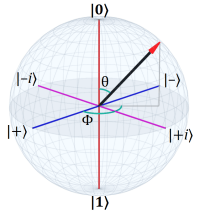
Photon spin connects the Bloch sphere to the Poincaré sphere — an optics version designed to represent different polarization states. Both involve a two-state system (a qubit) where system state is a superposition of two basis states.
Incidentally, photon polarization reflects light’s wave-particle duality.
Continue reading
8 Comments | tags: Bell's Theorem, photons, QM101, quantum spin, wave-function, wave-particle duality | posted in Physics
 This post’s fill-in-the-blank title (given the “season” clue that we’re talking about television shows) might refer to any of at least three series, all coincidentally from Amazon Prime studios. In fact it refers to all three, although this post is only about two because I already wrote about Upload. As it turns out, I liked it best of the three U___ shows.
The other two are Undone and Utopia (the new one). I’d tried the former last year but wasn’t grabbed. This time I liked it better and binge-watched the whole season. The latter was dark and very murder-y. Both of them were… okay. I don’t quite recommend either, though.
What I do recommend (highly!) is the anime movie, Penguin Highway.
Continue reading
37 Comments | tags: Amazon Prime, anime, Japanese anime, Penguin Highway, science fiction TV, SF, SF TV, Undone (TV series), Utopia (TV series) | posted in Sci-Fi Saturday, TV
 I finished The Quantum Labyrinth: How Richard Feynman and John Wheeler Revolutionized Time and Reality (2017), by Paul Halpern. As the title implies, the book revolves around the careers and lives of John A. Wheeler (1911–2008) and Richard Feynman (1918–1988). After Feynman graduated from MIT he became Wheeler’s teaching assistant at Princeton. The two men, despite very different personalities, became life-long friends and collaborators.
One of Wheeler’s many claims to fame is his promotion of Hugh Everett’s PhD thesis, The Theory of the Universal Wave Function. That paper, of course, is the seed from which grew the Many Worlds Interpretation of Quantum Mechanics.
The thing is, there are two major versions of the MWI.
Continue reading
3 Comments | tags: Many Worlds Interpretation, MWI, Paul Halpern, quantum mechanics, Sabine Hossenfelder | posted in Brain Bubble, Physics
 Retirement, along with online access to the library, has opened the door to exploring authors I’ve meant to read for ages. For example, I’d always meant to read one of my dad’s favorite books, The Name of the Rose (1980) by Umberto Eco, but it wasn’t until last year that I finally did (and it was really good; I can see why he loved it).
As a fan of literary science fiction for over six decades, I’ve long felt pressure to explore the works of Octavia Butler (1947–2006). Over the years, in collections, I’ve read some of her short stories (and found them tasty). It was only in the last month or so that I finally got into her novels.
And, my, oh my! She is every bit as good as everyone says she is.
Continue reading
29 Comments | tags: Octavia E. Butler, science fiction, science fiction books, SF Books | posted in Books, Sci-Fi Saturday
I’m two-thirds through my second Paul Halpern book this month. Earlier I read his book about cosmology, Edge of the Universe: A Voyage to the Cosmic Horizon and Beyond (2012), which was okay. Now I’m reading The Quantum Labyrinth: How Richard Feynman and John Wheeler Revolutionized Time and Reality (2017), which I’m enjoying a bit more. In part because cosmology has changed more since 2012 than quantum physics has since 2017. (Arguably, the latter hasn’t changed much since the 1960s.)
I wrote about Halpern’s book, Einstein’s Dice and Schrödinger’s Cat (2015), last year. As the title implies, it focuses on two great names from physics. Quantum Labyrinth (as its title also implies) also focuses on two great physics names.
But today’s Brain Bubble (as the title implies) is about wavefunction collapse.
Continue reading
10 Comments | tags: Paul Halpern, quantum mechanics, Schrödinger Equation, wave-function | posted in Brain Bubble, Physics
 History, location, and religion aside, the Wikipedia disambiguation page for “Babylon“ has 52 entries under “Arts and entertainment” — 26 of which are songs (including one by David Gray that I rather like). Two entries, a novel series and an anime series (which I binged last night), link to the same page because they refer to the same very interesting (very dark) story.
By interesting (and dark) I mean it’s about good, evil, and whether the right to suicide is a good thing. The battles here are mainly intellectual and spiritual. A key point for the characters is the question: what is good; what is evil?
I also recently watched Jupiter’s Legacy on Netflix (Meh!), and I want to offer props to the most recent episode of Grown-ish, which I thought was compelling, well-done, and worth seeing.
Continue reading
26 Comments | tags: anime, Grown-ish, Japanese anime, Netflix | posted in TV, TV Tuesday






 Logos con carne