Tag Archives: theory of mind
 Over the last three posts I’ve been exploring the idea of system states and how they might connect with computational theories of mind. I’ve used a full-adder logic circuit as a simple stand-in for the brain — the analog flow and logical gating characteristics of the two are very similar.
In particular I’ve explored the idea that the output state of the system doesn’t reflect its inner working, especially with regard to intermediate states of the system as it generates the desired output (and that output can fluctuate until it “settles” to a valid correct value).
Here I plan to wrap up and summarize the system states exploration.
Continue reading
2 Comments | tags: algorithm, computation, computationalism, computer model, computer program, consciousness, finite state machine, full-adder, state diagram, Theory of Consciousness, theory of mind | posted in Computers, Philosophy, Science
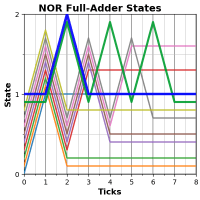 I left off last time talking about intermediate, or transitory, states of a system. The question is, if we only look at the system at certain key points that we think matter, do any intermediate states make a difference?
In a standard digital computer, the answer is a definite no. Even in many kinds of analog computers, transitory states exist for the same reason they do in digital computers (signals flowing through different paths and arriving at the key points at different times). In both cases they are ignored. Only the stable final state matters.
So in the brain, what are the key points? What states matter?
Continue reading
16 Comments | tags: computation, computationalism, computer code, computer model, computer program, consciousness, full-adder, Theory of Consciousness, theory of mind | posted in Computers, Philosophy, Science
In the last post I talked about software models for a full-adder logic circuit. I broke them into two broad categories: models of an abstraction, and models of a physical instance. Because the post was long, I was able to mention the code implementations only in passing (but there are links).
I want to talk a little more about those two categories, especially the latter, and in particular an implementation that bridges between the categories. It’s here that ideas about simulating the brain or mind become important. Most approaches involve some kind of simulation.
One type of simulation involves the states of a system.
Continue reading
8 Comments | tags: algorithm, computation, computationalism, computer code, computer model, computer program, consciousness, full-adder, Theory of Consciousness, theory of mind, Turing Machine | posted in Computers, Philosophy, Science
 Imagine the watershed for a river. Every drop of water that falls in that area, if it doesn’t evaporate or sink into the ground, eventually makes its way, through creeks, streams, and rivers, to the lake or ocean that is the shed’s final destination. The visual image is somewhat like the veins in a leaf. Or the branches of the leaf’s tree.
In all cases, there is a natural flow through channels sculpted over time by physical forces. Water always flows downhill, and it erodes what it flows past, so gravity, time, and the resistance of rock and dirt, sculpt the watershed.
The question is whether the water “computes.”
Continue reading
16 Comments | tags: algorithm, computation, computationalism, computer code, computer model, computer program, consciousness, full-adder, Theory of Consciousness, theory of mind, Turing Machine | posted in Computers, Philosophy, Science
 Previously, I wrote that I’m skeptical of interpretation as an analytic tool. In physical reality, generally speaking, I think there is a single correct interpretation (more of a true account than an interpretation). Every other interpretation is a fiction, usually made obvious by complexity and entropy.
I recently encountered an argument for interpretation that involved the truth table for the Boolean logical AND being seen — if one inverts the interpretation of all the values — as the truth table for the logical OR.
It turns out to be a tautology. A logical AND mirrors a logical OR.
Continue reading
9 Comments | tags: algorithm, AND gate, boolean logic, computation, computationalism, consciousness, human consciousness, interpretation, logic gate, NAND gate, NOR gate, OR gate, Theory of Consciousness, theory of mind, truth table | posted in Computers, Math, Philosophy
 My illusion of free will decided the month of May must be made for Mind (and maybe a dash of Mandelbrot). Lately, online discussions about consciousness have me pondering it again. I never posted on topics such as Chinese Rooms or Philosophical Zombies, largely because sensible arguments exist both ways, and I never decided exactly where I fell in the argument space.
It’s not that I’ve decided[1] on the topics so much as I’ve decided to write about them (and other topics). I’ve found that writing about a topic does a lot to clarify my mind about it. (Trying to teach a topic does that even more.)
I’ll start today with some personal observations and points of view.
Continue reading
11 Comments | tags: brain mind problem, cargo cult, computationalism, consciousness, human brain, human consciousness, human mind, interpretation, mind, Theory of Consciousness, theory of mind | posted in Computers, Philosophy, Science
 At one point in HBO’s Westworld (don’t worry, no spoilers) Robert Ford (Anthony Hopkins) gives a speech about stories, about the value of fiction. He references a belief that fiction elevates — or at least illuminates to good value — the human condition. The belief also holds that those who read a lot of fiction are in some sense “better” people.
The idea is controversial on several grounds. Firstly, it’s hard to define what makes people “better,” and you can’t measure or test what you can’t define. Secondly, even if “better” is defined, not everyone will agree with the definition. Thirdly, there’s a nature-nurture aspect that makes comparisons like this very hard to tease out of any data you can gather.
Maybe a place to start exploring the idea is to first define “fiction” and go from there…
Continue reading
8 Comments | tags: facts, false, Fiction, lies, storytelling, theory of mind, true, truth, wisdom | posted in Books, Movies, TV, Writing
 “In the beginning was the Word, and the Word was…”
Many of you will recognize that as the first words of John 1:1 in the Christian New Testament Bible. There’s also a cross-reference to the very first words of that Bible (Old Testament in this case), “In the beginning God created the heavens and the earth.”
This is about words and about beginnings.
Others might recognize it as a conflation of the lead-in to a Moody Blues tune, OM, from In Search of the Lost Chord, and the title of a song from another album, In the Beginning, from On the Threshold of a Dream.
(Yes “album.” I’m old!)
Continue reading
23 Comments | tags: brain, brain mind problem, computationalism, computer guy, human brain, human mind, logos, Marriage, Moody Blues, rational mind, René Descartes, Theory of Consciousness, theory of mind | posted in Baseball, Basics, Books, Computers, Life, Movies, Opinion, Philosophy, Politics, Rant, Science, Society, The Interweb, TV
 Over the last three posts I’ve been exploring the idea of system states and how they might connect with computational theories of mind. I’ve used a full-adder logic circuit as a simple stand-in for the brain — the analog flow and logical gating characteristics of the two are very similar.





 Logos con carne