Tag Archives: Special Relativity
 Last time I introduced you to the idea of a space-time event. In physics, an “event” has the same meaning as when Hollywood blares out about a “major motion picture event” — that is to say, nothing at all special — just something that happens at a specified location and time.
If you attend a social event, it has a location and a time. When we talk about space-time events, all we mean is a specific location and a specific time (hence the name, space-time event).
Today we’ll explore some interesting aspects of such events.
Continue reading
8 Comments | tags: light, light speed, space, space-time, space-time event, Special Relativity, time, time-space, time-space diagram | posted in Physics
 The last two posts introduced and explored the concept of time-space diagrams. This time I’ll complete that exploration by using them to consider motion from two points of view. This will be an exercise in application of our diagrams.
I’m going to connect that application with something I stressed last week: that motion has a symmetrical component. It’s perfectly valid to think of the world moving past the train as it is to think of the train moving through the world.
It happens that here our dueling points of view are resolved by something else I discussed last week. See if you spot it before I mention it.
Continue reading
11 Comments | tags: diagrams, motion, relative motion, space, space-time, space-time event, Special Relativity, time, time-space, time-space diagram | posted in Physics
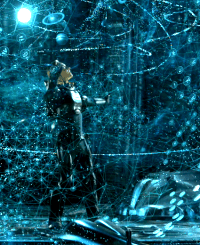
3D holograms! Me want!!
Last time I introduced you to the idea of a time-space diagram, which is a kind of map used to describe motion. As with many maps and diagrams, we choose to use a flat, two-dimensional representation. Someday hologram technology may advance to casual use of three-dimensional images, but so long as we use paper and display screens, we’re stuck with two.
Motion is movement in both space and time, so we want to use one of our two dimensions to represent time. That leaves us with only one remaining dimension for space, so our diagrams exist in a reduced one-dimensional world.
Today I’ll explore that world in more detail.
Continue reading
7 Comments | tags: 1D, 2D, 3D, diagrams, dimensions, maps, motion, space, Special Relativity, time, time-space, time-space diagram | posted in Physics
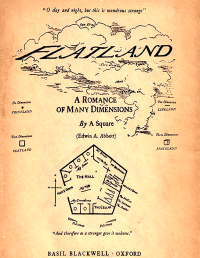 Last week I introduced you to the idea of relative motion between frames of reference. We’ve explored this form of relativity scientifically since Galileo, and it bears his name: Galilean Relativity (or Invariance). Moving objects within a (relatively) moving frame move differently according to those outside that frame.
I also introduced you to the idea that light doesn’t follow that rule; that light moves the same way to all observers. This is what makes Special Relativity different. It turns out that, if a frame is (relatively) moving fast enough, some bizarre things happen.
Time-space diagrams will help us explore that.
Continue reading
2 Comments | tags: 1D, 2D, 3D, diagrams, dimensions, Edwin Abbott, Emmy Noether, Flatland, maps, motion, Special Relativity, time, time-space, time-space diagram | posted in Physics
 It’s Friday, and I’m sure you’re thinking about the weekend, so today will be just a review and some more details about the speed of light.
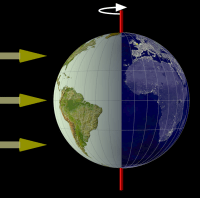
And speaking of light, today is the Vernal Equinox. For the next six months (for those of us in the northern hemisphere), our days will be longer than our nights. No doubt the combination of spring, the Equinox, and the weekend, have you wondering what you’re doing at your computer reading about Special Relativity.
I’ll try to be very brief…
Continue reading
8 Comments | tags: Albert Einstein, equinox, Galilean invariance, Galileo Galilei, light, light speed, light year, moon, Special Relativity, spring equinox, Sun, vernal equinox | posted in Physics

Throwing like a girl!
I’ve introduced the idea of an inertial frame of reference. This is when we, and objects in our frame, are either standing still or moving with constant (straight-line) motion. In this situation, we can’t tell if we’re really moving or standing still relative to some other frame of reference. In fact, the question is meaningless.
I’ve also introduced the idea that objects moving within our frame — moving (or standing still) along with us, but also moving from our perspective — move differently from the perspective of other frames. Specifically, the speed appears different.
Now I’ll dig deeper into that and introduce a crucial exception.
Continue reading
11 Comments | tags: Albert Einstein, Emmy Noether, Galilean invariance, Galileo Galilei, Mo'ne Davis, motion, scalars, Special Relativity, speed, vectors, velocity | posted in Physics
 In the last two posts I’ve explained how Special Relativity concerns relative motion between two frames of reference, and that the motion involved is constant, straight-line motion that allows us to view either frame as the “moving” one or the “standing still” one.
Today I’m going to dig a little bit deeper into the idea of relative motion and what that involves for actions within a constantly moving frame of reference versus what observers in a different frame perceive. In other words: trains, planes, and automobiles.
(Warning: this gets a little math-y, but you can ignore those bits.)
Continue reading
25 Comments | tags: Albert Einstein, bowling ball, Emmy Noether, frame of reference, Galileo Galilei, James Maxwell, motion, relative motion, relativity, Special Relativity | posted in Physics

A fun way to feel acceleration!
Last time I introduced some of the foundation concepts required for our exploration of Special Relativity. In particular, that the word “special” in this case refers to a specific kind of motion: constant motion in a straight line.
Which may have caused some of you to wonder: Okay, what about motion that isn’t constant (and what’s that business about “in a straight line” — why keep mentioning that)? As it turns out, when motion involves speeding up, or slowing down, or going along a curve (or even just changing direction), that changes the situation in very significant ways!
That’s what I’m going to discuss today.
Continue reading
3 Comments | tags: acceleration, Albert Einstein, constant motion, cubit, deceleration, fortnight, furlong, General Relativity, jiffy, motion, slowing down, Special Relativity, speeding up | posted in Physics
 Okay, if you’ll all take your seats and quiet down, we can begin. I’ll keep this very short today because I know it’s Spring and many of you are eager to get out there and walk Frisbees and throw dogs… I mean — well you know what I mean.
The point is, that in keeping with spring, I’m aiming to keep these posts light and breezy. Unfortunately, I have terrible aim, so we’ll see how that goes. I never met a paragraph I couldn’t make longer!
Ready? Let’s go…
Continue reading
24 Comments | tags: Albert Einstein, constant motion, frame of reference, motion, Special Relativity | posted in Physics
 Okay. I’ve been teasing doubly special Saturday and (especially this year) since last Monday (and planting hints along the way). If you haven’t figured it out by now, today is Albert Einstein’s birthday. It’s also pi day, and how cool is it that a guy like Al was born on pi day?
So: Happy Birthday Albert! The (especially this year) part is because it’s extra-special pi day (3/14/15) and because this year I’m finally going to do what I’ve been wanting to do here to commemorate Einstein’s birthday since I started this blog back in ought-eleven.
I’m going to write — at length — about Special Relativity!
Continue reading
8 Comments | tags: Albert Einstein, Emmy Noether, faster than light, FTL, Happy Birthday, light speed, pi day, Special Relativity | posted in Math, Physics







 Logos con carne