Category Archives: Science
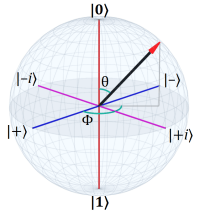 When I was in high school, bras were of great interest to me — mostly in regards to trying to remove them from my girlfriends. That was my errant youth and it slightly tickles my sense of the absurd that they’ve once again become a topic of interest, although in this case it’s a whole other kind of bra.
These days it’s all about Paul Dirac’s useful Bra-Ket notation, which is used throughout quantum mechanics. I’ve used it a bit in this series, and I thought it was high time to dig into the details.
Understanding them is one of the many important steps to climb.
Continue reading
15 Comments | tags: bra-ket notation, inner product, matrix multiplication, outer product, QM101, quantum mechanics | posted in Math, Physics
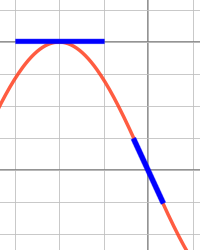 Today is the first Earth-Solar event of 2021 — the Vernal Equinox. It happened early in the USA: 5:37 AM on the east coast, 2:37 AM on the west coast. Here in Minnesota, it happened at 4:37 AM. It marks the first official day of Spring — time to switch from winter coats to lighter jackets!
Have you ever thought the Solstices seem more static than the Equinoxes? The Winter Solstice particularly, awaiting the sun’s return, does it seem like the change in sunrise and sunset time seems stalled?
If you have, you’re not wrong. Here’s why…
Continue reading
26 Comments | tags: derivatives, equinox, sine wave, Solstice, spring equinox, Summer Solstice, vernal equinox, Winter Solstice | posted in Life, Math
One small hill I had to climb involved the object I’ve been using as the header image in these posts. It’s called the Bloch sphere, and it depicts a two-level quantum system. It’s heavily used in quantum computing because qubits typically are two-level systems.
So is quantum spin, which I wrote about last time. The sphere idea dates back to 1892 when Henri Poincaré defined the Poincaré sphere to describe light polarization (which is the quantum spin of photons).
All in all, it’s a handy device for visualizing these quantum states.
Continue reading
16 Comments | tags: Bloch sphere, QM101, quantum computing, quantum mechanics, quantum spin | posted in Math, Physics
Popular treatments of quantum mechanics often treat quantum spin lightly. It reminds me of the weak force, which science writers often mention only in passing as ‘related to radioactive decay’ (true enough). There’s an implication it’s too complicated to explain.
With quantum spin, the handwave is that it is ‘similar to classical angular momentum’ (similar to actual physical spinning objects), but different in mysterious quantum ways too complicated to explain.
Ironically, it’s one of the simpler quantum systems, mathematically.
Continue reading
40 Comments | tags: QM101, quantum mechanics, quantum spin | posted in Math, Physics
Unless one has a strong mathematical background, one new and perhaps puzzling concept in quantum mechanics is all the talk of eigenvalues and eigenvectors.
Making it even more confusing is that physicists tend to call eigenvectors eigenstates or eigenfunctions, and sometimes even refer to an eigenbasis.
So the obvious first question is, “What (or who) is an eigen?” (It turns out to be a what. In this case there was no famous physicist named Eigen.)
Continue reading
14 Comments | tags: eigenstate, eigenvalue, eigenvector, matrix transform, QM101, quantum mechanics | posted in Math, Physics
In quantum mechanics, one hears much talk about operators. The Wikipedia page for operators (a good page to know for those interested in QM) first has a section about operators in classical mechanics. The larger quantum section begins by saying: “The mathematical formulation of quantum mechanics (QM) is built upon the concept of an operator.”
Operators represent the observables of a quantum system. All measurable properties are represented mathematically by an operator.
But they’re a bit difficult to explain with plain words.
Continue reading
6 Comments | tags: QM101, quantum mechanics, quantum operator | posted in Math, Physics
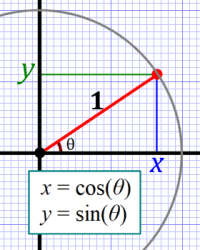 Trigonometry is infamously something most normal people fear and loath. Or at least don’t understand and don’t particularly want to deal with. (In fairness, it doesn’t pop up much in regular life.) As with matrix math, trig often remains opaque even for those who do have a basic grasp of other parts of math.
Excellent and thorough tutorials exist for those interested in digging into either topic, but (as with matrix math) I thought a high-altitude flyover might be helpful in pointing out important concepts.
The irony, as it turns out, is that trig is actually pretty easy!
Continue reading
31 Comments | tags: cosine, sine, sine wave, trigonometry | posted in Math, Sideband
 There are many tutorials and teachers, online and off, that can teach you how to work with matrices. This post is a quick reference for the basics. Matrix operations are important in quantum mechanics, so I thought a Sideband might have some value.
I’ll mention the technique I use when doing matrix multiplication by hand. It’s a simple way of writing it out that I find helps me keep things straight. It also makes it obvious if two matrices are compatible for multiplying (not all are).
One thing to keep in mind: It’s all just adding and multiplying!
Continue reading
7 Comments | tags: matrix math, matrix multiplication | posted in Math, Sideband
Last time I set the stage, the mathematical location for quantum mechanics, a complex vector space (Hilbert space) where the vectors represent quantum states. (A wave-function defines where the vector is in the space, but that’s a future topic.)
The next mile marker in the journey is the idea of a transformation of that space using operators. The topic is big enough to take two posts to cover in reasonable detail.
This first post introduces the idea of (linear) transformations.
Continue reading
13 Comments | tags: linear algebra, matrix transform, QM101, quantum mechanics, vector space, vectors | posted in Math, Physics
Whether it’s to meet for dinner, attend a lecture, or play baseball, one of the first questions is “where?” Everything that takes place, takes place some place (and some time, but that’s another question).
Where quantum mechanics takes place is a challenging ontological issue, but the way we compute it is another matter. The math takes place in a complex vector space known as Hilbert space (“complex” here refers to the complex numbers, although the traditional sense does also apply a little bit).
Mathematically, a quantum state is a vector in Hilbert space.
Continue reading
9 Comments | tags: coordinate system, inner product, QM101, quantum mechanics, vector space, vectors | posted in Math, Physics






 Logos con carne