Category Archives: Science
 Today I’m deep in some POV-Ray project work and waiting to see how the Los Angeles Dodgers do tonight at the St. Louis Cardinals. The Dodgers have a tough boat to row; I think the Cards will have to stumble, and the Dodgers will have to be excellent. For two games. I’d like to see it, but dot, dot, dot. The Detroit Tigers are in similar straits with the Boston Red Sox. It’s looking like the World Series will be red against red.
But due to something that came up in a conversation from yesterday’s article, I’m interrupting my previously scheduled day to bring you this special announcement:
I’m only going to say this once: Global climate change is real.
Continue reading
1 Comment | tags: Bad Astronomer, Big Blatant Lie, climate change, climate change deniers, Federal Executive Orders, global warming, Phil Plait, President Obama | posted in Rant, Science
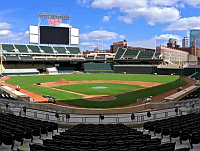
This one’s mine!
So I was conversing with a fellow I know, and the right side of my brain asked the left side, “So just how much square footage per person is there these days?” We both agreed that seemed like an interesting question (given all the people running around these days), so we looked around for a body to help us research the answer.
We just happened to find one handy, so off we all went to the virtual library and math lab. Unfortunately our math consultant was a Communications Arts major and made a small error thinking square kilometers to square miles was the same as kilometers to miles. Fortunately everyone involved obsessively double-checks their work, so we caught the error in time.
Pity, though. The original answer would have been fun to write about.
Continue reading
15 Comments | tags: big numbers, Earth, Earth population, numbers, square feet per person | posted in Life, Math
 Those who know me know that I’m not big on calendar holidays. Even my birthday tends to pass without fanfare. That comes from being single, the island that supposedly no one is. After a lifetime of Christmas and New Years’ being ordinary days, you get used to it.
But I do honor the Solar Event Days because (as I’ve mentioned many times) light is so important to me (and because I’m a geek). Christmas may not mean much to me, but the Winter Solstice does! The days finally start getting longer! Summer Solstice is a day of mourning for the opposite reason.
Today — the Autumnal Equinox — marks the halfway point.
Continue reading
9 Comments | tags: autumnal equinox, Earth, equinox, fall, moon, POV-Ray, summer, Sun, winter | posted in Basics, Science
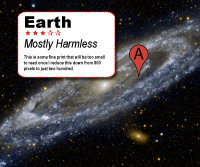 The other day I was Wiki Walking and ended up reading about the Rare Earth Hypothesis in reference to the Fermi Paradox and the Drake Equation. We’ve discovered that most stars in our galaxy appear to have planets of some kind, although ones with human-friendly environments may be quite rare. The presence of a plethora of planets presumably provides a potentially large factor for at least one part of the professor’s pretty problem.
But it’s possible that some of its other factors are extremely small. They may be much smaller than anyone had imagined. They may be so small as to ensure that we are alone in the galaxy.
It’s even possible we are alone — or nearly alone — in the universe!
Continue reading
8 Comments | tags: alien contact, alien vistors, aliens, Captain Kirk, Captain Picard, Drake Equation, Fermi Paradox, Golgafrincham, Hitchhikers Guide, Prime Directive, Rare Earth Hypothesis, Star Trek | posted in Basics, Science
 I’ve been playing with Python and POV-Ray, catching up on movies, enjoying the continued nice weather, and even getting in some reading. Yet it’s still weird how little I seem to get done considering the days are all mine. (And I still haven’t fully shaken the sense that all this free time ends at some point.)
For now, I plan to focus on project work—the previously mentioned Python and POV-Ray playing—so there may be a pause in the posting while I putter (possibly a plethora of pauses). Please stay tuned!
In the meantime, I have some questions:
Continue reading
28 Comments | tags: atheism, Joy, meaning, POV-Ray, purpose, Python, spirituality, suffering, theism | posted in Basics, Life, Philosophy, Religion, Science
 I’ve gotten spoiled. Writing about the con carne topics is much harder than writing about the life stories and the off-the-cuff opinions. Meaty topics require research and fact-checking (and often I need to create the images). And I expect they’re also harder to read!
My intention here was always to write mostly about ideas with a fallback of writing about things and, to a lesser extent, writing about life (which is to say, about people).
Today’s post keys off a Saturday Morning Breakfast Cereal cartoon I saw a while back. At first the cartoon spoke to me, but the more I thought about it, the less I agreed with it.
Continue reading
8 Comments | tags: Dune, Fahrenheit 451, Frank Herbert, George Carlin, Ken Follett, Larry Niven, Lee Smolin, Pillars of the Earth, Ray Bradbury, Ringworld, Robert Pirsig, SMBC, Winston Churchill, Zen Motorcycle | posted in Books, Life, Philosophy, Religion, Science, Writing
 I woke early to the sound of thunder this morning. It was hot enough earlier in the week to force me back to enclosed air conditioning. Friday, I realized it had cooled off enough to open the windows again. I very much prefer breezes blowing through my place. The weather witches mis-predicted rain Friday and Saturday but got it right Sunday morning.
I lay in bed sleepily thinking how much I enjoy the sound of rain and thunder. That thought was immediately followed by the realization that I needed to wake up and go close some windows! As the rain continued, I began to wonder if the Twins game today would be rained out, but now it’s just partly cloudy, so no problem.
I thundered yesterday, but on Sundays I try to be sunny (or just partly cloudy).
Continue reading
8 Comments | tags: canine, Canis lupus familiaris, dogs, love, needles, NOVA, phobias, thunder, time, University of Virginia sundial | posted in Life, Science
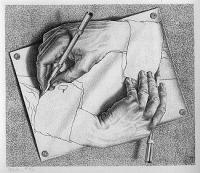 If you have read this blog much, you know that a topic that interests me greatly is the nature of consciousness. How is it that a three-pound clump of cells, a brain, gives rise to the rich experience of consciousness, our minds? Cognitive scientist David Chalmers termed this “the hard problem” of consciousness, and as it stands we really have no idea what consciousness is (and yet we all experience it all the time).
Back in 1979 cognitive scientist Douglas Hofstadter wrote Gödel, Escher, Bach, a book that attempts to answer the question. GEB, as it became known, was a large book most took as a random tour of interesting scientific ideas. But GEB did have a theme, so 25 years later Hofstadter wrote another (much shorter) book to re-state his case.
That book is called I Am a Strange Loop, and it has much worth considering!
Continue reading
46 Comments | tags: brain, David Chalmers, Douglas Hofstadter, experience, GEB, mind, Paris Hilton, Philosophical zombie, Theory of Consciousness | posted in Philosophy, Science
 Over the last two days I’ve written about a way of viewing words, sentences, even entire books, as single (very large) numbers. We do that by treating the characters in the string as “digits” in a number system we define. Technically speaking, we interpret the string as a number written in some large radix.
This is actually what we do every time we look at a written number. For example, we interpret the four-character text string “2013” as representing the numeric value two-thousand-and-thirteen. We do this easily, because we’ve grown up with the base 10 number system, decimal. The systems I’ve written about simply extend the concept.
Today, as a Sideband, I thought I’d get into some of the more technical details.
Continue reading
Leave a comment | tags: ASCII, CP-1252, decimal, hexadecimal, Mayans, number systems, Python, radix, Sumerians, Unicode, UTF-8 | posted in Computers, Math, Sideband
 Yesterday I introduced you to the idea of words as numbers. There are many ways to create a map between words and numbers. For example, we could assign them the number that represents their position in the dictionary. That would make words that start with “A” have smaller numbers while words that start with “Z” would have the largest numbers.
There are also ways to treat the words themselves as numbers. We can interpret the letters the same way we do digits. Each letter has an assigned numeric value, and then a string of letters—just like string of digits—forms a number. The scheme I showed you yesterday allows us to treat (only!) single words as numbers.
Now let’s extend this so that entire sentences—or even entire books—become numbers!
Continue reading
2 Comments | tags: big numbers, number systems, numbers, positional notation, Rudy Rucker, words, zero | posted in Basics, Math






 Logos con carne