Category Archives: Science
 Back in 2015, to celebrate Albert Einstein’s birthday, I wrote a month-long series of posts about Special Relativity. I still regard it as one of my better efforts here. The series oriented on explaining to novices why faster-than-light travel (FTL) is not possible (short answer: it breaks reality).
So, no warp drive. No wormholes or ansibles, either, because any FTL communication opens a path to the past. When I wrote the series, I speculated an ansible might work within an inertial frame. A smarter person set me straight; nope, it breaks reality. (See: Sorry, No FTL Radio)
Then Dr Sabine Hossenfelder seemed to suggest it was possible.
Continue reading
12 Comments | tags: Albert Einstein, ansible, causality violation, faster than light, FTL, FTL radio, light speed, Sabine Hossenfelder, simultaneity, spacetime, Special Relativity, speed of light | posted in Physics
 Last time I started talking about entropy and a puzzle it presents in cosmology. To understand the puzzle we have to understand entropy, which is a crucial part of our view of physics. In fact, we consider entropy to be a (statistical) law about the behavior of reality. That law says: Entropy always increases.
There are some nuances to this, though. For example we can decrease entropy in a system by expending energy. But expending that energy increases the entropy in some other system. Overall, entropy does always increase.
This time we’ll see how Roger Penrose, in his 2010 book Cycles of Time, addresses the puzzle entropy creates in cosmology.
Continue reading
27 Comments | tags: black hole, cosmology, entropy, galaxy, Immanuel Kant, laws of thermodynamics, Roger Penrose, thermodynamics, universe | posted in Physics
I’ve been chiseling away at Cycles of Time (2010), by Roger Penrose. I say “chiseling away,” because Penrose’s books are dense and not for the fainthearted. It took me three years to fully absorb his The Emperor’s New Mind (1986). Penrose isn’t afraid to throw tensors or Weyl curvatures at readers.
This is a library book, so I’m a little time constrained. I won’t get into Penrose’s main thesis, something he calls conformal cyclic cosmology (CCC). As the name suggests, it’s a theory about a repeating universe.
What caught my attention was his exploration of entropy and the perception our universe must have started with extremely low entropy.
Continue reading
12 Comments | tags: arrow of time, big bang, cosmology, entropy, laws of thermodynamics, Roger Penrose, thermodynamics, time, universe | posted in Physics
 Last time I started with wave-functions of quantum systems and the Schrödinger equation that describes them. The wave-like nature of quantum systems allows them to be merged (superposed) into combined quantum system so long as the coherence (the phase information) remains intact.
The big mystery of quantum wave-functions involves their apparent “collapse” when an interaction with (a “measurement” by) another system seemingly destroys their coherence and, thus, any superposed states. When this happens, the quantum behavior of the system is lost.
This time I’d like to explore what I think might be going on here.
Continue reading
17 Comments | tags: quantum effects, quantum mechanics, quantum physics, Schrödinger Equation, wave-function | posted in Physics
 Quantum physics is weird. How weird? “Too weird for words,” as we used to say, and there is a literal truth to words being inadequate in this case. There is no way to look at the quantum world that doesn’t break one’s mind a little. No one truly understands it (other than through the math). It’s like trying to see inside your own head.
Since we’re clueless we make up stories to fit the facts. Some stories advise that we just keep our heads down and do the math. (Which works very well but leaves us thirsty.) Other stories seek to quench that thirst, but every story seems to stumble somewhere.
One of quantum’s biggest and oldest stumbling blocks is wave-function collapse.
Continue reading
18 Comments | tags: quantum effects, quantum mechanics, quantum physics, Schrödinger Equation, wave-function | posted in Physics
 I’ve come to realize that, when it comes to the Many Worlds Interpretation (MWI) of quantum physics, there is at least one aspect of it that’s poorly understood. Since it’s an aspect that even proponents of MWI recognize as an issue, I thought I’d take a stab at explaining it. (If nothing else, I’ll have a long reply I can link to in the future.)
The issue in question involves what MWI does to probability. Essentially, our view of rare events — improbable events — is that they happen rarely, as we’d expect. Flip a fair coin 100 times; we expect to get heads roughly 50% of the time.
But under MWI, someone always gets 100 heads in a row.
Continue reading
11 Comments | tags: Many Worlds Interpretation, MWI | posted in Philosophy, Physics
 Last week, when I posted about the Mathematical Universe Hypothesis (MUH), I noted that it has the same problem as the Block Universe Hypothesis (BUH): It needs to account for its apparent out-of-the-box complexity. In his book, Tegmark raises the issue, but doesn’t put it to bed.
He invokes the notion of Kolmogorov complexity, which, in a very general sense, is like comparing things based on the size of their ZIP file. It’s essentially a measure of the size of information content. Unfortunately, his examples raised my eyebrows a little.
Today I thought I’d explore why. (Turns out I’m glad I did.)
Continue reading
18 Comments | tags: complexity, Kolmogorov complexity, Mathematical Universe Hypothesis, Max Tegmark, random | posted in Philosophy, Physics
 I just finished Humble Pi (2019), by Matt Parker, and I absolutely loved it. Parker, a former high school maths teacher, now a maths popularizer, has an easy breezy style dotted with wry jokes and good humor. I read three-quarters of the book in one sitting because I couldn’t stop (just one more chapter, then I’ll go to bed).
It’s a book about mathematical mistakes, some funny, some literally deadly. It’s also about how we need to be better at numbers and careful how we use them. Most importantly, it’s about how mathematics is so deeply embedded in modern life.
It’s my third maths book in a month and the only one I thoroughly enjoyed.
Continue reading
2 Comments | tags: Matt Parker, numbers, Parker Square | posted in Books, Math
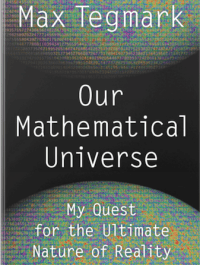 I finally finished Our Mathematical Universe (2014) by Max Tegmark. It took me a while — only two days left on the 21-day library loan. I often had to put it down to clear my mind and give my neck a rest. (The book invoked a lot of headshaking. It gave me a very bad case of the Yeah, buts.)
I debated whether to post this for Sci-Fi Saturday or for more metaphysical Sabbath Sunday. I tend to think either would be appropriate to the subject matter. Given how many science fiction references Tegmark makes in the book, I’m going with Saturday.
The hard part is going to be keeping this post a reasonable length.
Continue reading
34 Comments | tags: anthropic principle, block universe, doomsday argument, Mathematical Universe Hypothesis, Max Tegmark, MUH, MWI | posted in Books, Philosophy, Physics

Multiplying by i…
Recently I did a series of posts about how the complex numbers arise from a natural progression of math realizations. I’ve done posts in the past about how the natural numbers lead through the integers and rationals to the real numbers. (And I’ve done posts about how weird the real numbers are, but that’s another topic.)
I recently came across another way a progression of obvious natural questions directly leads to the necessity of a new type of number, and this progression takes us all the way from the naturals to the complex numbers.
All by asking, “What do you get when you…”
Continue reading
7 Comments | tags: complex numbers, complex plane, group theory, groups, integers, irrational numbers, natural numbers, rational numbers, real numbers, sets, town barber paradox | posted in Math






 Logos con carne