Category Archives: Science
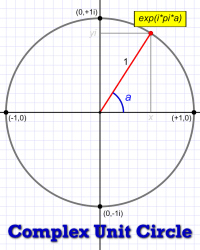 Last time I opened with basic exponentiation and raised it to the idea of complex exponents (which may, or may not, have been surprising to you). I also began exploring the ubiquitous exp function, which enables the complex math needed to deal with such exponents.
The exp(x) function, which is the same as ex, appears widely throughout physics. The complex version, exp(ix), is especially common in wave-based physics (such as optics, sound, and quantum mechanics). It’s instrumental in the Fourier transform.
Which in turn is as instrumental to mathematicians and physicists as a hammer is to carpenters and pianos.
Continue reading
8 Comments | tags: complex numbers, complex plane, exponential function, exponentiation, Fourier transform, Heisenberg Uncertainty | posted in Math, Physics
Five years ago today I posted, Beautiful Math, which is about Euler’s Identity. In the first part of that post I explored why the Identity is so exquisitely beautiful (to mathematicians, anyway). In the second part, I showed that the Identity is a special case of Euler’s Formula, which relates trigonometry to the complex plane.
Since then I’ve learned how naïve that post was! It wasn’t wrong, but the relationship expressed in Euler’s Formula is fundamental and ubiquitous in science and engineering. It’s particularly important in quantum physics with regard to the infamous Schrödinger equation, but it shows up in many wave-based contexts.
It all hinges on the complex unit circle and the exp(i×π×a) function.
Continue reading
14 Comments | tags: 3Blue1Brown, complex numbers, complex plane, Euler's Formula, Euler's Identity, exponential function, Fourier transform | posted in Math
 Sunday I breezed through Seven Brief Lessons On Physics (2014), by Carlo Rovelli. It’s a quick read of only 96 pages that still manages to touch on some of the key aspects of physics.
His much longer book, Reality Is Not What It Seems: The Journey to Quantum Gravity (2014), covers the same territory in greater detail (and greater length: 288 pages). After I finished what amounted to an appetizer, I tucked into the main course. I’m about 30% through it and am enjoying it quite a bit more than I have his work so far.
Both books, but especially the longer one, explore the theory of Loop Quantum Gravity (LQG), of which Rovelli is a co-founder.
Continue reading
28 Comments | tags: Carlo Rovelli, Loop Quantum Gravity, quantum gravity | posted in Physics
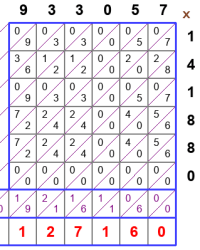 At the beginning of the month I posted about a neat Japanese visual method for multiplying smallish numbers. Besides its sheer visual attractiveness, it’s interesting in allowing one to multiply numbers without reference to multiplication tables (which, let’s face it, typically require rote memorization).
As I mentioned last time, my interest in multiplication is linked to my interest in generating Mandelbrot plots, which is a multiplication-intensive process. But for those learning math, digging into basic multiplication has some instructive value.
With that in mind, here are some other multiplication tricks.
Continue reading
14 Comments | tags: Cartesian product, multiplication | posted in Math
 As someone with almost literally a life-long love of astronomy (my first word was “star”), I’ve always been vaguely intrigued by astrology. I’m fascinated by that which endures through many ages and cultures of humanity. At the very least, such things reflect an aspect of human consciousness. They’re also a shared idea, so they form community in the like-minded.
Is there magic in the stars? No, not in the astrological sense. Any “magic” is in us, in our consciousness, not in the stars. (Worldwide, on average, almost 12 million babies are born each month. That an astrological sign applies to them all is a bit of a stretch.)
And the thing is, most of us aren’t the sign we think we are!
Continue reading
10 Comments | tags: astronomy, planet, solar system, sun sign, zodiac | posted in Life, Science

123 × 321 = 39,483
My interest in number multiplication goes back to exploring algorithms for generating Mandelbrot plots, which can require billions of multiplication operations on arbitrary precision numbers (numbers with lots and lots of digits).
Multiplying two numbers — calculating their product — is computationally intense because of the intermediate Cartesian product. Multiplying two 12-digit numbers creates a 24-digit result (12+12), but it also has an intermediate stage involving 144 (12×12) single digit multiplications.
Recently I learned an intriguing Japanese visual multiplication method.
Continue reading
23 Comments | tags: Cartesian product, Japanese multiplication method, Mandelbrot, multiplication | posted in Math
 I’ve posted more than once regarding my view of the Many Worlds Interpretation (MWI) of quantum physics. I find its rise in modern popularity genuinely inexplicable. (I can’t help but think it’s exactly the sort of thing Dr. Sabine Hossenfelder is talking about in her book, Lost in Math.)
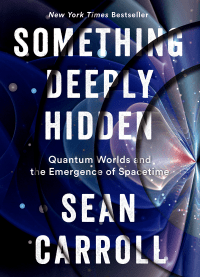
Hoping to find the logic that apparently appeals to so many, I read Something Deeply Hidden: Quantum Worlds and the Emergence of Spacetime (2019), by Sean Carroll. It is, in large part, his argument favoring the MWI. Carroll is a leading voice in promoting the view, so I figured his book would address my concerns.
But as far as I can tell, “there is no there there.”
Continue reading
33 Comments | tags: Many Worlds Interpretation, MUH, MWI, quantum physics, Sean Carroll | posted in Physics

Expert Logician
For a little Friday Fun I have a logic puzzle for you. I’ll give you the puzzle at the beginning of the post, detour to some unrelated topics (to act as a spoiler barrier), and then explain the puzzle in the latter part of the post. I would encourage you to stop reading and think about the puzzle first — it’s quite a challenge. (I couldn’t solve it.)
The puzzle involves an island with a population of 100 blue-eyed people, 100 brown-eyed people, and a very strange social practice. The logic involved is downright nefarious, and even after reading the explanation, I had to think about it for a bit to really see it. (I still think it’s twisted.)
To be honest, I’m kinda writing this to make sure I understand it!
Continue reading
21 Comments | tags: Daniel Craig, George Lazenby, James Bond, logic, logic puzzle, NASA, Pierce Brosnan, Randall Munroe, Roger Moore, Sean Connery, Terry Tao, Timothy Dalton | posted in Math
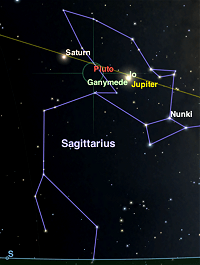 If you keep an eye on the night sky you may have noticed two bright “stars” to the south just around midnight. (To be precise: Jupiter is dead south at 11:02 pm; Saturn is dead south at 11:37 pm. By midnight they’ve moved slightly to the west.)
If you’re the type to keep an eye on the night sky, you likely already know those “stars” are Saturn (on the left) and Jupiter (on the right). What you may not know — and certainly can’t see — is that almost right smack dab between them is the former planet Pluto. All three just happen to be lined up nicely right now.
The New Horizons spacecraft is also out there, well beyond Pluto.
Continue reading
4 Comments | tags: astronomy, Jupiter, NASA, New Horizons, planet, Pluto, Pluto is amazing!, Saturn, solar system, space, space exploration | posted in Science
 Four years ago I started pondering the tesseract and four-dimensional space. I first learned about them back in grade school in a science fiction short story I’d read. (A large fraction of my very early science education came from SF books.)
Greg Egan touched on tesseracts in his novel Diaspora, which got me thinking about them and inspired the post Hunting Tesseracti. That led to a general exploration of multi-dimensional spaces and rotation within those spaces, but I continued to focus on trying to truly understand the tesseract.
Today we’re going to visit the 4D space inside a tesseract.
Continue reading
5 Comments | tags: 1D, 2D, 3D, 4D, cube, dimensions, square, tesseract | posted in Math, Sideband







 Logos con carne