Category Archives: Books
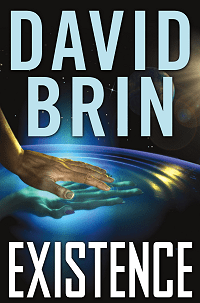 I’m not quite halfway through Existence, by David Brin, but I’m enjoying it so much I have to start talking about it now. For one thing, it’s such a change from the Last Chronicles, which was a hard slog with a disappointing ending. (Still worth the journey, though.)
The novel is a standalone, not part of his Uplift Universe, but it apparently can be viewed as a kind of prequel to that reality. However: so far no alien contact, humanity is still on Earth, and computers are not conscious (but AI is very, very good). The year, as far as I can tell, seems to be in the 2040s or 2050s.
At heart, the novel’s theme is the Fermi Paradox; it examines many of the potential Great Filters that might end an intelligent species. But now an alien artifact has been found, a kind of message in a bottle that appears to contain a crowd of alien minds…
Continue reading
18 Comments | tags: David Brin, Fermi Paradox, Great Filter, Isaac Asimov, Kiln People, Startide Rising, Sundiver | posted in Books, Sci-Fi Saturday, Society
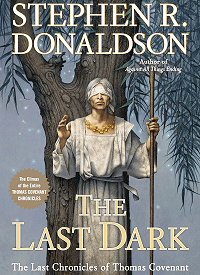 Earlier this week I posted about all the TV (5.0!) that I watched while dog-sitting Bentley. There I mentioned how days were allocated to reading in hopes of reducing what has grown to be a rather long To-Read list. (Not to mention the books in my To-Buy list; I really do need to spend more time reading.)
Central to the plan was, at long last, finishing The Chronicles of Thomas Covenant, by Stephen R. Donaldson. Specifically, finishing The Last Chronicles, the third (presumably final) set of the series (“set” because while the first two were trilogies, the third is a tetralogy, with four books).
Unfortunately, for various reasons (or various naps), I only managed to get halfway through the second book.
Continue reading
7 Comments | tags: Linden Avery, Stephen R. Donaldson, Thomas Covenant, white gold ring, wild magic | posted in Books, Sci-Fi Saturday
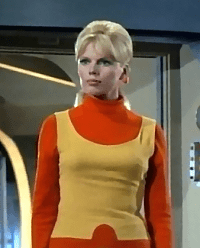
Judy, Judy, Judy!
I’ve been a fan of science fiction since the early 1960s. I was already an avid fan and ready audience for Lost in Space (1966–68; Judy was one of my earliest childhood crushes), It’s About Time (1966–67), and I was glued to the TV set enthralled when Kirk, Spock, and the rest, first boldly went in 1966.
By then I’d already consumed all I could of Asimov, Clarke, Heinlein, along with Verne, Wells, and Burroughs (I didn’t discover Tolkien or Howard until high school a few years later).
Movies like The Day the Earth Stood Still (1951), 20,000 Leagues Under the Sea (1954), and Forbidden Planet (1956), all had me avid for 2001: A Space Odyssey (1968).
It’s been a whole lot of years, and a whole lot of science fiction, is my point.
Continue reading
22 Comments | tags: cyberpunk, Edgar Rice Burroughs, H.G. Wells, Isaac Asimov, Jules Verne, Lost in Space, Neal Stephenson, Robert E. Howard, science fiction, science fiction books, science fiction movies, science fiction TV, SF, SF Books, SF Movies, Snow Crash, William Gibson | posted in Books, Movies, Sci-Fi Saturday, TV
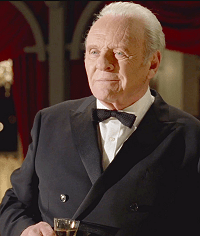 At one point in HBO’s Westworld (don’t worry, no spoilers) Robert Ford (Anthony Hopkins) gives a speech about stories, about the value of fiction. He references a belief that fiction elevates — or at least illuminates to good value — the human condition. The belief also holds that those who read a lot of fiction are in some sense “better” people.
The idea is controversial on several grounds. Firstly, it’s hard to define what makes people “better,” and you can’t measure or test what you can’t define. Secondly, even if “better” is defined, not everyone will agree with the definition. Thirdly, there’s a nature-nurture aspect that makes comparisons like this very hard to tease out of any data you can gather.
Maybe a place to start exploring the idea is to first define “fiction” and go from there…
Continue reading
8 Comments | tags: facts, false, Fiction, lies, storytelling, theory of mind, true, truth, wisdom | posted in Books, Movies, TV, Writing
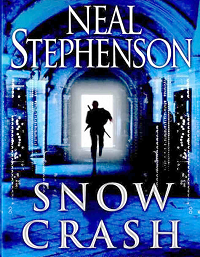 Fair Warning: Next week I have some political and social foaming at the mouth to do over current events and modern society, but that can wait. The weather recently has been too nice for my hot-collar wardrobe. The swelter is supposed to return next week; the forecast is for serious ranting with scattered raving.
For the weekend, for Science Fiction Saturday in particular, for all my disdain of movie and TV science fiction (especially TV SF, most of which does nothing for me), literary science fiction is very alive and quite well!
Recently I’ve been enjoying three authors in particular…
Continue reading
10 Comments | tags: Diaspora, Greg Egan, Hannu Rajaniemi, Neal Stephenson, Permutation City, Seveneves, Snow Crash, The Quantum Thief | posted in Books, Sci-Fi Saturday
 Here’s something that caught my eye: Researchers at the University of Vermont, in the Computational Story Lab (!), did an interesting word content analysis on 1,700 stories downloaded from Gutenberg. Each story had been downloaded at least 150 times by readers.
The researchers used “sentiment analysis” that measures the positive or negative emotional impact of words. Using a sliding window, they attempted to characterize the “emotional arcs” of each story. Their goal was to see if there were common patterns.
Turns out, there are!
Continue reading
26 Comments | tags: emotional arcs, printed word, seven plots, stories, story plots, storytelling, text, words | posted in Books, Writing

In the last quarter of the 19th century — USA-centrically, call it 139 years ago — we began to experience having the sound of strangers’ voices in our lives, even in our homes. Not just voices, but music from concert halls and clubs. And other sounds, too: the clip-clop of horse feet, the slam of a door, a gunshot. Less than 100 years ago, those sounds went electric, and we never looked back.
At the beginning of the 20th century, we started another love affair — this one with moving images on rectangular screens, a dance of light and shadow, windows to imaginary worlds. Or windows to recorded memories or news of distant places. When sound went electric, those moving images took voice and spoke and sang. No one alive in our society today remembers a time when moving images weren’t woven into our lives.
Here, now, into the 21st century, in an age of streaming video and music, from cloud to your pocket device (with its high-resolution display and built-in video camera), I can’t help but be impressed by how far we’ve come.

A long way, indeed.
18 Comments | tags: analog recording, audio recording, digital recording, internet, interweb, iPad, iPod, OnDemand, streaming audio, streaming video, video recording | posted in Books, Computers, Movies, Music, Science, The Interweb, TV
So what are the odds of reading two posts in short succession, both of which just demand to be reblogged? As I commented on the original post, speaking as a life-long deep reader, I agree with every word.
8 Comments | tags: intelligence, reading | posted in Books, Life
 Those with a life-long interest in what is now called STEM are almost universally fans of cartoonist Gary Larson. It is almost unheard of to walk into the workspace of any science or technology worker and not find a few of Larson’s cartoons posted.
For me, Larson is up there with people like Terry Pratchett as being brilliant observers of the human condition and also brilliant in their ability to express their observations. Some of Larson’s work is just plain funny (really funny), but a lot of it is philosophical and extremely insightful.
For some Friday Fun, I thought I’d show you some of my all-time favorites.
Continue reading
16 Comments | tags: blah blah blah Ginger, Bummer of a birthmark, cartoons, funny, Gary Larson, humor, My brain is full, The Far Side, What we say to dogs | posted in Books
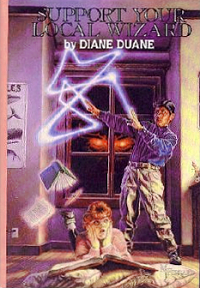 The punchline is that I was suddenly struck by how modern fiction seems to have conditioned me to expect an apparent White Hat to secretly be a Black Hat. The question I find myself asking now is whether fiction has actually changed (and if so why) or is it just me? The more I think about it, the more I’m inclined to think modern fiction has changed.
If so, does that reflect a modern sensibility about people today? Does the rise of the modern anti-hero bring with it the idea of the betrayer? Do we expect so little of people anymore that our heroes need to be dirty and double agents seem matter of course?
This all started with Diane Duane…
Continue reading
9 Comments | tags: anti-hero, Deep Wizardry, Diane Duane, Ghosts of Mars, High Wizardry, Judas, Manse Everard, Poul Anderson, So You Want to be a Wizard, Star Trek, Star Trek novels, story plots, storytelling, Time Patrol, Weeds, Young Wizards | posted in Books, Sci-Fi Saturday






 Logos con carne