Tag Archives: wave-function

BB #88: Boltsmann Brains

An article in a recent issue of New Scientist caught my attention on two counts: firstly, in what it said about my old friend wavefunction collapse and the measurement problem; and secondly, in mentioning Boltzmann Brains. Both set off my “Yeah, but!” reaction.

I’ll touch (as briefly as possible) on the first point, but this little Bubble is mainly about the second one.

Boltzmann Brains bug me.
Continue reading


QM 101: Intro to the Schrödinger Equation

It’s been a while, but the two previous posts in this series (this one and this one) explored the mechanism behind partial differential equations that equate the time derivative (the rate of change), with the second spatial derivative (the field curvature). The result pulls exceptions to the average back to the average in proportion to how exceptional they are.

Such equalities appear in many classical physics equations where they have clear physical meaning. Heat diffusion (explored in the previous posts) is a good example.

In quantum mechanics, they also appear in the Schrödinger Equation.

Continue reading


Objective Collapse

In the last four posts (Quantum Measurement, Wavefunction Collapse, Quantum Decoherence, and Measurement Specifics), I’ve explored the conundrum of measurement in quantum mechanics. As always, you should read those before you read this.

Those posts covered a lot of ground, so here I want to summarize and wrap things up. The bottom line is that we use objects with classical properties to observe objects with quantum properties. Our (classical) detectors are like mousetraps with hair-triggers, using stored energy to amplify a quantum interaction to classical levels.

Also, I never got around to objective collapse. Or spin experiments.

Continue reading


QM 101: Photon Spin

Earlier in this QM-101 series I posted about quantum spin. That post looked at spin 1/2 particles, such as electrons (and silver atoms). This post looks at spin in photons, which are spin 1 particles. (Bell tests have used both spin types.) In photons, spin manifests as polarization.

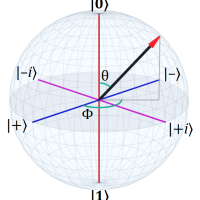
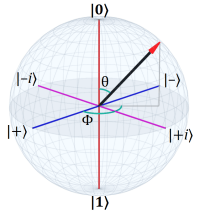
Photon spin connects the Bloch sphere to the Poincaré sphere — an optics version designed to represent different polarization states. Both involve a two-state system (a qubit) where system state is a superposition of two basis states.

Incidentally, photon polarization reflects light’s wave-particle duality.

Continue reading


BB #73: Wavefunction Collapse

I’m two-thirds through my second Paul Halpern book this month. Earlier I read his book about cosmology, Edge of the Universe: A Voyage to the Cosmic Horizon and Beyond (2012), which was okay. Now I’m reading The Quantum Labyrinth: How Richard Feynman and John Wheeler Revolutionized Time and Reality (2017), which I’m enjoying a bit more. In part because cosmology has changed more since 2012 than quantum physics has since 2017. (Arguably, the latter hasn’t changed much since the 1960s.)

I wrote about Halpern’s book, Einstein’s Dice and Schrödinger’s Cat (2015), last year. As the title implies, it focuses on two great names from physics. Quantum Labyrinth (as its title also implies) also focuses on two great physics names.

But today’s Brain Bubble (as the title implies) is about wavefunction collapse.

Continue reading


MWI: Questions, part 3

This is the third part of a series examining the Many Worlds Interpretation of Quantum Mechanics (the MWI of QM). The popularity of the MWI in books, blogs, and science videos, especially among the science-minded, tends to keep in present in some corner of my mind. Blog posts are a way to shoo it out.
The first part introduced the topic and talked about cats. The second part discussed the Schrödinger equation, wavefunctions, decoherence, and the question of how multiple instances of matter can coincide. That question, to me, is a central issue I have with MWI.

This time I dig into quantum superposition and touch on a few other topics.

Continue reading


MWI: Questions, part 2

Last time I started exploring questions I have about the Many Worlds Interpretation of Quantum Mechanics (the MWI of QM). Obviously I’m not a fan; quite the opposite. It presents as parsimonious, hung on the single hook of a universal wavefunction, but I think it gets more complicated and cumbersome when examined. I can’t say it’s broken, but I don’t find it very attractive.

I suspect most people, even in physics, don’t care. A few have invested themselves in books or papers, but these interpretations don’t matter to real physics work. The math is the math. But among the philosophical, especially the ontological, it’s food for debate.

Being both philosophical and ontological, I do smell what’s cooking!

Continue reading


MWI: Questions, part 1

Back in January, in a post about unanswered questions in physics, I included the Many Worlds Interpretation of Quantum Mechanics (the MWI of QM). I wish I hadn’t. Including it, and a few other more metaphysical topics, took space away from the physical topics.

I did it because I’ve had notes for an MWI: Questions post for a long time, but shoehorning it in like that was a mistake. Ever since, I’ve wanted to return and give it the attention of a full post. I’m reminded about it constantly; the concept of “many worlds” has become such a part of our culture that I encounter it frequently in fiction and in fact (and in other blog posts).

Its appeal is based on a simplicity, but to me it doesn’t seem at all that simple.

Continue reading


Ball: Beyond Weird

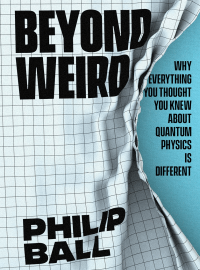
I just finished reading Beyond Weird: Why Everything You Thought You Knew About Quantum Physics Is Different (2018) by science writer Philip Ball. I like Ball a lot. He seems well grounded in physical reality, and I find his writing style generally transparent, clear, and precise.

As is often the case with physics books like these, the last chapter or three can get a bit speculative, even a bit vague, as the author looks forward to imagined future discoveries or, groundwork completed, now presents their own view. Which is fine with me so long as it’s well bracketed as speculation. I give Ball high marks all around.

The theme of the book is what Ball means by “beyond weird.”

Continue reading


Wave-Function Story

Last time I started with wave-functions of quantum systems and the Schrödinger equation that describes them. The wave-like nature of quantum systems allows them to be merged (superposed) into combined quantum system so long as the coherence (the phase information) remains intact.

The big mystery of quantum wave-functions involves their apparent “collapse” when an interaction with (a “measurement” by) another system seemingly destroys their coherence and, thus, any superposed states. When this happens, the quantum behavior of the system is lost.

This time I’d like to explore what I think might be going on here.

Continue reading