Tag Archives: quantum mechanics
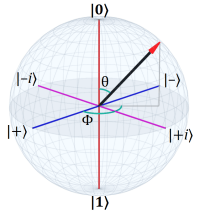 In quantum mechanics, one hears much talk about operators. The Wikipedia page for operators (a good page to know for those interested in QM) first has a section about operators in classical mechanics. The larger quantum section begins by saying: “The mathematical formulation of quantum mechanics (QM) is built upon the concept of an operator.”
Operators represent the observables of a quantum system. All measurable properties are represented mathematically by an operator.
But they’re a bit difficult to explain with plain words.
Continue reading
6 Comments | tags: QM101, quantum mechanics, quantum operator | posted in Math, Physics
Last time I set the stage, the mathematical location for quantum mechanics, a complex vector space (Hilbert space) where the vectors represent quantum states. (A wave-function defines where the vector is in the space, but that’s a future topic.)
The next mile marker in the journey is the idea of a transformation of that space using operators. The topic is big enough to take two posts to cover in reasonable detail.
This first post introduces the idea of (linear) transformations.
Continue reading
13 Comments | tags: linear algebra, matrix transform, QM101, quantum mechanics, vector space, vectors | posted in Math, Physics
Whether it’s to meet for dinner, attend a lecture, or play baseball, one of the first questions is “where?” Everything that takes place, takes place some place (and some time, but that’s another question).
Where quantum mechanics takes place is a challenging ontological issue, but the way we compute it is another matter. The math takes place in a complex vector space known as Hilbert space (“complex” here refers to the complex numbers, although the traditional sense does also apply a little bit).
Mathematically, a quantum state is a vector in Hilbert space.
Continue reading
9 Comments | tags: coordinate system, inner product, QM101, quantum mechanics, vector space, vectors | posted in Math, Physics
The word “always” always finds itself in phrases such as “I’ve always loved Star Trek!” I’ve always wondered about that — it’s rarely literally true. (I suppose it could be “literally” true, though. Language is odd, not even.) The implied sense, obviously, is “as long as I could have.”
The last years or so I’ve always been trying to instead say, “I’ve long loved Star Trek!” (although, bad example, I don’t anymore; 50 years was enough). Still, it remains true I loved Star Trek for a long (long) time.
On the other hand, it is literally true that I’ve always loved science.
Continue reading
12 Comments | tags: MIT OCW, QM101, quantum computing, quantum mechanics, Scientific American | posted in Physics
 I think we all agree 2020 has been, as the curse puts it, an “interesting” year. Going into it, I had intentions about making changes. Most fell by the wayside due to COVID-19; I still haven’t taken the bus to watch the St. Paul Saints play. Or the bus-light rail combo to Target Field.
As a life long hard-core introvert, “social isolation” mostly meant I shopped for groceries less often but stocked up more when I did. The pain was fewer occasions of meeting a friend for tasty food, drink, and chat. I’m really looking forward to dining out again.
All-in-all, the last four years, this year… It’s been exhausting.
Continue reading
21 Comments | tags: 2020, BOOL, library, mystery books, quantum computing, quantum mechanics, science fiction books, Twins 2020 | posted in Life
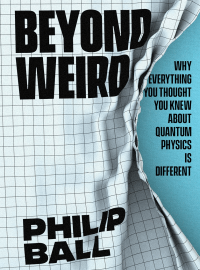 I just finished reading Beyond Weird: Why Everything You Thought You Knew About Quantum Physics Is Different (2018) by science writer Philip Ball. I like Ball a lot. He seems well grounded in physical reality, and I find his writing style generally transparent, clear, and precise.
As is often the case with physics books like these, the last chapter or three can get a bit speculative, even a bit vague, as the author looks forward to imagined future discoveries or, groundwork completed, now presents their own view. Which is fine with me so long as it’s well bracketed as speculation. I give Ball high marks all around.
The theme of the book is what Ball means by “beyond weird.”
Continue reading
12 Comments | tags: Philip Ball, quantum mechanics, wave-function | posted in Books, Physics
 Last time I started with wave-functions of quantum systems and the Schrödinger equation that describes them. The wave-like nature of quantum systems allows them to be merged (superposed) into combined quantum system so long as the coherence (the phase information) remains intact.
The big mystery of quantum wave-functions involves their apparent “collapse” when an interaction with (a “measurement” by) another system seemingly destroys their coherence and, thus, any superposed states. When this happens, the quantum behavior of the system is lost.
This time I’d like to explore what I think might be going on here.
Continue reading
17 Comments | tags: quantum effects, quantum mechanics, quantum physics, Schrödinger Equation, wave-function | posted in Physics
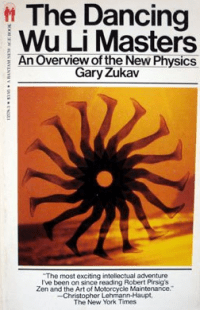 Quantum physics is weird. How weird? “Too weird for words,” as we used to say, and there is a literal truth to words being inadequate in this case. There is no way to look at the quantum world that doesn’t break one’s mind a little. No one truly understands it (other than through the math). It’s like trying to see inside your own head.
Since we’re clueless we make up stories to fit the facts. Some stories advise that we just keep our heads down and do the math. (Which works very well but leaves us thirsty.) Other stories seek to quench that thirst, but every story seems to stumble somewhere.
One of quantum’s biggest and oldest stumbling blocks is wave-function collapse.
Continue reading
18 Comments | tags: quantum effects, quantum mechanics, quantum physics, Schrödinger Equation, wave-function | posted in Physics
 For the last two weeks I’ve written a number of posts contrasting physical systems with numeric systems.
(The latter are, of course, also physical, but see many previous posts for details on significant differences. Essentially, the latter involve largely arbitrary maps between real world magnitude values and internal numeric representations of those values.)
I’ve focused on the nature of causality in those two kinds of systems, but part of the program is about clearly distinguishing the two in response to views that conflate them.
Continue reading
20 Comments | tags: Alan Turing, Cantor's Diagonal, Georg Cantor, Halting Problem, Heisenberg Uncertainty, Incompleteness Theorems, Kurt Gödel, quantum mechanics, Turing Halting Problem, Werner Heisenberg | posted in Brain Bubble, Computers
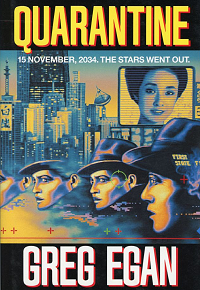 Last week I read Quarantine (Greg Egan, 1992), a science fiction novel that explores one of the more vexing conundrums in basic physics: the measurement problem. Egan’s stories (novels and shorts) often explore some specific aspect of physics (sometimes by positing a counterfactual reality, as in the Orthogonal series).
In Quarantine, Egan posits that the human mind, due to a specific set of neural pathways, is the only thing in reality that collapses the wave-function, the only thing that truly measures anything. All matter, until observed by a mind, exists in quantum superposition.
Unfortunately, it’s difficult to explore how this ties into the plot without spoiling it, so I’ll have to tread lightly.
Continue reading
15 Comments | tags: Greg Egan, quantum mechanics, science fiction, science fiction books | posted in Books, Sci-Fi Saturday




 Logos con carne