Tag Archives: computer program
 Last week we took a look at a simple computer software model of a human brain. (We discovered that it was big, requiring dozens of petabytes!) One goal of such models is replicating consciousness — a human mind. That can involve creating a (potentially superior) new mind or uploading an existing human mind (a very different goal).
Now that we’ve explored the basics of calculation, code (software), computers, and (computer software) models, we’re ready to explore what’s involved in attempting to model a (human) mind.
I’m dividing the possibilities into four basic levels.
Continue reading
18 Comments | tags: AI, algorithm, brain, computationalism, computer model, computer program, consciousness, enchanted loom, human brain, human consciousness, human mind, Isaac Asimov, mind, physicalism, positronic brain, qualia, René Descartes | posted in Computers
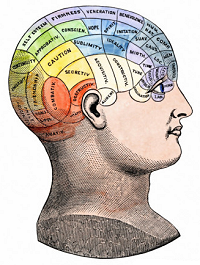 The ultimate goal is a consideration of how to create a working model of the human mind using a computer. Since no one knows how to do that yet (or if it’s even possible to do), there’s a lot of guesswork involved, and our best result can only be a very rough estimate. Perhaps all we can really do is figure out some minimal requirements.
Given the difficulty we’ll start with some simpler software models. In particular, we’ll look at (perhaps seeming oddity of) using a computer to model a computer (possibly even itself).
The goal today is to understand what a software model is and does.
Continue reading
4 Comments | tags: algorithm, American checkers, checkers, complexity, computer model, computer program, English draughts, Kolmogorov complexity, software, software model, state space | posted in Computers
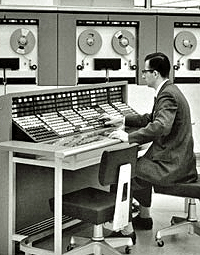 We started with mathematical expressions, abstract algorithms, and the idea of code — a list of instruction steps in some code language. We touched on how all algorithms have an abstract state diagram (a flowchart) representing them. Then we looked briefly at the stored-program physical machines that execute code.
Before we go on to characterize the complexity of a computer, I want to take a look — very broadly — at how the computer operates overall. Specifically, look at another Yin-Yang pair: the computer’s operating system versus its applications.
This has a passing relevance to the computer’s complexity.
Continue reading
20 Comments | tags: algorithm, application code, computer program, hardware, O/S, operating system, software, stored program computer, system code, user code | posted in Computers
 We started with the idea of code — data consisting of instructions in a special language. Code can express an algorithm, a process consisting of instruction steps. That implies an engine that understands the code language and executes the steps in the code.
Last time we started with Turing Machines, the abstract computers that describe algorithms, and ended with the concrete idea of modern digital computers using stored-programs and built on the Von Neumann architecture.
Today we look into that architecture a bit…
Continue reading
17 Comments | tags: address bus, algorithm, assembly language, bits, code, computer language, computer program, CPU, data, data bus, RAM, source code, stored program computer, Von Neumann architecture | posted in Computers
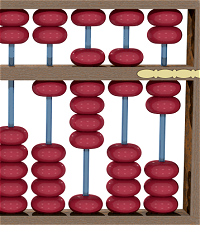 The previous post, Halt! (or not), described the Turing Halting Problem, a fundamental limit on what computers can do, on what can be calculated by a program. Kurt Gödel showed that a very similar limit exists for any (sufficiently powerful) mathematical system.
This raises some obvious questions: What is calculation, exactly? What do we mean when we talk about a program or algorithm? (And how does all of this connect with the world of mathematics?)
Today we’re going to start exploring that.
Continue reading
13 Comments | tags: Alan Turing, algorithm, binary digits, calculation, Church-Turing thesis, code, computer program, data, information theory, lambda calculus, mathematical expression, Turing Machine, Universal Turing Machine | posted in Math, Opinion






 Logos con carne