Category Archives: Science
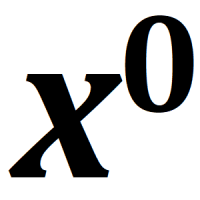 At some point in our early math education, we’re told that anything to the power of zero evaluates to one. 1°=1 and 5°=1 and 99°=1. Basically, x°=1 for all x. It’s typically presented as just a rule about taking anything to the power of zero, but it’s actually derived from a more basic rule about exponents.
Thinking about x° in connection with something else recently, it occurred to me there’s a second way to justify the notion that anything to the power of zero is one.
It also occurred to me 0ⁿ might be an implementation of the Dirac delta.
Continue reading
2 Comments | tags: Dirac delta, exponentiation, group theory, multiplication, Paul Dirac, zero | posted in Math
 I don’t know why I’m so fascinated that the rational numbers are countable even though they’re a dense subset of the uncountable real numbers. A rational number can be arbitrarily close to any real number, making you think they’d be infinite like the reals, but in fact, nearly all numbers are irrational (and an uncountable subset of the reals).
So, the rational numbers — good old p/q fractions — though still infinite are countably infinite (see this post for details).
More to the point here, a common way of enumerating the rational numbers, when graphed results in some pretty curves and illustrates some fun facts about the rational numbers.
Continue reading
4 Comments | tags: charts, fractions, graphs, rational numbers | posted in Brain Bubble, Math
 Zeno’s famous Paradoxes involve the impossibility of arriving somewhere as well as the impossibility of even starting to go somewhere. And that flying arrows have to be an illusion. [Time flies like an arrow, but fruit flies like a banana.]
If Zeno were alive today, he’d be over 2500 years old and would have seen his paradoxes explained in a variety of ways by a lot of very smart people. Yet at heart they still have some metaphysical oomph. And the thing is, at least in some contexts, Zeno was (sort of) right. There is something of a paradox here involving space and time.
Or at least something interesting to think about.
Continue reading
7 Comments | tags: rational numbers, real numbers, Zeno of Ela, Zeno's paradoxes | posted in Brain Bubble, Math, Philosophy
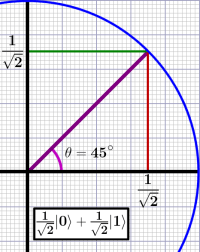 It’s actually obvious and might fall under the “Duh!” heading for some, but it only recently sunk in on me that the Born Rule is really just another case of the Pythagorean theorem. The connection is in the way the coefficients of a quantum superposition, when squared, must sum to unity (one).
For that matter, Special Relativity, which is entirely geometric, is yet another example of the Pythagorean theorem, but that’s another story. (One I’ve already told. See: SR #X6: Moving at Light Speed)
The obvious connection is the geometry behind how a quantum state projects onto the basis eigenvectors axes.
Continue reading
9 Comments | tags: geometry, Pythagoras, QM101, quantum mechanics, trigonometry | posted in Brain Bubble, Math, Physics
 In The Road to Reality (2004), Roger Penrose writes about a great analogy for symmetry breaking. Apparently, this analogy is rather common in the literature. (No, it’s not the thing about the pencil — this one involves an iron ball.) Once again, I find myself agreeing with Penrose about something; it is a great analogy.
Symmetry breaking (which can be explicit or spontaneous) is critical in many areas of physics. For instance, it’s instrumental in the Higgs mechanism that’s responsible for the mass of some particles.
The short post is for those interested in physics who (like I) have struggled to understand exactly what symmetry breaking is and why it matters.
Continue reading
5 Comments | tags: QM101, Roger Penrose, symmetry | posted in Brain Bubble, Physics
 I started 2022 with a post titled Things I Think Are True. It was an echo of the Hard Problems post I’d done to start 2021. That earlier post listed a (possibly surprising) number of open questions in physics. Not trivial questions, either, but big ones like: “What is time?” and “What is the shape and size of the universe?”
The post in 2022 was more of an opinion piece about things that, in the context of those open questions, I think are true. Pure speculation on my part, some of it close to mainstream thinking, some of it rather less so (but all, I would argue, grounded in what we do know).
This year, for contrast, I thought I’d make a list of stuff I don’t believe is true.
Continue reading
16 Comments | tags: causal determinism, computationalism, eternal inflation, ghosts, MWI, String theory, supersymmetry, time travel | posted in Opinion, Physics
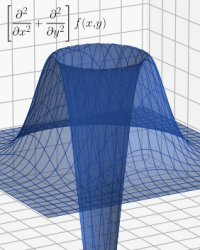 Last time I began exploring the similarity between the Schrödinger equation and a classical heat diffusion equation. In both cases, valid solutions push the high curvature parts of their respective functions towards flatness. The effect is generally an averaging out in whatever space the function occupies.
Both equations involve partial derivatives, and I ignored that in our simple one-dimensional case. Regular derivatives were sufficient. But math in two dimensions, let alone in three, requires partial derivatives.
Which were yet another hill I faced trying to understand physics math. If they are as opaque to you as they were to me, read on…
Continue reading
11 Comments | tags: derivatives, exponential function, partial derivatives, QM101, Schrödinger Equation | posted in Math, Physics
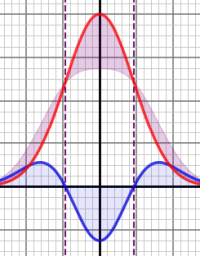 This is the first of a series of posts exploring the mysterious Schrödinger Equation — a central player of quantum mechanics. Previous QM-101 posts have covered important foundational topics. Now it’s time to begin exploring that infamous, and perhaps intimidating, equation.
We’ll start with something similar, a classical equation that, among other things, governs how heat diffuses through a material. For simplicity, we’ll first consider a one-dimensional example — a thin metal rod. (Not truly one-dimensional, but reasonably close.)
Traveller’s Advisory: Math and graphs ahead!
Continue reading
9 Comments | tags: derivatives, exponential function, QM101, quantum, Schrödinger Equation | posted in Math, Physics

“Time is out of joint.”
I’ve long puzzled over the idea that physics is reversible. That its laws, with some caveats, work the same if time runs forwards or backwards. It’s even been suggested that, except for entropy, time could run backwards just as easily as forwards.
But this seems contrary to our everyday experience. With some exceptions, we can tell if a film or video clip is shown in reverse. Objects that fall, break, or grow (such as plants or crystals), look different seen in reverse.
I think there is more going on there than just entropy.
Continue reading
30 Comments | tags: arrow of time, time | posted in Physics
If you follow stuff like this, you probably already know, but the James Webb Space Telescope team just released the first actual image from the telescope:

More images are expected to be released tomorrow (July 12). Visit their page for details (and the full-sized image — all 4537×4630 pixels of it). Visit their excellent “Where Is Webb?” page for the latest status and stats on the JWST.
Congrats again to everyone involved! This was an amazing (and prolonged) effort. I’m glad I get to see some of the results now!
7 Comments | tags: astronomy, James Webb Space Telescope, JWST, space | posted in Science







 Logos con carne