Category Archives: Science
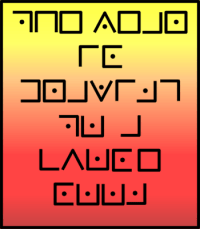 When I was a high school kid, my dad and I sometimes played a game where one of us would make up a secret code, write a message in that code, and the other would try to decipher the message. We generally used simple substitution ciphers, so it was an exercise in letter frequency analysis and word guessing.
There’s a cute secret code I found in a book back then that really stuck with me because of the neat way it looks. It also stuck with me because it’s so simple that once you learn it, you really can’t forget it.
So, for some Saturday fun, I thought I’d share it with you.
Continue reading
6 Comments | tags: Alan Turing, Alienese, cipher, code, decipher, decoder ring, Freemasons Cipher, Futurama, one-time pad, Pigpen Cipher, secret codes, substitution cipher | posted in Basics, Math
Long-time readers of this blog know I very rarely re-blog. Occasionally something strikes my fancy so hard, I have to (if nothing else) mention it and post a link to it here.
Derek Lowe, a chemist who also writes In the Pipeline, a great chemistry blog, recently posted something striking:
…a new analysis of clinical trials for pain medication shows that the placebo effect in [the area of pain relief] has been getting stronger. The same also seems to be true for antipsychotics and antidepressants, but this effect seems to be mainly (or only) visible in large-scale US trials…
Continue reading
1 Comment | tags: belief, chemistry, Derek Lowe, drug trials, In The Pipeline, medical trials, pain relief, placebo, power of will, USA | posted in From My Collection, Science

Is that you, HAL?
Last time, in Calculated Math, I described how information — data — can have special characteristics that allow it to be interpreted as code, as instructions in some special language known to some “engine” that executes — runs — the code.
In some cases, the code language has characteristics that make it Turing Complete (TC). One cornerstone of computer science is the Church-Turing thesis, which says that all TC languages are equivalent. What one can do, so can all the others.
That is where we pick up this time…
Continue reading
2 Comments | tags: Alan Turing, algorithm, Church-Turing thesis, code, data, flowchart, lambda calculus, state diagram, stored program computer, Turing Machine, Universal Turing Machine, Von Neumann architecture | posted in Math
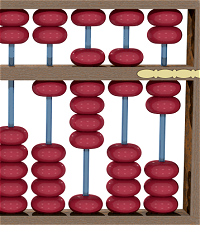 The previous post, Halt! (or not), described the Turing Halting Problem, a fundamental limit on what computers can do, on what can be calculated by a program. Kurt Gödel showed that a very similar limit exists for any (sufficiently powerful) mathematical system.
This raises some obvious questions: What is calculation, exactly? What do we mean when we talk about a program or algorithm? (And how does all of this connect with the world of mathematics?)
Today we’re going to start exploring that.
Continue reading
13 Comments | tags: Alan Turing, algorithm, binary digits, calculation, Church-Turing thesis, code, computer program, data, information theory, lambda calculus, mathematical expression, Turing Machine, Universal Turing Machine | posted in Math, Opinion

But my brain is full!
You may have noticed that, in a number of recent posts, the topic has been math. The good-bad news is that there’s more to come (sorry, but I love this stuff). The good-good news is that I’m done with math foundations. For now.
To wrap up the discussion of math’s universality and inevitability — and also of its fascination and beauty — today I just have some YouTube videos you can watch this Sunday afternoon. (Assuming you’re a geek like me.)
So get a coffee and get comfortable!
Continue reading
6 Comments | tags: algebraic numbers, math and sex, math ontology, mathematics, numbers, Philosophy of Math, Theory of Mathematics, transcendental numbers | posted in Math, Opinion
Take a moment to gaze at Euler’s Identity:

It has been called “exquisite” and likened to a “Shakespearean sonnet.” It has earned the titles “the most famous” and “the most beautiful” formula in all of mathematics, and, in a mere seven symbols, symbolizes much of its foundation.
Today we’re going to graze on it!
Continue reading
19 Comments | tags: complex numbers, Euler's Formula, Euler's Identity, exponential function, Leonhard Euler, trigonometry, Yin and Yang | posted in Math, Opinion, Philosophy
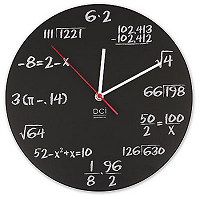 In the recent post Inevitable Math I explored the idea that mathematics was both universal and inevitable. The argument is that the foundations of mathematics are so woven into the fabric of reality (if not actually being the fabric of reality) that any intelligence must discover them.
Which is not to say they would think about or express their mathematics in ways immediately recognizable to us. There could be fundamental differences, not just in their notation, but in how they conceive of numbers.
To explore that a little, here are a couple of twists on numbers:
Continue reading
8 Comments | tags: alien math, Frederik Pohl, Heechee, math origins, math theory, more math, prime numbers, real numbers, surreal number | posted in Math, Opinion, Sideband
Oh, no! Not math again!
Among those who try to imagine alien first contact, many believe that mathematics will be the basis of initial communication. This is based on the perceived universality and inevitability of mathematics. They see math as so fundamental any intelligence must not only discover it but must discover the same things we’ve discovered.
There is even a belief that math is more real than the physical universe, that it may be the actual basis of reality. The other end of that spectrum is a belief that mathematics is an invented game of symbol manipulation with no deep meaning.
So today: the idea that math is universal and inevitable.
Continue reading
44 Comments | tags: alien math, cardinal numbers, cardinality, counting, counting numbers, first contact, Leopold Kronecker, math origins, math theory, mathematics, natural numbers, numbers, Philosophy of Math, rational numbers, real numbers, Theory of Mathematics | posted in Math, Opinion
Put on your arithmetic caps, dear readers. Also your math mittens, geometry galoshes and cosine coats. Today we’re venturing after numeric prey that lurks down among the lines and angles.
There’s no danger, at least not to life or limb, but I can’t promise some ideas won’t take root in your brain. There’s a very real danger of learning something when you venture into dark territory such as this. Even the strongest sometimes succumb, so hang on to your hats (and galoshes and mittens and coats and brains).
Today we’re going after vectors and scalars (and some other game)!
Continue reading
16 Comments | tags: 2D, 3D, azimuth, coordinates, declination, dimensions, direction, elevation, location, scalars, speed, technology, vectors, velocity | posted in Math
There comes a time when words fail, and all you can do is stare in amazement. The Friday press conference from the New Horizons team had that effect on many of us. (I’m not the only one who wept with sheer joy.)
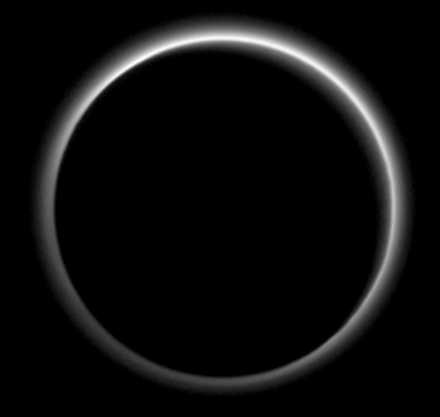
From behind, the Sun illuminates Pluto’s 100 mi layer of haze. Having an atmosphere kinda makes it seem like a planet to me.
They say pictures are worth thousands of words, so I’ll let the pictures do most of the talking (click on any image to go to the source)…
Continue reading
2 Comments | tags: Carl Sagan, NASA, New Horizons, Pluto, Pluto is a planet, Pluto is amazing!, space, space exploration, Sputnik Planum, star-tar, tholins | posted in Science






 Logos con carne