Tag Archives: computer generated images
 Winter announced itself a bit earlier than usual this year. In December it settled in with a fair bit of snow, though some warm spells melted a lot of it. We had our annual January Thaw but are in the deep freeze now.
Maybe it’s winter. Maybe it’s the insanity of the last decade catching up with me. I find myself decidedly in the blogging blahs (and fishing ain’t gonna help).
But let’s see if I can whip up another edition of Friday Notes.
Continue reading
14 Comments | tags: atheists, cold, computer generated images, desktop, email spam, Schrödinger's Glass, snow, weather, winter | posted in Friday Notes
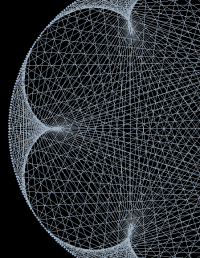 One of the Substack blogs I follow, A Piece of the Pi by Richard Green, is almost ideal from my point of view because it features articles that interest me but only — at most — a few a month (so I needn’t strain to keep up).
Which matters because keeping up with dozens of science and math blogs, video channels, and occasional papers takes considerable time away from various hobby projects. But sometimes (and this is the third time Mr. Green has done this) something captures my imagination and sends me off on a tangent.
The results often seem worth sharing, and this is no exception. The delight here is that such a simple idea results in a variety of interesting patterns.
Continue reading
5 Comments | tags: computer generated images, Mary Everest Boole, Python | posted in Computers, Math
As I posted Tuesday, I finished the software for my virtual CPU on Monday, but now I’ve finished the most important part: the project graphic.
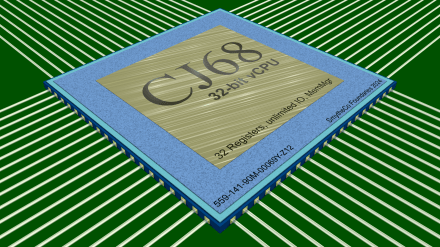
Now that I’m done, the project is obsolete, and it’s time to start the next version, cj68 vII. The other protocol would be to bump the number, but cj69 might lead to smirks.
Stay processing, my friends! Go forth and spread beauty and light.
∇
1 Comment | tags: 3D images, computer generated images, CPU, POV-Ray, programming, software design, sun sign | posted in Computers, Life
 Recently I mentioned that mathematician John Conway died last April. To his eternal disgruntlement, he is most famous for his “game” of Life — something he considered trivial and inferior to his real mathematical work. That fame is largely due to a Martin Gardener column in Scientific American — the most popular column the magazine had published up to then.
I said I wasn’t going to write about Life because it’s such a well-covered topic, but I thought I might whip up an implementation in Conway’s honor. (Went there; did that; videos below.) Getting into it made me realize Life connects back to my virtual reality posts.
So it turns out I am going to write about it (a little).
Continue reading
4 Comments | tags: computation, computer generated images, computer model, computer program, Conway's Life, John Conway, Turing Halting Problem, Turing Machine, virtual reality | posted in Computers
 Last time I left off with a virtual ball moving towards a virtual wall after touching on the basics of how we determine if and when the mathematical ball virtually hits the mathematical wall. It amounts to detecting when one geometric shape overlaps another geometric shape.
In the physical world, objects simply can’t overlap due to physics — electromagnetic forces prevent it. An object’s solidity is “baked in” to its basic nature. In contrast, in the virtual world, the very idea of overlap has no meaning… unless we define one.
This time I want to drill down on exactly how we do that.
Continue reading
4 Comments | tags: algorithm, computer generated images, computer model, computer program, virtual reality | posted in Computers
 Last time we saw that, while we can describe a maze abstractly in terms of its network of paths, we can implement a more causal (that is: physical) approach by simulating its walls. In particular, this allows us to preserve its basic physical shape, which can be of value in game or art contexts.
This time I want to talk more about virtual walls as causal objects in a maze (or any) simulation. Walls are a basic physical object (as well as a basic metaphysical concept), so naturally they are equally foundational in the abstract and virtual worlds.
And ironically, “Something there is that doesn’t love a wall.”
Continue reading
16 Comments | tags: computer generated images, computer model, computer program, virtual reality | posted in Computers
 First, I discussed five physical causal systems. Next, I considered numeric representations of those systems. Then, I began to explore the idea of virtual causality, and now I’ll continue that in the context of virtual mazes (such as we might find in a computer game).
I think mazes make a simple enough example that I should be able to get very specific about how a virtual system implements causality.
With mazes, it’s about walls and paths, but mostly about paths.
Continue reading
14 Comments | tags: computer generated images, computer model, computer program, virtual reality | posted in Computers
 This is the third of a series of posts about causal systems. In the first post I introduced five physical systems (personal communication, sound recording, light circuit, car engine, digital computer). In the second post I considered numerical representations of those systems — that is, implementing them as computer programs.
Now I’d like to explore further how we represent causality in numeric systems. I’ll return to the five numeric systems and end with a much simpler system I’ll examine in detail next time.
Simply put: How is physical causality implemented in virtual systems?
Continue reading
2 Comments | tags: computer generated images, computer model, computer program, virtual reality | posted in Computers
 November shouldn’t pass with just the one post. I intended a post last Science Fiction Saturday to rave about the new Doctor Who episode (celebrating 50 years of Doctor Who), but the day slipped to Sunday before I got the writing motor started. I’ll rave about it now: it was really, really good! A wonderful, delightful milestone marker and, as always, built on a damn good story.
I’ve not been idle lately! Dedicated post-retirement loafing finally shook the work dust off my shoes, and I’ve gotten back into personal project work. Seriously into it. In the 16-hour sessions, sleep and eating are unwelcome distractions, not knowing what time of day (let alone what day of the week) it is sense of seriously.
And I read some really good vampire novels!
Continue reading
11 Comments | tags: Amy Heckerling, Berserker series, Bram Stoker, Chelsea Yarbro, computer generated images, computer programming, Count Dracula, Doctor Who, Fred Saberhagen, Johnny Dangerously, POV-Ray, Python, science fiction, vampires | posted in Books, Computers, Movies, Sci-Fi Saturday, TV
 As reported earlier, this week got off to a rough start. I let my guard down (foolishly) and got nabbed by the greedy PC rapists. All I wanted was to find a particular font for a project. The next day a more careful search turned up exactly what I needed, the fonts and just the fonts (ma’am).
Monday I mentioned that I planned to share my font-needing project with you. It’s not finished (many of my projects live a long time as I tweak them — some are living things that grow and improve forever). But it turned out so much better than I expected, I just had to share it with you this Science Fiction Saturday.
I’m also going to boldly try a new WordPress blogging trick!
Continue reading
10 Comments | tags: 3D, 3D images, CGI, computer generated images, ffmpeg, mp4, NCC-1701, POV-Ray, Star Trek, TOS, USS Enterprise | posted in Computers, Sci-Fi Saturday, TV









 Logos con carne