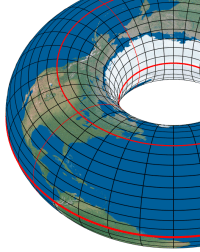
Flat Earth!
To describe how space could be flat, finite, and yet unbounded, science writers sometimes use an analogy involving the surface of a torus (the mathematical abstraction of the doughnut shape). Such a surface has no boundary — no edge. And despite being embedded in three-dimensional space, the torus surface, if seen in terms of compensating surface metric, is indeed flat.
Yet a natural issue people have is that the three-dimensional embedding is clearly curved, not flat. It’s easy to see how wrapping a flat 2D sheet into a cylinder doesn’t distort it, but hard to see why wrapping a cylinder around a torus doesn’t stretch the outside and compress the inside.
In fact it does, but there are ways to eat our cake (doughnut).

 This post’s fill-in-the-blank title (given the “season” clue that we’re talking about television shows) might refer to any of at least three series, all coincidentally from Amazon Prime studios. In fact it refers to all three, although this post is only about two because
  I finished
  Retirement, along with online access to the library, has opened the door to exploring authors I’ve meant to read for ages. For example, I’d always meant to read one of my dad’s favorite books,
  History, location, and religion aside, the Wikipedia
  I’ve written





 Logos con carne