Category Archives: Science
 A single line from a blog post I read got me wondering if maybe (just maybe) the answer to a key quantum question has been figuratively lurking under our noses all along.
Put as simply as possible, the question is this: Why is the realm of the very tiny so different from the larger world? (There’s a cosmological question on the other end involving gravity and the realm of the very vast, but that’s another post.)
Here, the answer just might involve the wavelength of matter.
Continue reading
9 Comments | tags: de Broglie wavelength, QM101, quantum computing, quantum mechanics, qubits | posted in Opinion, Physics
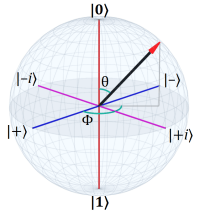
I’ve been working my way through The Principles of Quantum Mechanics (1930), by Paul Dirac. (It’s available as a Kindle eBook for only 6.49 USD.) It’s perhaps best known for being where he defines and describes his 〈bra|ket〉 notation (which I posted about in QM 101: Bra-Ket Notation). More significantly, Dirac shows how to build a mathematical quantum theory from the ground up.
This is not a pop-science book. Common wisdom is that including even a single equation in a science book greatly reduces reader interest. Dirac’s book, in its 82 chapters, has 785 equations! (And no diagrams, which is a pity. I like diagrams.)
What I wanted to post about is something he mentioned about qubits.
Continue reading
14 Comments | tags: Bloch sphere, bra-ket notation, Paul Dirac, QM101, quantum computing, quantum mechanics, qubits | posted in Physics
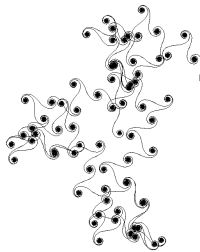 I posted a while back about the wonders of Fourier Curves, and I’ve posted many times about Euler’s Formula and other graphical wonders of the complex plane. Recently, a Numberphile video introduced me to another graphical wonder: Euler Spirals. They’re one of those very simple ideas that results in almost infinite variety (because of chaos).
As it turned out, the video (videos, actually) led to a number of fun diversions that have kept me occupied recently. (Numberphile has inspired more than a few projects over the years. Cool ideas I just had to try for myself.)
This all has to do with virtual turtles.
Continue reading
10 Comments | tags: geometry, Leonhard Euler, Numberphile, pi | posted in Math, Wednesday Wow
 Last February I posted about how my friend Tina, who writes the Diotima’s Ladder blog, asked for some help with a set of diagrams for her novel. The intent was to illustrate an aspect of Plato’s Divided Line — an analogy about knowledge from his worldwide hit, the Republic. Specifically, to demonstrate that the middle two (of four) segments always have equal lengths.
The diagrams I ended up with outlined a process that works, but I was never entirely happy with the last steps. They depended on using a compass to repeat a length as well as on two points lining up — concrete requirements that depend on drawing accuracy.
Last week I had a lightbulb moment and realized I didn’t need them. Lurking right in front of my eyes is a solid proof that’s simple, clear, and fully abstract.
Continue reading
4 Comments | tags: algebra, geometry, Plato | posted in Math, Philosophy
In the last four posts (Quantum Measurement, Wavefunction Collapse, Quantum Decoherence, and Measurement Specifics), I’ve explored the conundrum of measurement in quantum mechanics. As always, you should read those before you read this.
Those posts covered a lot of ground, so here I want to summarize and wrap things up. The bottom line is that we use objects with classical properties to observe objects with quantum properties. Our (classical) detectors are like mousetraps with hair-triggers, using stored energy to amplify a quantum interaction to classical levels.
Also, I never got around to objective collapse. Or spin experiments.
Continue reading
23 Comments | tags: measurement problem, QM101, quantum mechanics, quantum physics, wave-function | posted in Opinion, Physics
In the last three posts (Quantum Measurement, Wavefunction Collapse, and Quantum Decoherence), I’ve explored one of the key conundrums of quantum mechanics, the problem of measurement. If you haven’t read those posts, I recommend doing so now.
I’ve found that, when trying to understand something, it’s very useful to think about concrete real-world examples. Much of my puzzling over measurement involves trying to figure out specific situations and here I’d like to explore some of those.
Starting with Mr. Schrödinger’s infamous cat.
Continue reading
8 Comments | tags: measurement problem, QM101, quantum mechanics, quantum physics, Schrödinger's Cat | posted in Opinion, Physics
In the last two posts (Quantum Measurement and Wavefunction Collapse), I’ve been exploring the notorious problem of measurement in quantum mechanics. This post picks up where I left off, so if you missed those first two, you should go read them now.
Here I’m going to venture into what we mean by quantum coherence and the Yin to its Yang, quantum decoherence. I’ll start by trying to explain what they are and then what the latter has to do with the measurement problem.
The punchline: Not very much. (But not exactly nothing, either.)
Continue reading
52 Comments | tags: measurement problem, QM101, quantum mechanics, quantum physics | posted in Opinion, Physics
The previous post began an exploration of a key conundrum in quantum physics, the question of measurement and the deeper mystery of the divide between quantum and classical mechanics. This post continues the journey, so if you missed that post, you should go read it now.
Last time, I introduced the notion that “measurement” of a quantum system causes “wavefunction collapse”. In this post I’ll dig more deeply into what that is and why it’s perceived as so disturbing to the theory.
Caveat lector: This post contains a tiny bit of simple geometry.
Continue reading
13 Comments | tags: measurement problem, QM101, quantum mechanics, quantum physics, Schrödinger Equation | posted in Opinion, Physics
Over the last handful of years, fueled by many dozens of books, lectures, videos, and papers, I’ve been pondering one of the biggest conundrums in quantum physics: What is measurement? It’s the keystone of an even deeper quantum mystery: Why is quantum mechanics so strangely different from classical mechanics?
I’ll say up front that I don’t have an answer. No one does. The greatest minds in science have chewed on the problem for almost 100 years, and all they’ve come up with are guesses — some of them pretty wild.
This post begins an exploration of the conundrum of measurement and the deeper mystery of quantum versus classical mechanics.
Continue reading
24 Comments | tags: measurement problem, QM101, quantum mechanics, quantum physics | posted in Opinion, Physics
 Being retired, along with doing all my TV watching via streaming services, has the consequence of almost completely disconnecting me from the weekly rhythm. Weekends mean nothing when every day is Saturday. To create some structure, I follow a simple schedule. For instance, Mondays I do laundry and Thursdays I buy groceries.
More to the point here, Monday (and sometimes Tuesday) evenings are for YouTube videos, many of which are science related. Last night I watched Jim Baggott give two talks at the Royal Institution, one about mass, the other about loop quantum gravity (LQG).
In the latter, Baggott mentioned gravity waves and that generated a Brain Bubble.
Continue reading
13 Comments | tags: Albert Einstein, gravity, gravity wave, quantum gravity, quantum physics | posted in Brain Bubble, Physics






 Logos con carne