Category Archives: Science

A fun way to feel acceleration!
Last time I introduced some of the foundation concepts required for our exploration of Special Relativity. In particular, that the word “special” in this case refers to a specific kind of motion: constant motion in a straight line.
Which may have caused some of you to wonder: Okay, what about motion that isn’t constant (and what’s that business about “in a straight line” — why keep mentioning that)? As it turns out, when motion involves speeding up, or slowing down, or going along a curve (or even just changing direction), that changes the situation in very significant ways!
That’s what I’m going to discuss today.
Continue reading
3 Comments | tags: acceleration, Albert Einstein, constant motion, cubit, deceleration, fortnight, furlong, General Relativity, jiffy, motion, slowing down, Special Relativity, speeding up | posted in Physics
 Okay, if you’ll all take your seats and quiet down, we can begin. I’ll keep this very short today because I know it’s Spring and many of you are eager to get out there and walk Frisbees and throw dogs… I mean — well you know what I mean.
The point is, that in keeping with spring, I’m aiming to keep these posts light and breezy. Unfortunately, I have terrible aim, so we’ll see how that goes. I never met a paragraph I couldn’t make longer!
Ready? Let’s go…
Continue reading
24 Comments | tags: Albert Einstein, constant motion, frame of reference, motion, Special Relativity | posted in Physics
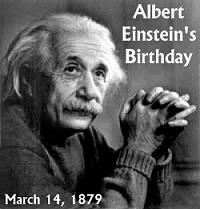 Okay. I’ve been teasing doubly special Saturday and (especially this year) since last Monday (and planting hints along the way). If you haven’t figured it out by now, today is Albert Einstein’s birthday. It’s also pi day, and how cool is it that a guy like Al was born on pi day?
So: Happy Birthday Albert! The (especially this year) part is because it’s extra-special pi day (3/14/15) and because this year I’m finally going to do what I’ve been wanting to do here to commemorate Einstein’s birthday since I started this blog back in ought-eleven.
I’m going to write — at length — about Special Relativity!
Continue reading
8 Comments | tags: Albert Einstein, Emmy Noether, faster than light, FTL, Happy Birthday, light speed, pi day, Special Relativity | posted in Math, Physics
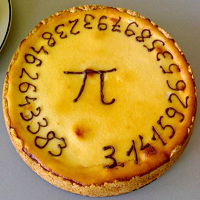
It’s pi day! Be irrational!
Earlier this week I mentioned that “this coming Saturday is a doubly special date (especially this year).” One of the things that makes it special is that it is Pi Day — 3/14 (at least for those who put the month before the day). What makes it extra-special this year is that it’s 3/14/15— a pi day that comes around only once per century. (Super-duper extra-special pi day, which happens only once in a given calendar, happened way back on 3/14/1529.)
I’ve written before about the magical pi, and I’m not going to get into it, as such, today. I’m more of a tau-ist, anyway; pi is only half as interesting. (Unfortunately, extra-special Tau Day isn’t until 6/28/31, and the super-duper extra-special day isn’t until 6/28/3185!)
What I do want to talk about is a fascinating property of pi.
Continue reading
148 Comments | tags: cake, Carl Sagan, Contact (book), Ellie Arroway, irrational numbers, Magnum Pi, normal sequence, numbers, pi, pi day, pie, real numbers, tau, tau day, transcendental numbers | posted in Math

Computing…
I’ve written here before about chaos theory and how it prevents us from calculating certain physical models effectively. It’s not that these models don’t accurately reflect the physics involved; it’s that any attempt to use actual numbers introduces tiny errors into the process. These cause the result to drift more and more as the calculation extends into the future.
This is why tomorrow’s weather prediction is fairly accurate but a prediction for a year from now is entirely guesswork. (We could make a rough guess based on past seasons.) Yet the Earth itself is a computer — an analog computer — that tells us exactly what the weather is a year from now.
The thing is: it runs in real-time and takes a year to give us an answer!
Continue reading
3 Comments | tags: analog, analog computer, chaos theory, digital, Information Technology, mathematics, orbital mechanics, Pluto, Pluto is a planet, solar system, three-body problem, weather, weather prediction | posted in Math
 You couldn’t know this, but my blogging workspace is littered with balls of virtual crumpled paper. The ones writers make when they rip failed writing attempts from their typewriter, smush them up in disgust, and toss them disdainfully over their shoulder. This post — which has been in my mental queue for well over a year — has the strongest resistance to being written that I’ve ever encountered.
I wrote the note you see here somewhere back in 2013. It seemed like exactly the sort of thought chain that would make an interesting post. Many of the items in that chain (consciousness, art, science) are things that fascinate me and are even areas this blog tries to discuss.
So why is a post about it so dang hard to write?
Continue reading
18 Comments | tags: art, consciousness, experience, Isaac Newton, language, questions, relaxation oscillation, technology, Vitruvian Man | posted in Philosophy, Science
 No doubt those who regard quantum physics or Einstein’s relativity or even just trigonometry as an impenetrable thicket of unknowable terms and ideas have a hard time believing science could be easy. The lingo alone seems to create an exclusive “members only” club.
The trick is: easy (or difficult) compared to what? Many scientists now disdain philosophy (apparently forgetting what we now call science was once called natural philosophy). They point to the advances of science in the last 500 (or whatever) years and then say that philosophy hasn’t been nearly as successful in 2000 years.
But that’s because science is easy. It’s philosophy that’s hard!
Continue reading
54 Comments | tags: Albert Einstein, CERN, epistemology, fireworks, Galileo Galilei, JFK Rice University speech, John F. Kennedy, Karl Popper, Large Hadron Collider, LHC, rockets | posted in Science
 One of the things I mentioned in my recent Material Disbelief post was that, if you accept everything physics has discovered in the last 100 years or so — and if you believe in philosophical materialism — you are faced with the very strong possibility that all of reality is some sort of simulation or machine process.
Not only does all the evidence, as well as some basic logic, seem to point in that direction, but as a model of reality it provides easy answers to many of the conundrums of modern physics (e.g. Einstein’s “spooky action at a distance” and some basic questions regarding the Big Bang).
Today I want to lay out the details of the arguments for this.
Continue reading
31 Comments | tags: Albert Einstein, Bell's Theorem, DisneyQuest, DNA, EPR paper, Leopold Kronecker, materialism, metaphysics, Philosophical materialism, physicalism, reality, simulations, virtual reality, Zeno's paradoxes | posted in Physics
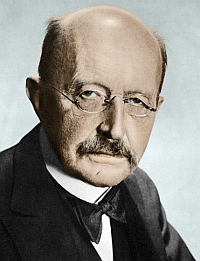
Too Weird for Words!
I started with the idea of physical determinism and what it implies about free will and the future. Then I touched on chaos theory, which is sometimes raised as a possible way around determinism (short answer: nope). In the first article I drew a distinction between “classical” mechanics and quantum mechanics because only at the quantum level is there any sign of randomness in reality.
It turns out that the quantum world is decidedly weird, and while we have math and models that seem to describe it extremely well, it can honestly be said that no one actually understands it. This time I’ll tell you about some of that weirdness and how it may (or may not) apply to the world as we know it.
The key question here is whether our brains make use of quantum effects.
Continue reading
16 Comments | tags: Erwin Schrödinger, Heisenberg Uncertainty, J.B.S. Haldane, Max Planck, quantum effects, quantum mechanics, quantum physics, Schrödinger's Cat, Werner Heisenberg | posted in Physics

Tick-Tock, goes the clock…
Last time, in the Determined Thoughts post, I talked about physical determinism, which is the idea that the universe is a machine — like a clock — that is ticking off the minutes of existence. The famous French mathematician, Pierre-Simon Laplace (the “French Newton”), was the first (in 1814) to articulate the idea of causal determinism.
We now know that quantum mechanics makes it impossible to know both the position and motion of particles, so Laplace’s Demon isn’t possible at the sub-atomic level. (It might be possible at the classical or macro level — that’s an open question.) Sometimes the issue of chaos theory is proposed as a counter-argument to determinism, so I thought I’d cover what chaos theory is and how it might apply.
If you want to skip to the punchline, the answer is it doesn’t apply at all.
Continue reading
8 Comments | tags: butterfly effect, chaos theory, Edward Lorenz, KAOS, Lorenz attractor, Mandelbrot, Mandelbrot fractal, Pierre-Simon Laplace, strange attractor, weather, weather prediction | posted in Math







 Logos con carne