Category Archives: Math
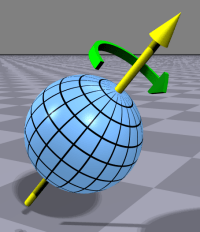 Folded into the mixed baklava of my 2018, was a special mathematical bit of honey. With the help of some excellent YouTube videos, the light bulb finally went on for me, and I could see quaternions. Judging by online comments I’ve read, I wasn’t alone in the dark.
There does seem a conceptual stumbling block (I tripped, anyway), but once that’s cleared up, quaternions turn out to be pretty easy to use. Which is cool, because they are very useful if you want to rotate some points in 3D space (a need I’m sure many of have experienced over the years).
The stumbling block has to do with quaternions having not one, not two, but three distinct “imaginary” numbers.
Continue reading
19 Comments | tags: complex numbers, math theory, mathematics, natural numbers, number systems, numbers, octonion, quaternion, real numbers | posted in Math, Sideband
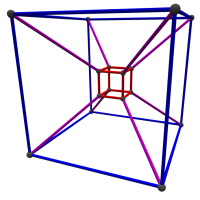
 If you’re anything like me, you’ve probably spent a fair amount of time wondering what is the deal with tesseracts? Just exactly what the heck is a “four-dimension cube” anyway? No doubt you’ve stared curiously at one of those 2D images (like the one here) that fakes a 3D image of an attempt to render a 4D tesseract.
Recently I spent a bunch of wetware CPU cycles, and made lots of diagrams, trying to wrap my mind around the idea of a tesseract. I think I made some progress. It was an interesting diversion, and at least I think I understand that image now!
FWIW, here’s a post about what I came up with…
Continue reading
9 Comments | tags: 3D space, coordinates, cube, dimensions, geometry, line, point, rectangular coordinates, right angle, square, tesseract | posted in Math
 Well, it’s Pi Day once again (although this date becomes more and more inaccurate as the century proceeds). So, once again, I’ll opine that Tau Day is cooler. (see: Happy Tau Day!)
Last year, for extra-special Pi Day, I wrote a post that pretty much says all I have to say about Pi. (see: Here Today; Pi Tomorrow) That post was actually published the day before. I used the actual day to kick off last Spring’s series on Special Relativity.
What remains to be said? Not much, really, but I’ve never let that stop me before, so why start now?
Continue reading
14 Comments | tags: irrational numbers, normal number, pi, pi day, tau, tau day, transcendental numbers | posted in Math
I seem to be doing a lot of reblogging lately (a lot for me, anyway). But I’m on kind of a math kick right now, and this ties in nicely with all that.
 4 gravitons
You’ve probably seen it somewhere on your facebook feed, likely shared by a particularly wide-eyed friend: pi found hidden in the hydrogen atom!



From the headlines, this sounds like some sort of kabbalistic nonsense, like finding the golden ratio in random pictures.
Read the actual articles, and the story is a bit more reasonable. The last two I linked above seem to be decent takes on it, they’re just saddled with ridiculous headlines. As usual, I blame the editors. This time, they’ve obscured an interesting point about the link between physics and mathematics.
So what does “pi found hidden in the hydrogen atom” actually mean?
It doesn’t mean that there’s some deep importance to the number pi in nature, beyond its relevance in mathematics in general. The reason that pi is showing up here isn’t especially deep.
It isn’t trivial either, though. I’ve seen a few people…
View original post 546 more words
2 Comments | tags: math theory, mathematics, pi, quantum physics | posted in Math
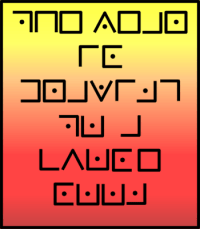 When I was a high school kid, my dad and I sometimes played a game where one of us would make up a secret code, write a message in that code, and the other would try to decipher the message. We generally used simple substitution ciphers, so it was an exercise in letter frequency analysis and word guessing.
There’s a cute secret code I found in a book back then that really stuck with me because of the neat way it looks. It also stuck with me because it’s so simple that once you learn it, you really can’t forget it.
So, for some Saturday fun, I thought I’d share it with you.
Continue reading
6 Comments | tags: Alan Turing, Alienese, cipher, code, decipher, decoder ring, Freemasons Cipher, Futurama, one-time pad, Pigpen Cipher, secret codes, substitution cipher | posted in Basics, Math

Is that you, HAL?
Last time, in Calculated Math, I described how information — data — can have special characteristics that allow it to be interpreted as code, as instructions in some special language known to some “engine” that executes — runs — the code.
In some cases, the code language has characteristics that make it Turing Complete (TC). One cornerstone of computer science is the Church-Turing thesis, which says that all TC languages are equivalent. What one can do, so can all the others.
That is where we pick up this time…
Continue reading
2 Comments | tags: Alan Turing, algorithm, Church-Turing thesis, code, data, flowchart, lambda calculus, state diagram, stored program computer, Turing Machine, Universal Turing Machine, Von Neumann architecture | posted in Math
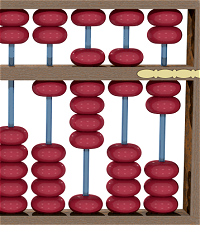 The previous post, Halt! (or not), described the Turing Halting Problem, a fundamental limit on what computers can do, on what can be calculated by a program. Kurt Gödel showed that a very similar limit exists for any (sufficiently powerful) mathematical system.
This raises some obvious questions: What is calculation, exactly? What do we mean when we talk about a program or algorithm? (And how does all of this connect with the world of mathematics?)
Today we’re going to start exploring that.
Continue reading
13 Comments | tags: Alan Turing, algorithm, binary digits, calculation, Church-Turing thesis, code, computer program, data, information theory, lambda calculus, mathematical expression, Turing Machine, Universal Turing Machine | posted in Math, Opinion
But my brain is full!
You may have noticed that, in a number of recent posts, the topic has been math. The good-bad news is that there’s more to come (sorry, but I love this stuff). The good-good news is that I’m done with math foundations. For now.
To wrap up the discussion of math’s universality and inevitability — and also of its fascination and beauty — today I just have some YouTube videos you can watch this Sunday afternoon. (Assuming you’re a geek like me.)
So get a coffee and get comfortable!
Continue reading
6 Comments | tags: algebraic numbers, math and sex, math ontology, mathematics, numbers, Philosophy of Math, Theory of Mathematics, transcendental numbers | posted in Math, Opinion
Take a moment to gaze at Euler’s Identity:

It has been called “exquisite” and likened to a “Shakespearean sonnet.” It has earned the titles “the most famous” and “the most beautiful” formula in all of mathematics, and, in a mere seven symbols, symbolizes much of its foundation.
Today we’re going to graze on it!
Continue reading
19 Comments | tags: complex numbers, Euler's Formula, Euler's Identity, exponential function, Leonhard Euler, trigonometry, Yin and Yang | posted in Math, Opinion, Philosophy
 In the recent post Inevitable Math I explored the idea that mathematics was both universal and inevitable. The argument is that the foundations of mathematics are so woven into the fabric of reality (if not actually being the fabric of reality) that any intelligence must discover them.
Which is not to say they would think about or express their mathematics in ways immediately recognizable to us. There could be fundamental differences, not just in their notation, but in how they conceive of numbers.
To explore that a little, here are a couple of twists on numbers:
Continue reading
8 Comments | tags: alien math, Frederik Pohl, Heechee, math origins, math theory, more math, prime numbers, real numbers, surreal number | posted in Math, Opinion, Sideband







 Logos con carne